
Gravensteen in Gent: a stone castle above the Leie
Published on 09/18/2026 at 16:19 | Editorial responsibility: Rafael Müller, Editor-in-Chief AD HOC NEWS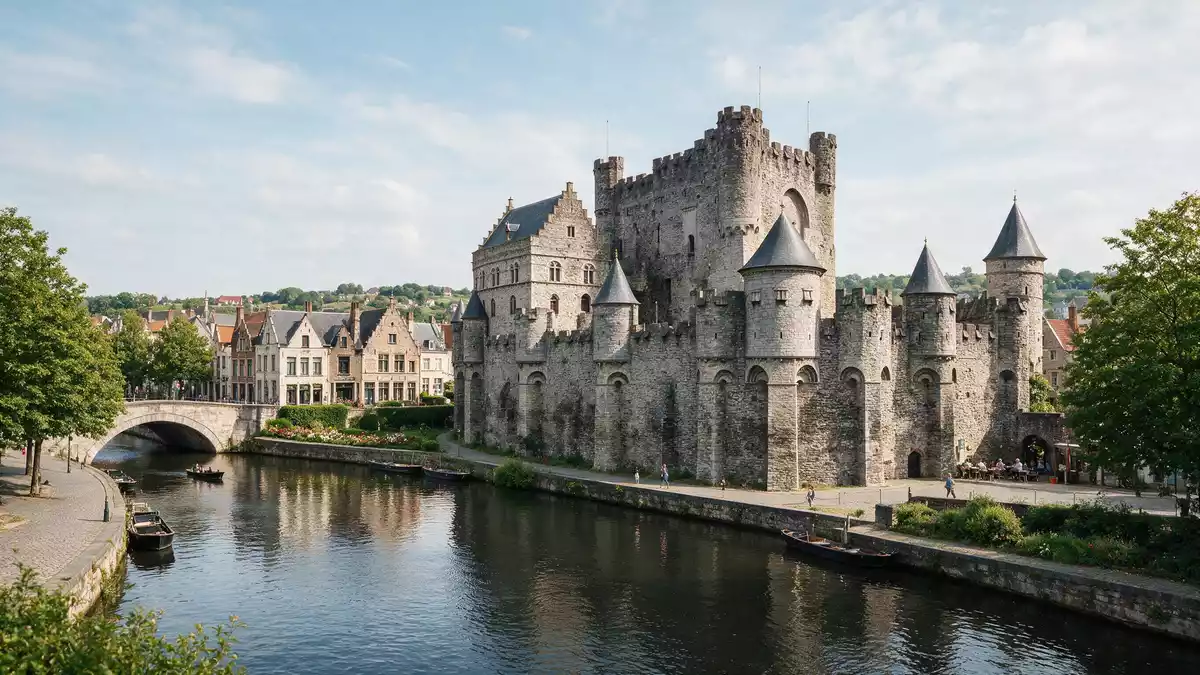
Gravensteen in Gent is a medieval castle whose hard stone bulk still defines the centre of the city. Built in 1180 for Philip of Alsace, it remains one of the clearest survivals of comital power in Flanders.
The castle’s shape is compact and defensive, with a central keep, enclosed walls and a moat. Its long use as a residence, court, prison, mint and cotton mill gives the building a layered history without changing its stern outline.
Philip of Alsace and the castle of 1180
Gravensteen belongs to the age of the Counts of Flanders, and the name itself points to that lineage. The present castle dates from 1180 and is linked to Philip of Alsace, one of the key figures in its history.Philip of Alsace
The building is a stone castle in Ghent, in East Flanders, and its recorded materials include sandstone and Tournai limestone.stone castle in Ghent The medieval form remains readable in the keep, the enclosing walls and the surrounding water.
From count's residence to city landmark
For centuries, Gravensteen served the Counts of Flanders as a residence, then moved through civic and commercial roles. It became a court, a prison and a mint, and later a cotton mill before restoration returned it to public use.Counts of Flanders
The restoration campaign ran between 1893 and 1903, and Joseph De Waele was involved in that work.Joseph De Waele That later phase left the castle legible as a historic monument rather than a ruin, with walls and towers that still carry the weight of its medieval plan.
Stone walls, moat and inner spaces
The castle has a moat and a dense enclosure of walls around the central core. Its plan includes a donjon and smaller attached buildings, all set within a fortified outline that reads clearly from outside.fortified outline
Gent’s historic centre provides the setting, but the building itself is the main event: a medieval fortress that later absorbed courtrooms, prison spaces and industrial use. The result is a castle whose exterior is military and whose history is civil as well as feudal.industrial use
Visiting Gravensteen: what travellers from Western Europe should know
- Gravensteen stands in Gent, East Flanders, and the address recorded by the city is Sint-Veerleplein 11. The castle is reached on foot through the historic centre.
- The building has multiple levels, stone stairways and a compact plan. The moat and enclosing walls make the castle feel enclosed rather than open.
- The official language is Dutch and the currency is the euro.
- Entry requirements depend on your nationality; UK travellers can check the FCDO travel advice at gov.uk/foreign-travel-advice, Irish travellers the Department of Foreign Affairs at ireland.ie.
Searching for Gravensteen on social platforms
These links open searches for Gravensteen on each platform.
Frequently asked questions about Gravensteen
Where is Gravensteen?
Gravensteen is in Gent, in East Flanders, and it sits in the historic centre near Sint-Veerleplein. It is part of the city rather than a separate outlying monument.
What does a visit involve?
The castle presents stone walls, a moat, a keep and several interior levels. Its sequence of spaces reflects its long life as a fortress, an administrative place and an industrial building.
What makes Gravensteen distinctive?
The castle combines a clear medieval profile with a documented history of later uses. Philip of Alsace, the Counts of Flanders and Joseph De Waele all belong to that story, alongside the year 1180.


