
Great Barrier Reef, a vast coral seascape off Cairns
Published on 09/01/2026 at 13:01 | Editorial responsibility: Rafael Müller, Editor-in-Chief AD HOC NEWS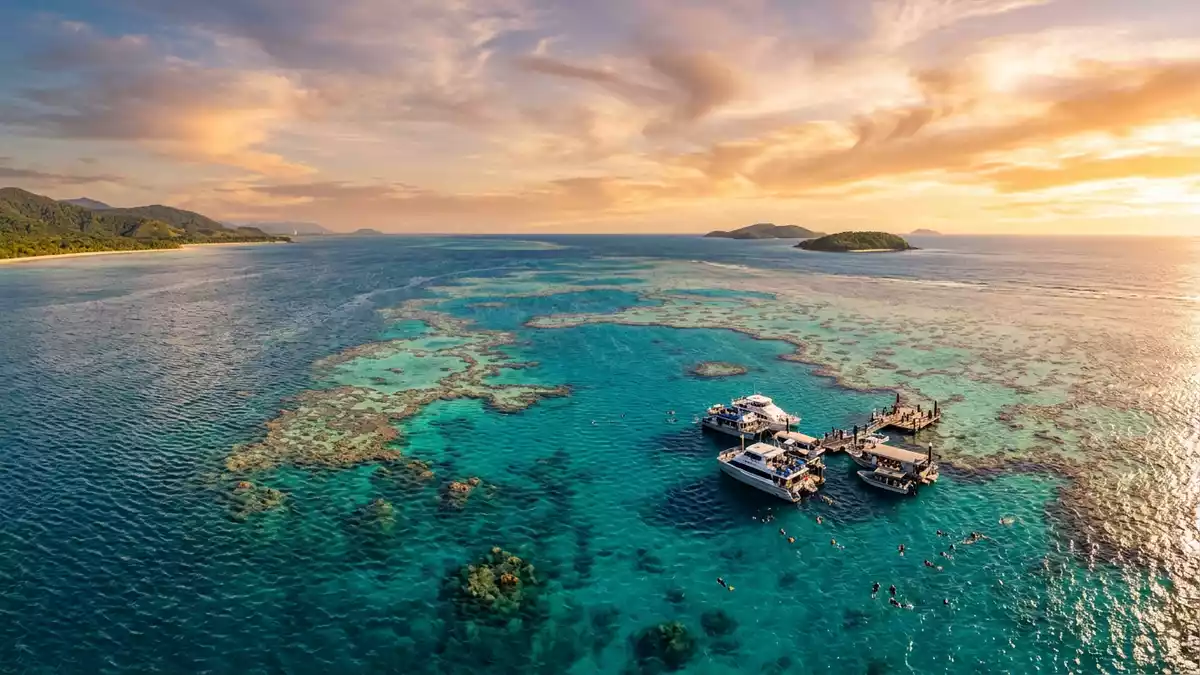
Great Barrier Reef stretches along the northeastern coast of Australia, forming a vast coral ecosystem off Queensland that travellers commonly reach from Cairns. It is recognised as the world’s largest coral reef system and was inscribed as a natural World Heritage site in 1981, a status that underlines its global importance as a marine landscape shaped by coral growth over thousands of years.
A reef measured in hundreds of thousands of square kilometres
The scale of Great Barrier Reef is the first thing that sets it apart. The reef system extends for about 2,300 km (1,430 mi) along the coast of Queensland, following the line of the Coral Sea from waters near the Torres Strait down towards the Tropic of Capricorn.The reef stretches over 2,300 kilometres Offshore, the reef lies between the mainland and the open Pacific, occupying a belt of sea that can reach hundreds of kilometres in width.
As a defined World Heritage property and marine park, Great Barrier Reef covers an area in the order of 348,000 km² (133,000 sq mi), making it one of the largest protected marine environments on Earth.The Reef covers an area of 348,000 square kilometres Within this area lie thousands of individual reefs and hundreds of islands, forming a complex mosaic of coral structures, sand cays and continental islands scattered across warm tropical waters.
Coral architecture and marine life
Great Barrier Reef is made up of many types of coral formations, including barrier reefs separated from the mainland by lagoons, fringing reefs along island shores and smaller patch reefs rising from the seabed. As an ecosystem it contains the world’s largest collection of coral reefs, with hundreds of recorded coral species building the limestone framework that gives the reef its structure.The site contains the world’s largest collection of coral reefs These formations create sheltered shallows and steep walls, giving divers and snorkellers a range of underwater landscapes.
The biodiversity of Great Barrier Reef extends far beyond the corals themselves. Surveys have documented well over a thousand fish species, numerous types of molluscs and many other invertebrates, as well as marine mammals and turtles that move along the reef and its adjacent waters.The reef supports more than 1,600 fish species For visitors on the water this biological richness translates into frequent encounters with reef fish, occasional views of rays or sharks in the deeper channels, and seasonal movements of whales along the wider Coral Sea.
Cairns as a gateway to the reef
Cairns in northern Queensland serves as one of the principal urban gateways to Great Barrier Reef, especially for the northern and central sections of the reef system.Cairns is a primary gateway city for visiting the Great Barrier Reef From the city’s waterfront, vessels head out into the Coral Sea to reach outer reef platforms, smaller coral cays or islands with fringing reefs. The approach by boat often passes low-lying sand islands, deeper blue channels and shallower turquoise patches where reef structures rise close to the surface.
Once at the reef, the terrain is defined by water depth rather than solid ground. On many day trips the experience centres on floating platforms or moored vessels with access to the water by steps and ladders, and viewing areas such as underwater windows. At coral cays and islands, the contrast between sandy beaches, vegetated interiors and surrounding coral gardens is visible on foot, with shallow reef flats giving way to drop-offs where the seascape changes abruptly.
Visiting Great Barrier Reef: what travellers from Western Europe should know
- Great Barrier Reef lies off the northeastern coast of Australia in the Coral Sea, and Cairns in Queensland functions as a major departure point for boat trips heading to nearby sections of the reef.
- Out on the reef, access usually involves walking on vessel decks or pontoons and using stairways or ladders to enter the water; on coral islands, sandy beaches and uneven shore rock require secure footwear when moving between jetty structures and the waterline.
- In the wider region, other coastal centres such as Port Douglas, Townsville and Airlie Beach act as gateways to different parts of the reef system, each linked to particular reef complexes and islands.
- The official language is English and the currency is the Australian dollar.
- Entry requirements depend on your nationality; UK travellers can check the FCDO travel advice at gov.uk/foreign-travel-advice, Irish travellers the Department of Foreign Affairs at ireland.ie.
Searching for Great Barrier Reef on social platforms
These links open searches for Great Barrier Reef on each platform.
Frequently asked questions about Great Barrier Reef
Where is Great Barrier Reef in relation to Cairns?
Great Barrier Reef lies offshore in the Coral Sea along the coast of Queensland, and Cairns is one of the main coastal cities providing organised trips out to nearby reef areas.
What should visitors expect on a first trip to the reef?
A first visit usually involves a boat journey from a port such as Cairns, time spent on a vessel or platform at a reef site, and opportunities to view coral and marine life from the water or through underwater observation areas.
What makes Great Barrier Reef distinctive among marine destinations?
Its distinction lies in its scale as a continuous coral reef system, its formal recognition as a World Heritage site since 1981, and the diversity of corals, fish and other marine species that inhabit its warm tropical waters.


