
Great Blue Hole: a blue circle in Belize’s reef
Published on 09/23/2026 at 11:33 | Editorial responsibility: Rafael Müller, Editor-in-Chief AD HOC NEWS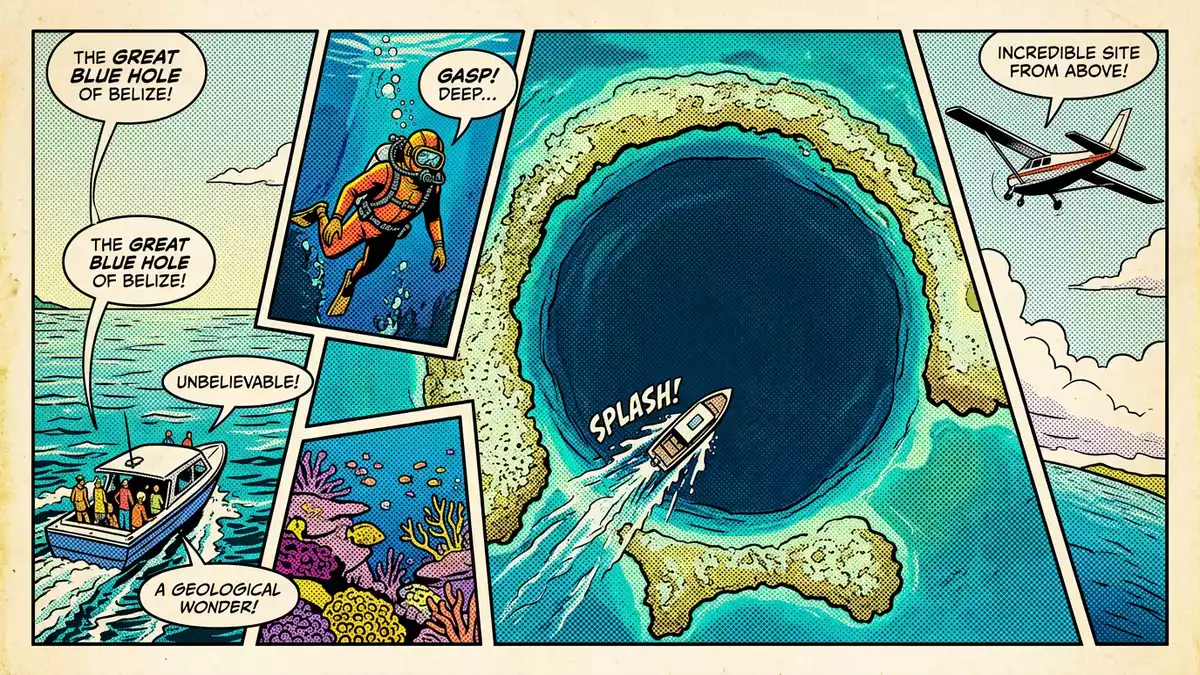
Great Blue Hole is a flooded limestone sinkhole at the centre of Lighthouse Reef, an atoll off the coast of Belize. Seen from above, it forms a dark blue basin within pale reef water, measuring about 318 m (1,043 ft) across and reaching roughly 124 m (407 ft) deep. Its broad surface and steep underwater walls make the place a landscape of scale, colour and submerged geology.
Great Blue Hole as a circle within Lighthouse Reef
The sinkhole lies near the centre of Lighthouse Reef, an offshore atoll surrounded by the Caribbean Sea. Its position places a deep marine cavity among shallow reef platforms, sandy cays and channels. The contrast is visible from the air and from the surface: a dark central expanse interrupts the lighter water around it.
Great Blue Hole forms part of the Belize Barrier Reef Reserve System, inscribed on the UNESCO World Heritage list in 1996. The protected area includes reef habitats and marine landscapes extending beyond the sinkhole itself. Lighthouse Reef location is recorded near the atoll’s centre, about 80 km (50 miles) from mainland Belize.
A limestone cavern beneath the Caribbean
Great Blue Hole began as a limestone cave system during periods when sea levels were lower. Geological evidence places its development across several phases of Quaternary glaciation, with stalactites and stalagmites preserved beneath the water. Rising seas flooded the cavity, while the collapse of its roof produced the open basin visible today.
The submerged walls contain ledges and limestone formations that record the cavity’s former position above sea level. Stalactites occur below the surface, an unusual feature in a marine sinkhole. submerged limestone formations connect the present seascape with the cave’s earlier geological history.
Depth, diving and the changing underwater landscape
The upper opening is broad, while the interior descends through darker water towards the seabed. Divers encounter limestone shelves and formations within the cavity, with the underwater environment changing as depth increases. Light becomes limited below the upper layers, and the sinkhole’s deepest sections contain little marine life compared with the surrounding reefs.
The nearby reef supports coral, fish and sea turtles, creating a marked contrast with the deeper interior. Great Blue Hole therefore combines several marine settings within one named site: shallow reef, open water, submerged cave and deep basin. the flooded limestone sinkhole remains the defining geological feature of Lighthouse Reef.
Visiting Great Blue Hole: what travellers from Western Europe should know
- Great Blue Hole lies in Lighthouse Reef, off Belize’s mainland coast. It is reached by boat from Belize’s coastal settlements, while scenic flights provide views of the circular basin.
- The site is offshore and marine. Diving takes place in open water above a deep sinkhole, with descending walls, limited light and submerged limestone formations.
- The official language is English and the currency is the Belize dollar.
- Entry requirements depend on your nationality; UK travellers can check the FCDO travel advice at gov.uk/foreign-travel-advice, Irish travellers the Department of Foreign Affairs at ireland.ie.
Searching for Great Blue Hole on social platforms
These links open searches for Great Blue Hole on each platform.
Frequently asked questions about Great Blue Hole
Where is Great Blue Hole?
Great Blue Hole lies near the centre of Lighthouse Reef, an atoll off Belize’s mainland coast in the Caribbean Sea.
What can visitors expect at the site?
Visitors encounter an offshore marine setting, with boat access, aerial views and diving above a deep limestone sinkhole.
What makes Great Blue Hole distinctive?
Its defining features are a broad blue opening, a depth of about 124 m (407 ft) and submerged limestone formations from an earlier cave system.


