
Great Zimbabwe’s stone city above the Masvingo lowveld
Published on 08/15/2026 at 14:19 | Editorial responsibility: Rafael Müller, Editor-in-Chief AD HOC NEWS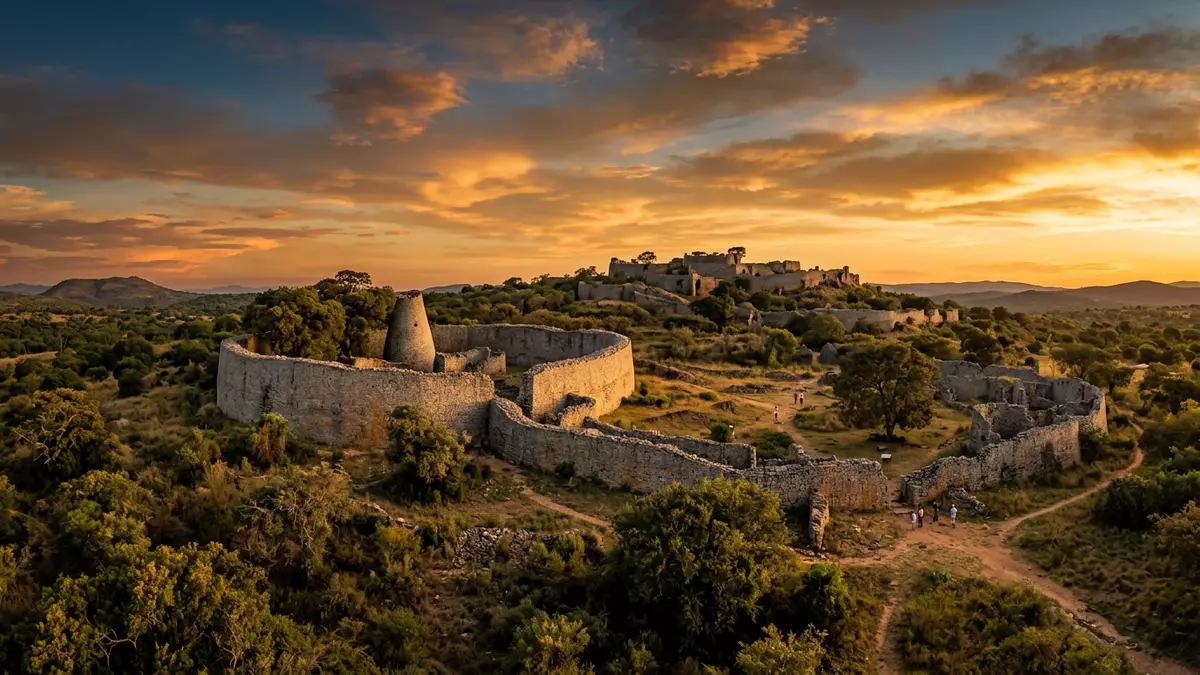
South-east of Masvingo, Great Zimbabwe rises from a low granite kopje into an extensive stone city whose terraces, walls and enclosures still dominate the surrounding landscape. Built between the 11th and 15th centuries as the capital of the Kingdom of Great Zimbabwe, it is recognised as a national monument and inscribed as a UNESCO World Heritage Site, giving the country its very name.Great Zimbabwe National Monument
Stone architecture of the Shona heartland
Great Zimbabwe is an archaeological city of dry-stone architecture spread across the hills and valley floor of Masvingo Province in south-eastern Zimbabwe.extensive stone ruins of an African Iron Age city The builders used local granite, shaping blocks and laying them without mortar into broad walls that curve and bend with the contours of the terrain. In places these walls reach substantial heights, stacked in ordered courses that hold their form through gravity and careful placement rather than binding material.walls reaching 9.7 meters high in places
The city extends over an area of around 80 ha (198 acres) of core ruins within a wider archaeological landscape approaching 800 ha, making it the largest known stone complex of its kind in Zimbabwe and Mozambique.central area of ruins extends about 80 hectares The Shona word “zimbabwe” refers to a house of stone, and hundreds of smaller stone sites across the country take their name from this building tradition. Here, at Great Zimbabwe, that tradition reaches monumental scale, with freestanding walls enclosing courtyards, narrow passageways and stone platforms that once supported huts of more perishable materials.name of the site derives from a Shona word meaning “stone house”
The Hill Ruins, Great Enclosure and Valley Ruins
The ruins of Great Zimbabwe are divided into three main groups that reflect different parts of the former city: the Hill Ruins, the Great Enclosure and the Valley Ruins.divided into three groups: the Hill Ruins, the Great Enclosure and the Valley Ruins On the hill, a granite outcrop carries a complex of walls, terraces and small enclosures that once formed an acropolis above the settlement. Approached by steep paths over rock, these hilltop structures occupy a commanding position, with views across the lowveld and down to the valley.
Below, the Great Enclosure forms one of the most striking single features of the site. It is defined by a massive, continuous wall of granite blocks containing internal passages and subsidiary walls, and it is often described as the largest ancient masonry structure in sub-Saharan Africa.the iconic Great Enclosure, the largest ancient structure to be built in sub-Saharan Africa Nearby, the Valley Ruins spread across gentler ground, with clusters of lower walls outlining former compounds and residential ensembles. Together these three parts show how the city combined elevated strongholds with extensive stone-built quarters on the lower slopes.
Kingdom, trade and national symbolism
Great Zimbabwe flourished between the 11th and 15th centuries as the capital of the Kingdom of Great Zimbabwe and an inland trading centre linked to wider Indian Ocean networks.served as the capital of the Kingdom of Great Zimbabwe from the 13th century At its peak in the fourteenth century the city may have housed a population in the tens of thousands, supported by agriculture and control of regional trade, including gold that moved towards coastal entrepôts.at the peak of the Kingdom of Zimbabwe in the fourteenth century, the city was home to a population of more than 10,000
The ruins stand as a material record of Bantu civilisation in the Shona heartland, a role recognised when Great Zimbabwe National Monument was inscribed on the World Heritage List in 1986.inscribed 1986 The stylised soapstone birds found at the site became national emblems, and the modern Republic of Zimbabwe took its name from this stone city. For visitors based in Western Europe, the site offers direct access to a major African Iron Age metropolis, with architecture, sculpture and landscape all contributing to an understanding of Shona state formation and its long-distance connections.
Visiting Great Zimbabwe: what travellers from Western Europe should know
- Great Zimbabwe lies in the lowveld of south-eastern Zimbabwe, around 30 km south-east of Masvingo along the road network linking Harare and the South African border.
- The Hill Ruins require a walk over uneven granite and up steep paths, and exploring the site involves covering long stretches on foot across terraced slopes and valley floors.
- Great Zimbabwe stands at an altitude of about 1,100 m (3,609 ft), so the approach from Masvingo rises gently onto higher ground before reaching the main clusters of ruins.located in the lowveld at an altitude of some 1100 m
- The official language is English and the currency is the Zimbabwean dollar.
- Entry requirements depend on your nationality; UK travellers can check the FCDO travel advice at gov.uk/foreign-travel-advice, Irish travellers the Department of Foreign Affairs at ireland.ie.
Searching for Great Zimbabwe on social platforms
These links open searches for Great Zimbabwe on each platform.
Frequently asked questions about Great Zimbabwe
Where is Great Zimbabwe located?
Great Zimbabwe lies about 30 km south-east of Masvingo in south-eastern Zimbabwe, on granite hills above the lowveld and near Lake Mutirikwi.
What should visitors expect on a visit?
A visit involves walking among extensive dry-stone ruins, climbing to the Hill Ruins and exploring the Great Enclosure and Valley Ruins spread across terraces and gentle slopes.
What makes Great Zimbabwe distinctive?
Great Zimbabwe is distinctive for its large-scale Shona dry-stone architecture, its role as the capital of a medieval kingdom and its status as the namesake of modern Zimbabwe.


