
Griffith Observatory and the double view of Los Angeles
Published on 09/22/2026 at 16:30 | Editorial responsibility: Rafael Müller, Editor-in-Chief AD HOC NEWS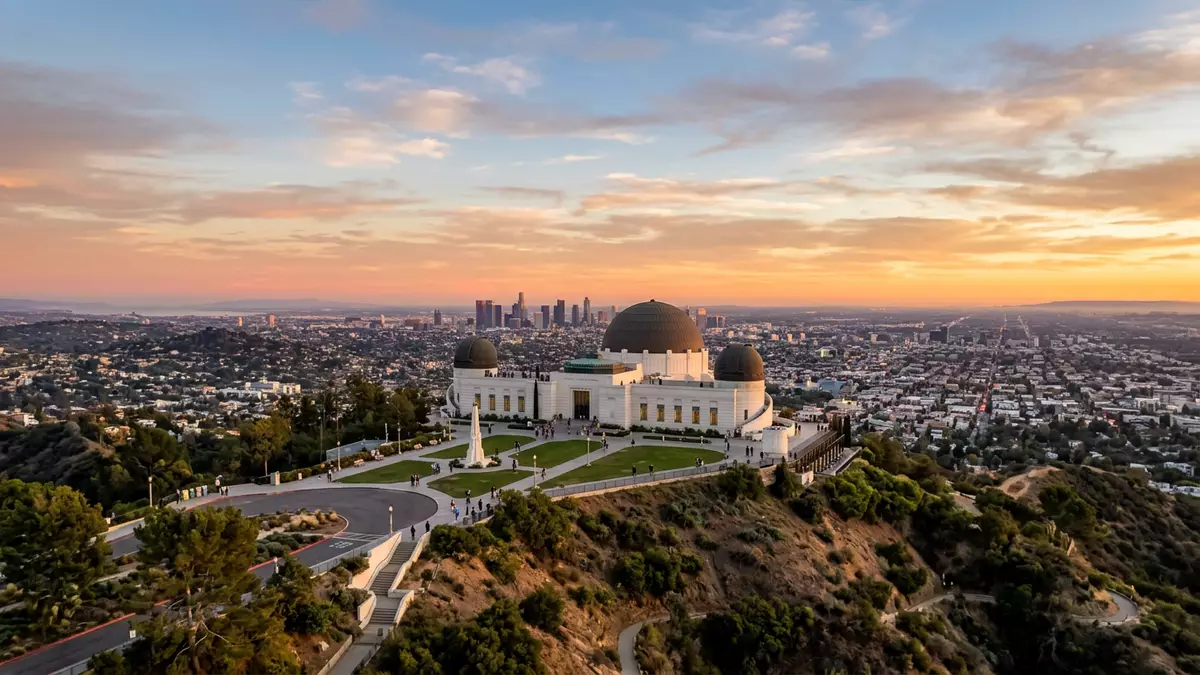
Griffith Observatory sits on Mount Hollywood above Los Angeles, where copper domes, pale concrete and long terraces frame two kinds of view. The building looks across the city while its telescopes turn towards the sky, bringing astronomy and the Los Angeles basin into one visible setting.
Griffith Observatory rises above Los Angeles
The observatory stands at 2800 East Observatory Road in Griffith Park. Its position on Mount Hollywood places the building above the Los Angeles basin, with the Hollywood Sign on the surrounding slopes and the city spread beyond the terraces.
Griffith J. Griffith gave Griffith Park to Los Angeles in 1896 and left funds for a public observatory. His name belongs to both the park and the building, linking the observatory to a civic landscape shaped across the twentieth century.
Concrete, copper and the architecture of 1935
John C. Austin and Frederick M. Ashley developed the final plans for Griffith Observatory, with Russell W. Porter serving as a consultant. Construction began in 1933, and the building opened in May 1935. The 1935 opening of Griffith Observatory remains central to its identity.
The structure uses concrete for its walls and terraces, while copper-clad domes mark the telescope rooms. The exterior combines the streamlined character of Art Deco with classical references, creating a civic building whose scientific function can be read from its roofline and domes.
From public telescopes to planetary galleries
Griffith Observatory combines exhibition halls, a planetarium and working public telescopes. Its displays cover the Solar System, the Sun, the Moon, galaxies and the history of astronomical observation. The building presents science through instruments, models, images and views across the city.
The Zeiss telescope occupies the eastern dome, while solar telescopes connect the western side of the building with daytime observation. The Samuel Oschin Planetarium occupies the central complex and contains a large projection dome, a Zeiss star projector and 290 seats. The Samuel Oschin Planetarium extends the observatory’s subject from direct observation to projected journeys through space.
The building also carries traces of its public role in the surrounding architecture. Roof terraces, the central copper cupola and the telescope domes form a sequence of outdoor and indoor spaces. The roof terraces and copper cupola are part of the observatory’s architectural vocabulary, not merely a backdrop for the exhibits.
Visiting Griffith Observatory: what travellers from Western Europe should know
- Griffith Observatory is on Mount Hollywood in Griffith Park, above Los Angeles. The address is 2800 East Observatory Road, and city roads lead into the park.
- The building sits on a hillside, with paved approaches, terraces and steps connecting the exterior levels. The elevated position exposes visitors to broad views across the Los Angeles basin.
- Public telescopes, the planetarium, exhibition halls and roof terraces occupy different parts of the complex. The Zeiss telescope is housed in the eastern copper-clad dome.
- The official language is English and the currency is the United States dollar.
- Entry requirements depend on your nationality; UK travellers can check the FCDO travel advice at gov.uk/foreign-travel-advice, Irish travellers the Department of Foreign Affairs at ireland.ie.
Searching for Griffith Observatory on social platforms
These links open searches for Griffith Observatory on each platform.Frequently asked questions about Griffith Observatory
Where is Griffith Observatory?
Griffith Observatory is on Mount Hollywood in Griffith Park, Los Angeles. Its address is 2800 East Observatory Road.
What can visitors see inside?
The complex contains astronomy exhibits, public telescopes, solar instruments and the Samuel Oschin Planetarium. Its roof terraces provide views across the Los Angeles basin.
What makes Griffith Observatory distinctive?
Its concrete Art Deco architecture, copper-clad domes and public astronomy functions share one hillside building. The observatory joins direct telescope viewing with planetary galleries and a city panorama.


