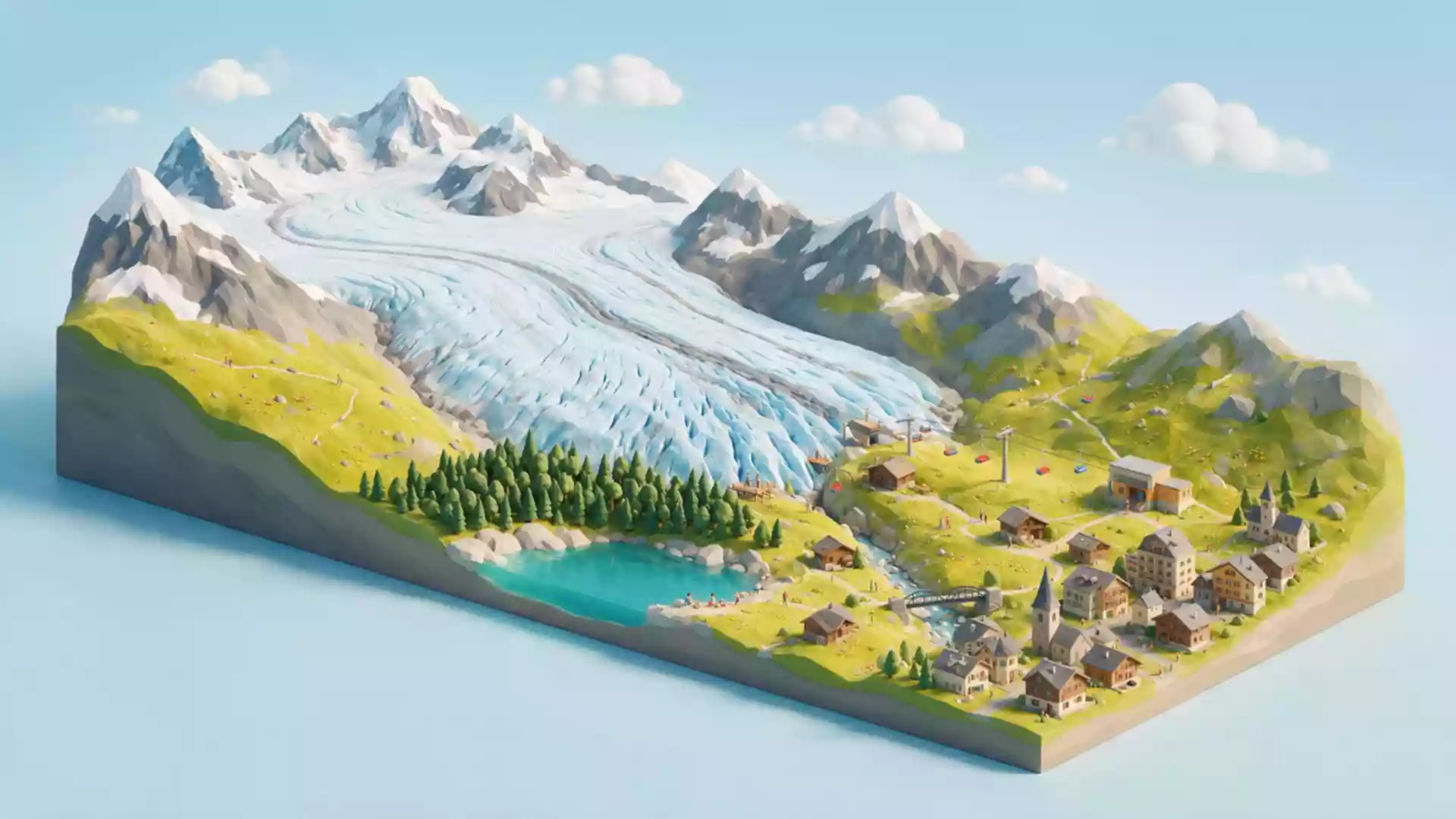
Grosser Aletschgletscher and the long arc of ice above Fiesch
Published on 09/02/2026 at 09:44 | Editorial responsibility: Rafael Müller, Editor-in-Chief AD HOC NEWS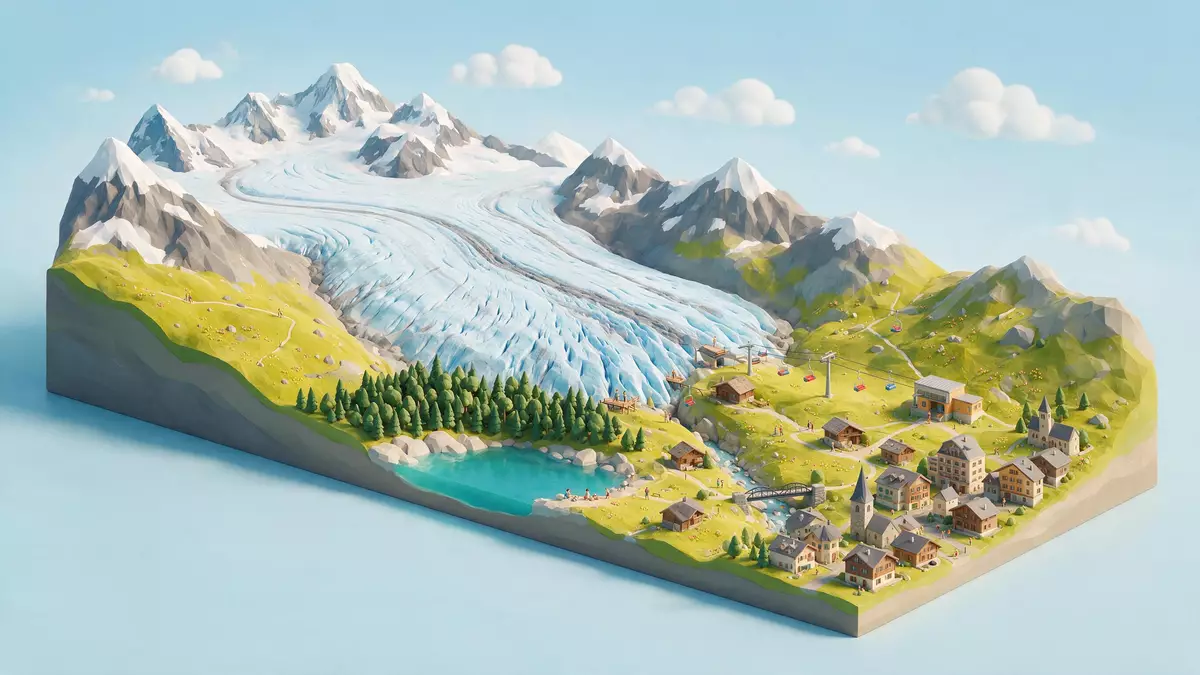
Grosser Aletschgletscher is the Great Aletsch Glacier above Fiesch in Switzerland, a vast high-alpine river of ice curving along the southern slope of the Bernese Alps. It lies in the canton of Valais and forms the largest single glacier body in the Alps, part of the Swiss Alps Jungfrau-Aletsch landscape inscribed as a UNESCO World Heritage site in 2001.
The great curve of ice in the Swiss Alps
From the ridges above Fiesch, Grosser Aletschgletscher appears as a long, pale arc of ice stretching from the Jungfrau region towards the upper Rhône valley. The glacier gathers its mass from accumulation basins around peaks such as Jungfrau and Mönch before flowing towards the Massaschlucht, a deep valley that drains the ice meltwater into the Rhône.The glacier lies on the southern flank of the Bernese Alps in Valais and occupies a central position in the Swiss Alps Jungfrau-Aletsch protected area.
Measured from its head at Konkordiaplatz to its terminus above the Massaschlucht, Grosser Aletschgletscher reaches a length of over 20 km (about 12.4 mi). Its surface covers several dozen square kilometres, and the ice thickness reaches several hundred metres at its deepest point near Konkordiaplatz, where different accumulation basins feed into the main flow.Figures for length, area and maximum ice thickness are documented by the regional tourism board and show the scale of this glacier within the Alpine landscape.
A core of the Swiss Alps Jungfrau-Aletsch World Heritage
Grosser Aletschgletscher forms the icy heart of the Swiss Alps Jungfrau-Aletsch area, a property recognised on the UNESCO World Heritage List as Jungfrau-Aletsch-Bietschhorn in 2001.The World Heritage inscription covers an extensive high mountain region where glaciers, peaks and valleys form a classic alpine landscape and highlights Grosser Aletschgletscher as the largest glacier in this part of Europe.
The protected area extends across parts of the Bernese Oberland and Valais, bringing together summits such as Eiger, Mönch and Jungfrau with the long ice body of Grosser Aletschgletscher.Within this framework the glacier is described as the central ice feature of the Jungfrau-Aletsch landscape and a key element in understanding the formation of the High Alps. From viewpoints along the ridge above Fiesch, the combination of ice, rock faces, scattered patches of high forest and distant peaks gives a clear impression of this protected high-alpine environment.
Moraines, forest and viewpoints above Fiesch
The surface of Grosser Aletschgletscher carries dark bands of debris, the moraines that mark where tributary ice streams join the main flow. Near Konkordiaplatz, three major snow and firn fields come together to form the glacier body, including the Grosser Aletschfirn and other accumulation basins feeding into the main channel.Descriptions from the Aletsch Arena region emphasise the glacier’s long profile, the thickness of the ice at Konkordiaplatz and the role of these tributary basins.
On the flank above the ice, the Aletsch forest covers sections of the slope with stands of mountain pine and other high-alpine trees.Information from the Valais tourism authorities highlights that this forested slope forms part of the World Heritage property, offering a contrast between dark, wooded ground and the pale glacier surface below. Above Fiesch, viewpoints such as Eggishorn and other accessible ridges provide broad views along the glacier’s curve, allowing visitors to see both the accumulation basins near the high peaks and the descending ice towards the valley.
Visiting Grosser Aletschgletscher: what travellers from Western Europe should know
- Grosser Aletschgletscher lies above the upper Rhône valley in the canton of Valais, south of the Bernese Alps; Fiesch serves as one of the lower access points.
- Access to viewpoints commonly involves cableways or mountain railways from the valley and a short walk on prepared paths along high ridges or terraces.
- The terrain around the viewpoints is high-alpine, with rocky paths, steps and exposed sections near drop-offs, so firm footwear is important.
- Snow can linger at higher elevations, and weather conditions may change quickly in the mountains.
- The official language in this part of Switzerland is German and the currency is the Swiss franc.
Searching for Grosser Aletschgletscher on social platforms
These links open searches for Grosser Aletschgletscher on each platform.
Frequently asked questions about Grosser Aletschgletscher
Where is Grosser Aletschgletscher located?
Grosser Aletschgletscher lies above the upper Rhône valley in the canton of Valais on the southern side of the Bernese Alps, near Fiesch in Switzerland.
What should visitors expect when viewing the glacier?
The glacier is viewed from high-alpine viewpoints reached by mountain transport and short walks on prepared paths, with extensive views over ice, rock faces and surrounding peaks.
What makes Grosser Aletschgletscher distinctive among Alpine glaciers?
Grosser Aletschgletscher is the largest glacier in the Alps and forms the central ice body of the Swiss Alps Jungfrau-Aletsch UNESCO World Heritage landscape.