
Grosser Aletschgletscher and the long curve of ice
Published on 09/18/2026 at 16:44 | Editorial responsibility: Rafael Müller, Editor-in-Chief AD HOC NEWS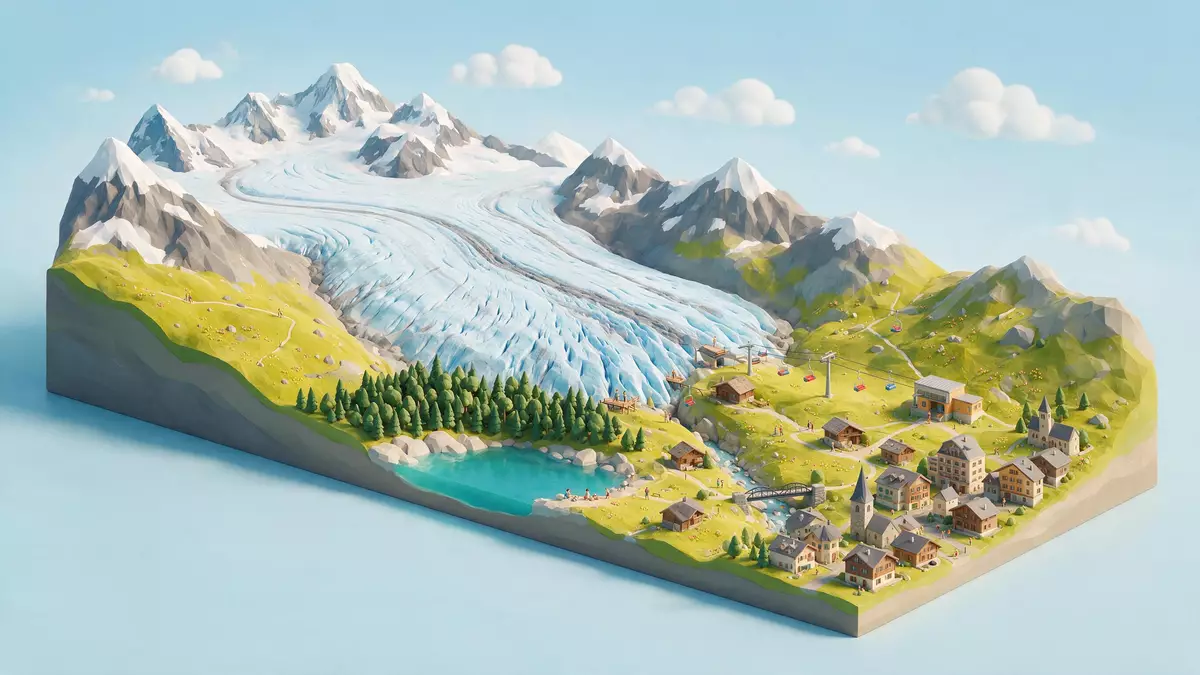
Grosser Aletschgletscher is the broad sweep of ice above Fiesch in Valais, set in the Bernese Alps and linked to the Jungfrau-Aletsch protected area. Its long arc and exposed tongue give it a clear profile even from distant viewpoints. Aletsch Glacier
The glacier’s long curve above Valais
The glacier runs through a high Alpine basin and then narrows into a lower tongue of ice and debris. That contrast between the broad upper body and the lower reach is its most immediate visual feature. long river of ice above Fiesch
Within the Alps, Grosser Aletschgletscher has long been described as the largest glacier by length and area. The glacier is part of the Swiss Alps Jungfrau-Aletsch World Heritage landscape, inscribed in 2001, which places it among the best-known glacial landscapes in Europe. largest glacier UNESCO World Heritage
UNESCO landscape and Alpine scale
The glacier’s scale is part of what gives the wider landscape its sense of depth. Ice, rock and snowfields meet along a long descent, and the surrounding peaks frame the view rather than hiding the glacier’s line. heart of the Jungfrau-Aletsch
Grosser Aletschgletscher lies in the canton of Valais, on the southern side of the Bernese Alps. That position places it above the upper Rhône valley, where the glacier reads as a white and grey ribbon against darker mountain slopes.
Fiesch and the approach to the ice
Fiesch is the nearest named valley base in the article’s framing, and it gives the glacier its most practical reference point. Mountain transport leads upwards from the valley, and viewpoints along the rim open broad views over the ice. village of Fiesch mountain transport
The lower part of the glacier is less uniform than the upper body, with rock debris visible across the ice margin. That visible mixture of ice and rubble gives the glacier a rougher edge than the smoother-looking upper fields.
Visiting Grosser Aletschgletscher: what travellers from Western Europe should know
- The glacier is reached from Fiesch through mountain transport routes and viewpoints above the Rhône valley. The setting belongs to high Alpine terrain in Valais.
- The terrain is glaciated and elevated, with broad ice surfaces, rock bands and debris at the lower edge. Walking here requires the usual caution expected on mountain ground.
- Fiescheralp and Eggishorn are named access points in the surrounding area. They give a clear sense of the glacier’s position in the landscape.
- The glacier forms part of a protected World Heritage landscape. That designation is tied to the broader Jungfrau-Aletsch region rather than to a single lookout.
Searching for Grosser Aletschgletscher on social platforms
These links open searches for Grosser Aletschgletscher on each platform.
Frequently asked questions about Grosser Aletschgletscher
Where is Grosser Aletschgletscher?
It lies in Valais, on the southern side of the Bernese Alps above the upper Rhône valley. Fiesch is the nearest named valley settlement in the article’s framing.
What does a visit involve?
The place is a mountain landscape rather than a built attraction, so the main experience is viewing the glacier from upland routes and viewpoints. Its scale and layered ice-and-rock structure are the main features.
What makes Grosser Aletschgletscher distinctive?
Its long sweep of ice, UNESCO setting and alpine scale define it. The glacier is also closely associated with the broader Jungfrau-Aletsch landscape, which gives the site its formal context.


