
Grotta Azzurra on Capri and its luminous sea cave
Published on 09/19/2026 at 10:53 | Editorial responsibility: Rafael Müller, Editor-in-Chief AD HOC NEWS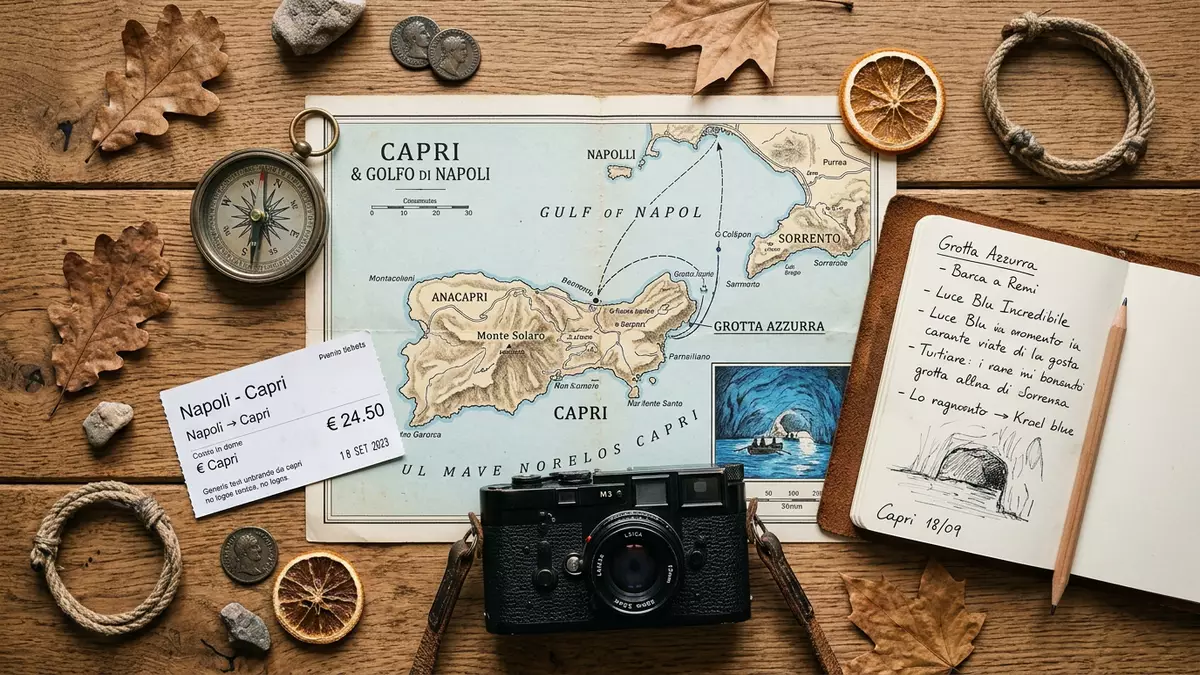
Grotta Azzurra on the island of Capri in southern Italy is a sea cave where daylight and seawater combine to produce a deep blue glow across a flooded rock chamber. Set into limestone cliffs on the island’s north?western coast within the municipality of Anacapri, the cave forms part of a karstic system that links the rock face directly with the Tyrrhenian Sea.sea cave on Capri
A flooded chamber lit from below
The core of Grotta Azzurra is a single large cavity, a rock hall with seawater filling the floor and the walls rising up from the waterline into a vault of pale stone. Measurements from geological and tourism sources describe a cave around 60 m long and about 25 m wide, creating an elongated interior where small boats move along the water surface under the rock ceiling.60 metres long and 25 metres wide Depth readings indicate that the water inside reaches around 13 m in places, with a sandy seabed that reflects light back into the chamber.depth and sandy bottom
The famous blue colour is linked to the way sunlight reaches the interior of the cave. The visible entrance at the cliff face is relatively small compared with the size of the chamber, and beneath it lies a second opening entirely below the water surface where the rock meets the sea.submerged opening to the sea Light passes through this submerged opening and filters through the seawater before reflecting off the pale seabed, so the flooded interior appears suffused with an intense blue light while the rock above remains in softer tones.
Roman Capri and the marine nymphaeum
Grotta Azzurra belongs to the same stretch of coastline as the Roman Villa di Gradola, a residence linked with Emperor Tiberius during the first century AD when Capri served as an imperial retreat.Villa di Gradola and Tiberius Archaeological finds from the cave floor, including statues representing marine figures such as Triton and Neptune, indicate that the grotto formed part of a maritime nymphaeum, an ornamental waterside grotto connected to the villa above and used in the Roman period.Roman nymphaeum linked to the villa
Accounts of Roman use describe Grotta Azzurra as a place where Tiberius could bathe and where sculptural works once stood within the flooded chamber or on carved rock ledges toward the rear of the cave.personal swimming place of Tiberius Statues and fragments recovered from the seabed have been conserved in museums on Capri and in Anacapri, connecting present?day visitors to the Roman layer of the grotto’s history.Roman statues conserved locally
Discovery, approach and the coastal setting
After the Roman period, Grotta Azzurra was known to local fishermen but over generations became associated with superstition, which limited visits to the interior.status among local fishermen In 1826 the grotto was explored systematically by the German writer August Kopisch and the painter Ernst Fries, guided by the Capri fisherman Angelo Ferraro.rediscovery by Kopisch and Fries Kopisch’s published account drew wider attention to the cave and its luminous water, placing Grotta Azzurra within the developing Romantic interest in Mediterranean landscapes.
Geologically, Grotta Azzurra is part of a karstic underground cavity system in the limestone of Capri’s north?western coast, with the visible chamber known in Italian as the “Duomo Azzurro”.karstic cavity and Duomo Azzurro The surrounding shoreline combines cliffs, narrow rock ledges and small landing spots where boats can approach the entrance, and the administrative territory of Anacapri includes this stretch of coast and the cave itself.location on the northwestern coast
Visiting Grotta Azzurra: what travellers from Western Europe should know
- Grotta Azzurra lies on the north?western coast of Capri within the commune of Anacapri in southern Italy, with the access point signposted along Via Grotta Azzurra.
- The cave is reached by boat, and the final approach to the entrance uses small craft that pass through a low opening at the base of the cliff.
- The entrance to the grotto is narrow and partly below the water surface, so visitors enter the flooded chamber in small boats where space and movement are confined.
- Inside the cave, visitors remain seated in boats on seawater over a sandy bottom, with rock walls and the vault rising directly from the water.
- The official language is Italian and the currency is the euro.
Searching for Grotta Azzurra on social platforms
These links open searches for Grotta Azzurra on each platform.Frequently asked questions about Grotta Azzurra
Where is Grotta Azzurra located on Capri?
Grotta Azzurra is set into limestone cliffs on the north?western coast of Capri in southern Italy, within the municipal territory of Anacapri.
What can visitors expect inside the cave?
Visitors enter by boat through a low opening into a flooded rock chamber, where the seawater appears intensely blue under the pale vault of the cave.
What makes Grotta Azzurra distinctive among sea caves?
The combination of its submerged opening, reflective sandy seabed and Roman archaeological remains gives Grotta Azzurra a luminous interior and a documented imperial history.


