
Guanajuato Centro Historico and its painted hillsides
Published on 09/03/2026 at 06:53 | Editorial responsibility: Rafael Müller, Editor-in-Chief AD HOC NEWS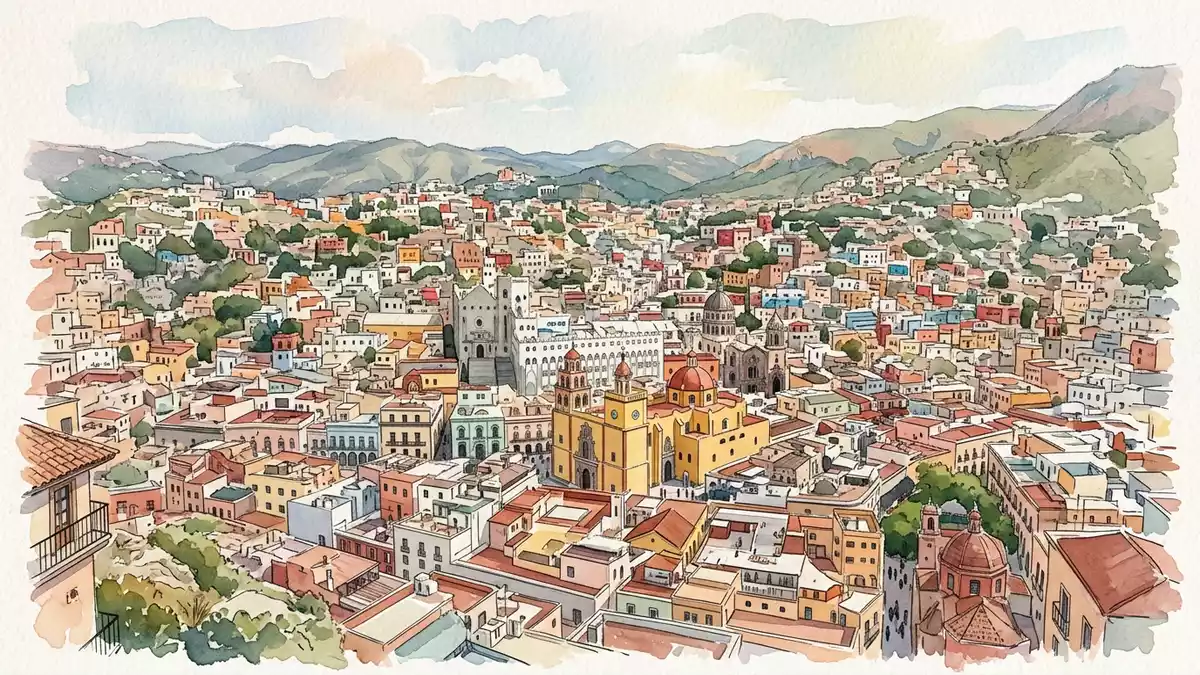
Guanajuato Centro Historico gathers the historic core of Guanajuato into a tight bowl of streets, plazas and painted houses rising up the surrounding hills. At its heart stand ornate churches and civic buildings shaped by the silver wealth that turned the town into a major mining centre in the eighteenth century, a legacy recognised in 1988 when the Historic Town of Guanajuato and Adjacent Mines entered the UNESCO World Heritage List.Historic Town of Guanajuato
Baroque façades around Plaza de la Paz
The formal centre of Guanajuato Centro Historico is Plaza de la Paz, also known as the main plaza, where government buildings and grand houses surround the bright Basílica Colegiata de Nuestra Señora de Guanajuato.Plaza de la Paz main plaza The basilica, dedicated to Our Lady of Guanajuato, was built between 1671 and 1696 in a sober Mexican Baroque style with details donated by mining families, and it gained minor basilica status in 1696 and full basilica status in 1957.Basílica Colegiata construction dates
The image of Our Lady of Guanajuato, patroness of the city, occupies the focus of the main altar and was given to Guanajuato in 1557 by Carlos I and his son Felipe II, binding the town’s religious life closely to Spanish royal patronage.Our Lady of Guanajuato image Around the plaza, pink and green sandstone mansions line up beside civic buildings, with façades that still display carved balconies, doorways and coats of arms from the colonial period when wealthy mine owners chose this square for their principal residences.colonial-era mansions sandstone
Jardín de la Unión and Teatro Juárez: the city’s living room
A short walk from Plaza de la Paz brings visitors to Jardín de la Unión, a triangular formal garden edged by restaurants and hotels that works as an outdoor parlour for Guanajuato Centro Historico.Jardín de la Unión triangular plaza Large trees shade its paths and benches, while a metal kiosk from the Porfirian era stands near the centre, a reminder of nineteenth-century town planning that reshaped the former Plaza de San Diego into a landscaped square during the 1800s.kiosk and Plaza de San Diego
On one side of the garden rises Teatro Juárez, a historic theatre whose main entrance, inspired by classical architecture, gives the square a monumental edge.Teatro Juarez main entrance Construction of Teatro Juárez began in 1872 based on designs by architect José Noriega, and the building mixes an exterior with columns reminiscent of ancient Rome and an interior decorated with oriental-inspired details and Art Nouveau spaces such as the smoking lounge.Teatro Juarez construction and style
Painted hillsides, subterranean streets and the university steps
Seen from a hillside viewpoint, Guanajuato Centro Historico appears as a basin packed with tightly-knit streets and houses painted in strong colours, with church towers and university buildings emerging above the roofs.historic town at night Part of the city’s distinct character comes from thoroughfares that run partially or entirely underground, a system of subterranean streets linked to the mining landscape that helped earn Guanajuato its World Heritage status alongside the adjacent mines.
The University of Guanajuato reinforces the sense that this is both a historic and a student city, with its main campus building a block north of the basilica and long flights of steps leading up to its entrance, which have become an informal gathering place for students.University of Guanajuato main building The university traces its roots to Jesuit educational initiatives and later development, and the main building from the 1940s incorporates the earlier Templo de los Hospitales, a sixteenth-century church originally built for the Indigenous population of Guanajuato.Templo de los Hospitales in campus
Visiting Guanajuato Centro Historico: what travellers from Western Europe should know
- Guanajuato Centro Historico lies in central Mexico within the city of Guanajuato, whose historic town and adjacent mines hold UNESCO World Heritage status under the designation Historic Town of Guanajuato and Adjacent Mines.
- The old town occupies a steep valley with streets that climb the hillsides and several routes running through underground tunnels, so walking often involves gradients, staircases and changes between open streets and covered passages.
- Jardín de la Unión sits beside Teatro Juárez and close to the Basílica Colegiata de Nuestra Señora de Guanajuato, making this cluster of plaza, theatre and basilica a straightforward point of orientation when exploring the historic centre on foot.
- The official language is Spanish and the currency is the Mexican peso. Entry requirements depend on your nationality; UK travellers can check the FCDO travel advice at gov.uk/foreign-travel-advice, Irish travellers the Department of Foreign Affairs at ireland.ie.
Searching for Guanajuato Centro Historico on social platforms
These links open searches for Guanajuato Centro Historico on each platform.
Frequently asked questions about Guanajuato Centro Historico
Where is Guanajuato Centro Historico?
Guanajuato Centro Historico forms the central district of Guanajuato in central Mexico, part of the UNESCO-listed Historic Town of Guanajuato and Adjacent Mines.
What should visitors expect in Guanajuato Centro Historico?
Visitors encounter steep streets, underground roadways, Baroque churches such as the Basílica Colegiata de Nuestra Señora de Guanajuato and lively plazas including Plaza de la Paz and Jardín de la Unión.
What makes Guanajuato Centro Historico distinctive?
The combination of colourful hillside housing, colonial architecture, subterranean streets and the strong presence of the University of Guanajuato gives the historic centre a character that links mining history with student life.


