
Gugong and the ordered scale of imperial Beijing
Published on 09/05/2026 at 17:53 | Editorial responsibility: Rafael Müller, Editor-in-Chief AD HOC NEWS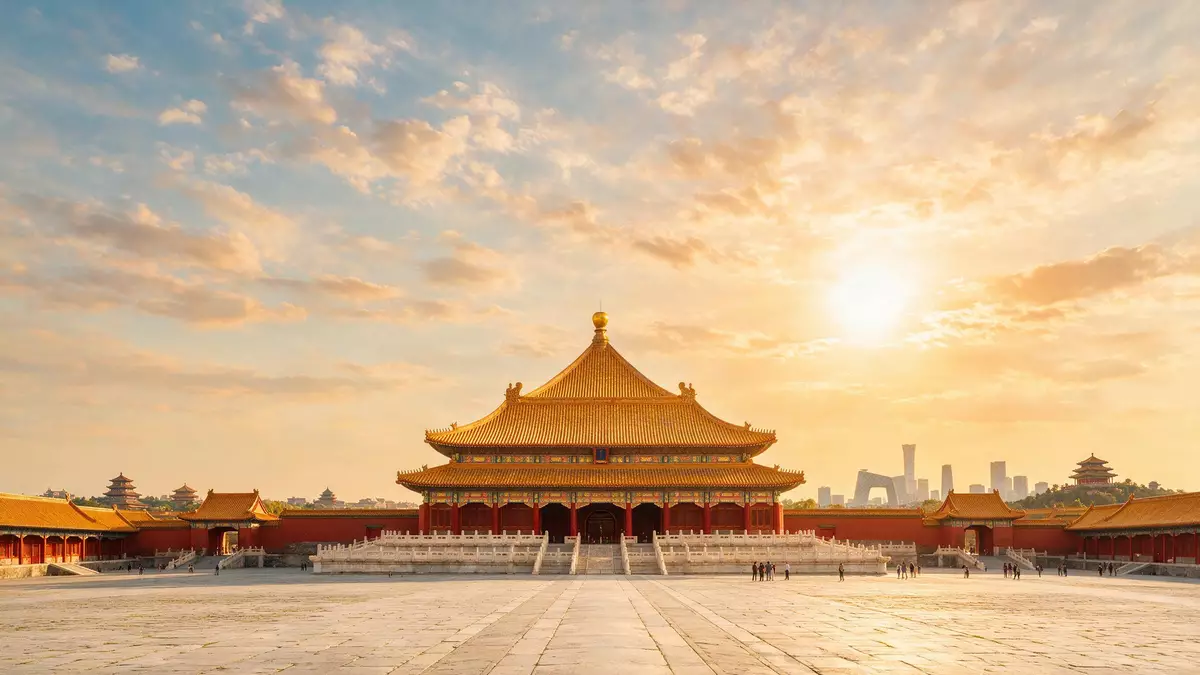
Gugong in Peking is the former imperial palace complex at the centre of the city, now linked to the Palace Museum. Its halls and courtyards sit inside walls, gates and a moat, and the whole complex still reads as a planned imperial enclosure.
Gugong’s walls, halls and courtyards
The name Gugong is the Chinese term for the Forbidden City, the palace of the Ming and Qing dynasties. The site began under the Yongle reign and was completed in 1420. That long imperial history remains visible in the formal sequence of courts, rooflines and enclosed passageways.
The palace complex covers a vast rectangular area and contains many halls arranged along a strong central axis. The main buildings include the Hall of Supreme Harmony, the Hall of Preserving Harmony and the Hall of Mental Cultivation, names that belong to the palace’s ceremonial and residential past. The overall effect is measured and repetitive, yet each court opens into another layer of roofs, terraces and gates.
From Ming court to Palace Museum
The outer buildings became a museum in 1914, and the Palace Museum was formally established in 1925 after Puyi of the Qing dynasty moved out. That shift left the palace architecture in place while changing its use from imperial residence to museum. The result is a historic court complex whose ceremonial spaces now frame exhibitions of art and artefacts.
Gugong is also recognised as part of the imperial palace heritage of Beijing. The place lies on the city’s central axis, and its south gate faces Tian'anmen Square with Jingshan Park to the north. That setting gives the complex a clear urban position without reducing it to a single monument.
The Palace Museum’s historic fabric
Inside Gugong, the buildings preserve the scale of a working imperial court. The Hall of Supreme Harmony is among the best-known structures, and the palace also includes the Hall of Central Harmony and the Hall of Preserving Harmony. Their raised terraces, timber structures and tiled roofs give the complex its layered profile.
The museums inside the palace hold bronzes, ceramics, jade, silks and paintings from Chinese history. The palace garden at the northern end adds a different scale, with rockeries, pavilions and planting arranged within a confined imperial enclosure. Together these parts show Gugong as both a ceremonial centre and a place of curated memory.
Visiting Gugong: what travellers from Western Europe should know
- Gugong stands in central Peking, near Tian'anmen Square. It is reached through the city’s street network and the main palace gates.
- The complex is large and enclosed, with many courtyards, terraces and long paved routes between halls. The ground plan is formal rather than compact.
- The palace fabric is dominated by timber halls, painted roofs and high walls. The architecture is best read as a sequence of courts rather than a single building.
- The site includes the Imperial Garden at the northern end. Its pavilions, rockeries and trees give the palace a more intimate scale after the formal courts.
Searching for Gugong on social platforms
These links open searches for Gugong on each platform.
Frequently asked questions about Gugong
Where is Gugong?
Gugong is in central Peking, on the city’s historic north-south axis. It sits close to Tian'anmen Square and Jingshan Park.
What does a visit involve?
The place is a large palace complex with gates, courtyards and halls laid out in sequence. Visitors encounter timber architecture, roofed terraces and the Imperial Garden.
What makes Gugong distinctive?
Its distinction lies in the scale and order of the former imperial court. The survival of the palace fabric, together with the Palace Museum, gives it a clear historical continuity.


