
Gyeongbokgung, Seoul’s royal palace framed by mountains
Published on 09/01/2026 at 16:28 | Editorial responsibility: Rafael Müller, Editor-in-Chief AD HOC NEWS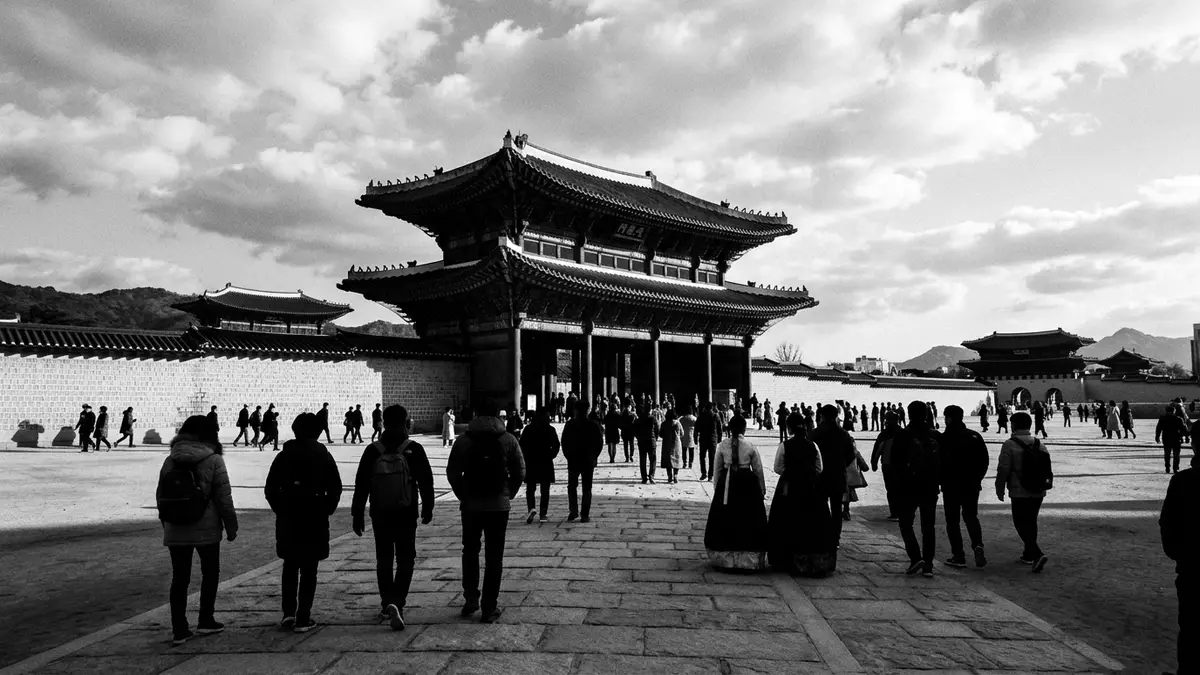
Gyeongbokgung in Seoul is the former main royal palace of the Joseon dynasty, laid out as a walled complex aligned between city and mountains. Built in 1395 under King Taejo, it became the principal seat of Korea’s new dynasty and still preserves key halls, pavilions and gates within its grounds.
A palace on Seoul’s north–south axis
Gyeongbokgung stands in northern Seoul, with its main gate facing south towards the old city and its rear halls backed by the ridge of Bugaksan. The palace was established in 1395, in the early years of the Joseon dynasty founded by Yi Seong-gye, later known as King Taejo.Built in 1395 as the official palace The complex became the main royal residence and administrative centre, forming part of the group of Five Grand Palaces constructed for the dynasty in Seoul.The largest of the Five Grand Palaces
The name Gyeongbokgung is often translated as “Palace of Great Blessing”, expressing an auspicious wish for the dynasty’s future.Palace of radiant happiness Within the wider group of Seoul palaces it is sometimes called the Northern Palace because of its position to the north of Changdeokgung and Gyeonghuigung.Referred to as the Northern Palace For travellers used to European royal complexes, the palace’s orientation between city and mountain, and its enclosing walls, give a different sense of how a capital was organised around court life.
Royal halls, pavilions and courtyards
Inside the walls, Gyeongbokgung is structured around a sequence of gates and stone-paved courtyards leading to the main throne hall, Geunjeongjeon. This hall stands on a raised stone platform and was used for important state ceremonies and royal audiences, with stone markers in the courtyard indicating the positions of officials ranked by status.Geunjeongjeon, the throne hall The architecture follows Joseon timber palace traditions, with wooden columns carrying multi-tiered tiled roofs and bracketed eaves.
To one side of the main axis lies Gyeonghoeru Pavilion, built out over a pond on stone columns and used historically for banquets and state receptions.Gyeonghoeru Pavilion and pond Further within the grounds, Hyangwonjeong Pavilion sits beside another pond in a quieter section of the complex, connected to the land by a slender bridge.Hyangwonjeong Pavilion within the palace These pavilions, along with residential quarters and ancillary service buildings, give the palace its mixture of ceremonial spaces and smaller, more intimate environments. Two national museums are integrated into the wider site: the National Palace Museum of Korea stands just outside one of the inner gates, while the National Folk Museum of Korea occupies part of the eastern side of the grounds.
A palace shaped by war and restoration
Construction of Gyeongbokgung during King Taejo’s reign was followed by expansion under later rulers including King Sejong, when the palace flourished as a centre of governance and culture. Sejong’s reign in the fifteenth century saw the creation of Hangul, the Korean script, with important work on language carried out at the palace.Hangul created at the palace This period fixed Gyeongbokgung’s role as the heart of Joseon royal authority.
The palace was destroyed during the Imjin War, when Japanese forces invaded the peninsula in 1592, and its buildings were burned.Destroyed during the Japanese invasion in 1592 For centuries the grounds lay in ruins until large-scale reconstruction in the nineteenth century during the reign of King Gojong, under the leadership of Heungseon Daewongun.Restored under Heungseon Daewongun in 1867 This rebuilding re-established Gyeongbokgung as the main palace, although later political events again changed its status. Parts of the complex were dismantled during the period of Japanese colonial rule in the early twentieth century, altering the ensemble that visitors see, but major halls and pavilions remain or have been reconstructed.
Visiting Gyeongbokgung: what travellers from Western Europe should know
- Gyeongbokgung stands in central Seoul at the northern end of the historic city axis, with Gwanghwamun Gate facing Sejong-daero. It is reached by city public transport, including metro lines serving nearby stations such as Gyeongbokgung Station.
- The palace grounds are extensive, with long paved approaches between gates and wide courtyards; visiting involves substantial walking on stone surfaces and gravel paths.
- The National Palace Museum of Korea lies on the western side outside one of the inner gates, and the National Folk Museum of Korea occupies an area towards the eastern part of the grounds, making it straightforward to combine the palace with museum visits.
- The official language is Korean and the currency is the South Korean won.
- Entry requirements depend on your nationality; UK travellers can check the FCDO travel advice at gov.uk/foreign-travel-advice, Irish travellers the Department of Foreign Affairs at ireland.ie.
Searching for Gyeongbokgung on social platforms
These links open searches for Gyeongbokgung on each platform.
Frequently asked questions about Gyeongbokgung
Where is Gyeongbokgung located?
Gyeongbokgung is in northern Seoul, South Korea, with its main gate opening towards the historic city centre and Bugaksan mountain rising behind the palace.
What should visitors expect inside the palace grounds?
Visitors encounter a sequence of monumental gates, stone courtyards, throne and audience halls, as well as pavilions set beside ponds and museum buildings within or near the complex.
What makes Gyeongbokgung distinctive among Seoul’s palaces?
Gyeongbokgung is the principal Joseon royal palace, established in 1395 and rebuilt in the nineteenth century, combining major ceremonial halls with notable pavilions such as Gyeonghoeru and Hyangwonjeong.


