
Hakone Jinja and the red torii of Lake Ashi
Published on 09/23/2026 at 02:00 | Editorial responsibility: Rafael Müller, Editor-in-Chief AD HOC NEWS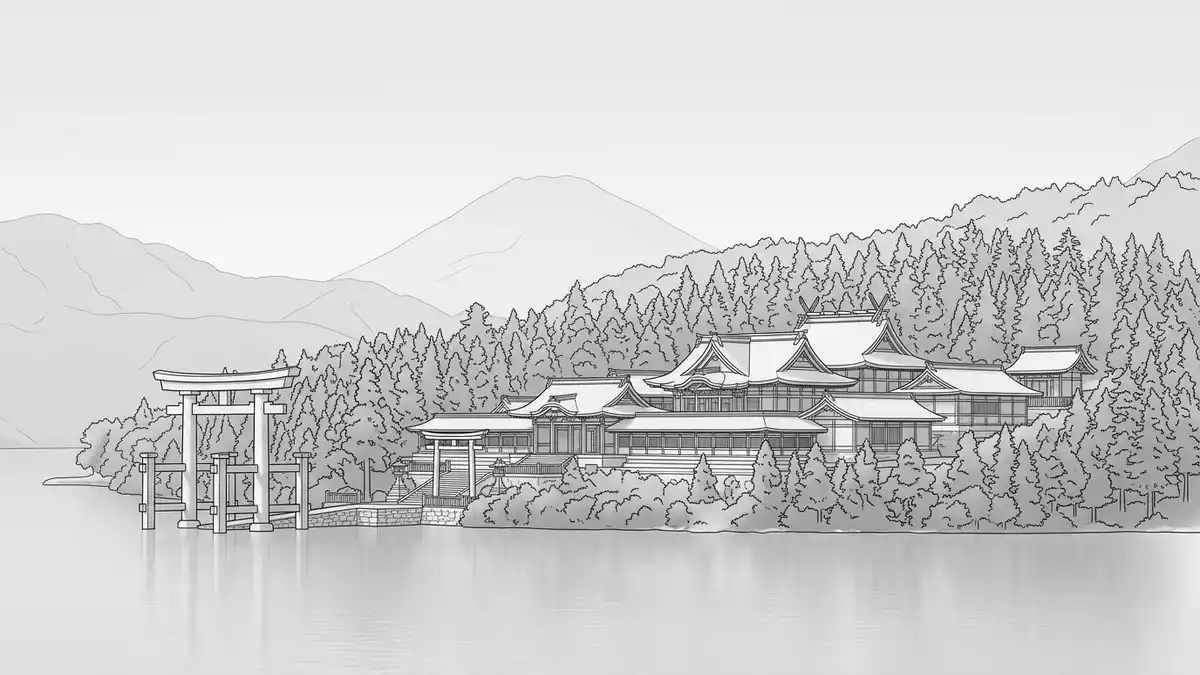
Hakone Jinja is a Shinto sanctuary beside Lake Ashi in Hakone, where dark forest, red shrine buildings and open water form a single setting. Its most recognisable feature is the Heiwa no Torii, a vermilion gate standing at the lakeshore, while the main sanctuary lies among cedar trees above it.
The shrine is traditionally dated to 757, linking the landscape with Mangan Shonin and the religious history of the Hakone mountains. The visible complex combines an ancient foundation, a main hall dating from 1667 and a lakeside gate from 1952.
Hakone Jinja between forest and lake
The approach to Hakone Jinja passes through a wooded precinct associated with mountain worship. Stone steps rise beneath tall trees towards the main sanctuary, whose vermilion surfaces contrast with the surrounding greenery and dark timber.
Lake Ashi remains part of the shrine’s visual identity. The Heiwa no Torii stands at the water’s edge, separated from the principal buildings by the lakeside approach. Its position creates a clear relationship between the sanctuary, the forest and the volcanic lake. The gate carries the word “Heiwa”, meaning peace, on a plaque facing the water.
The red gate was erected in 1952 and commemorates the San Francisco Peace Treaty. Its twentieth-century date gives the precinct a visible layer distinct from the older shrine buildings and the centuries-old mountain tradition.
From Mangan Shonin to the Kamakura age
Hakone Jinja’s foundation is connected with the Buddhist priest Mangan Shonin, whose name remains central to the shrine’s origin story. The sanctuary was established during the Nara period, when Buddhist and older Japanese religious practices existed together.
The original religious presence was associated with Komagatake, the summit of Mount Hakone. The shrine was later relocated to the shores of Lake Ashi, and its current lakeside form dates to 1667. This history places the sanctuary across several important periods of Japanese culture.
During the Kamakura period, Hakone Jinja was linked with warrior society. Minamoto no Yoritomo, founder of the Kamakura shogunate, is associated with the shrine, which became connected with military devotion and the Tokaido route through eastern Japan.
The shrine’s deities are known collectively as Hakone Okami. They include Ninigi-no-Mikoto, Konohanasakuya-hime-no-Mikoto and Hikohohodemi-no-Mikoto, figures connected with Japanese mythology and the mountains of Hakone.
The Peace Torii and the shrine’s layered identity
Hakone Jinja is not represented by a single building. Its identity emerges from the relation between the torii at Lake Ashi, the forested stairway and the sanctuary above the shore.
The main hall’s present form dates from 1667 and belongs to the Edo period. Vermilion details, dark wood and compact shrine structures sit within a landscape of cedar, volcanic slopes and water. The setting is architectural and geological at once.
Kuzuryu Shrine forms another part of the precinct’s religious world. Its name refers to the nine-headed dragon associated with Lake Ashi, a sacred figure preserved in local tradition as a guardian deity. The dragon story gives the lake a mythic presence without changing its physical character as a volcanic mountain lake.
The result is a place where historical layers remain visible together. Mangan Shonin belongs to the eighth-century foundation, Minamoto no Yoritomo to the Kamakura period, the main hall to 1667 and the Peace Torii to 1952. Each name and date belongs to a different part of Hakone Jinja.
Visiting Hakone Jinja: what travellers from Western Europe should know
- Hakone Jinja is at Moto-Hakone on the southern shore of Lake Ashi in Hakone Town, Kanagawa Prefecture. Hakone Tozan buses connect the lakeside area with Hakone-Yumoto, and boats cross Lake Ashi.
- The main approach uses a long flight of stone steps beneath cedar trees. The lakeside torii is reached separately from the forested sanctuary.
- Hakone lies in a mountainous volcanic region. Lake Ashi, Mount Hakone and Komagatake form the geographical setting of the shrine.
- The official language is Japanese and the currency is the Japanese yen.
- Entry requirements depend on your nationality; UK travellers can check the FCDO travel advice at gov.uk/foreign-travel-advice, Irish travellers the Department of Foreign Affairs at ireland.ie.
Searching for Hakone Jinja on social platforms
These links open searches for Hakone Jinja on each platform.
Frequently asked questions about Hakone Jinja
Where is Hakone Jinja?
Hakone Jinja stands at Moto-Hakone on the shore of Lake Ashi in Hakone Town, Kanagawa Prefecture, Japan.
What can visitors see there?
The precinct includes a forested stairway, vermilion shrine buildings, the main sanctuary and the Heiwa no Torii beside Lake Ashi.
What makes Hakone Jinja distinctive?
The shrine joins an eighth-century religious tradition with a main hall dating to 1667 and a lakeside Peace Torii erected in 1952.


