
Halaszbastya: neo-Romanesque terraces above the Danube
Published on 09/19/2026 at 17:30 | Editorial responsibility: Rafael Müller, Editor-in-Chief AD HOC NEWS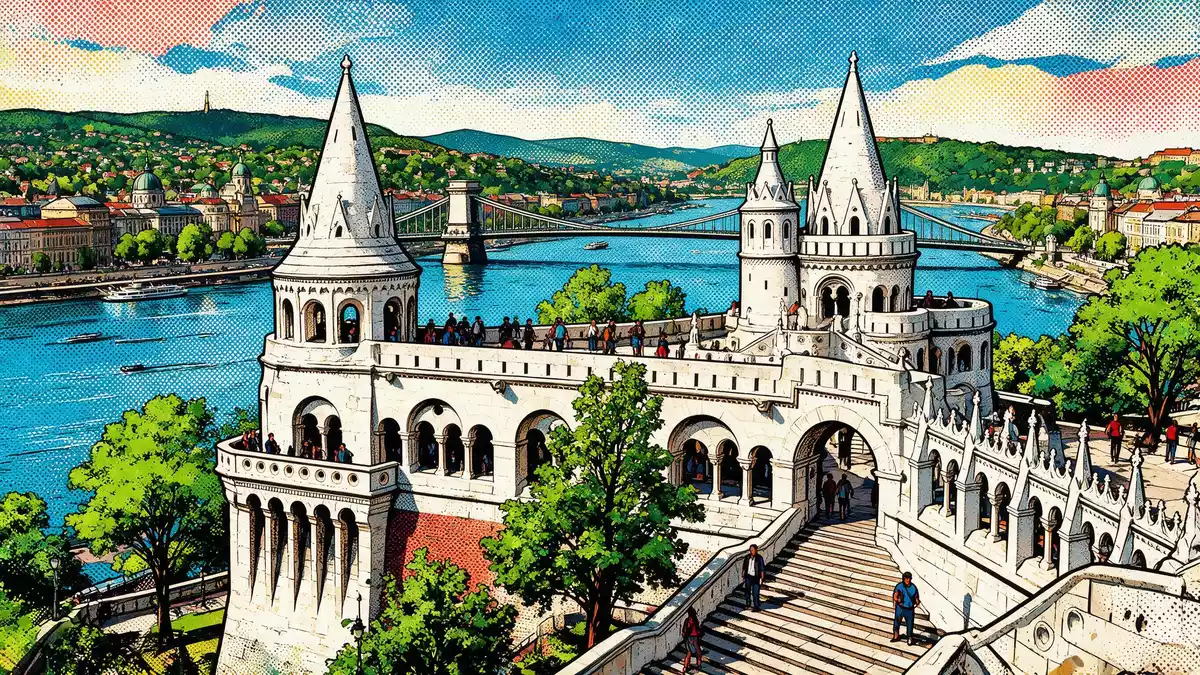
Halaszbastya, known in English as Fisherman’s Bastion, is a neo-Romanesque terrace of towers and arcaded walks high on Castle Hill in Budapest, looking across the Danube to the Pest side of the city. The ensemble stands within the historic Buda Castle District, which forms part of Budapest’s UNESCO-listed World Heritage area and gathers around the rebuilt Matthias Church on the hilltop. Designed by architect Frigyes Schulek at the end of the nineteenth century and opened to the public in 1905, the bastion takes medieval defensive walls and recasts them as a monumental promenade and viewpoint above the river.
Terraces of stone above the river
Halaszbastya occupies the crest of Castle Hill on the Buda side of Budapest, just west of the Danube and close to the cluster of buildings known as the Buda Castle District.Buda Castle District The bastion’s terraces run along the edge of the plateau and form a long, stepped promenade that follows the line of earlier fortification walls on the eastern face of the hill.section of the Buda Castle wall From these stone platforms the Danube lies directly below, with the river crossing dominated by the Széchenyi Chain Bridge and the broad urban plane of Pest stretching away beyond.
The bastion is built in pale masonry, with flights of steps, open loggias and battlement-like parapets forming a layered vertical landscape between the hilltop and the drop towards the river. Rounded towers rise from the terrace line and are linked by arcaded walkways, creating a rhythm of vertical and horizontal elements that frame views across Budapest. The structure lies immediately adjacent to Matthias Church, and the close relationship between church and bastion means that the terraces wrap around the churchyard, giving changing vistas of the church’s roof and spire together with the panorama over the Danube.Matthias Church
From medieval wall to neo-Romanesque promenade
For centuries a section of the defensive wall of Buda Castle stood where Halaszbastya now rises, guarding the steep face above the riverside quarter traditionally associated with the city’s fishermen.defensive wall of Buda Castle The Buda Castle Quarter formally lost its military function in 1874, and the hill was reshaped into a civic area rather than an active fortress, opening the way to projects that treated the old fortifications as a scenic setting.lost its military function in 1874 Halaszbastya belongs to that transformation: a work that keeps the memory of the wall but uses it as the foundation for a promenade rather than a battlement.
Construction of the present bastion in neo-Romanesque revival style began in the 1890s to designs by Frigyes Schulek, whose work on Matthias Church reshaped the hill’s skyline in the same period.construction began at the end of the nineteenth century The main structural elements were in place by the turn of the century, and in 1905 the bastion was ceremonially opened to the public as a viewpoint and promenade. In its present form the building draws on medieval imagery: turrets, merlons, staircases and arcades appear throughout, yet the composition belongs to a late nineteenth-century taste for historical styles, applied to a civic terrace rather than to a fortress wall.
Symbolism, towers and the Fisherman’s name
One of the most striking features of Halaszbastya is the group of pointed towers that stand along its upper terrace, each rooted in the masonry of the former line of defence. These towers, built in a romanticised medieval style, are associated with the seven Magyar tribes that founded the Hungarian state, a reference that ties the architecture on Castle Hill to the narratives celebrated during the millennial anniversary of Hungary in the 1890s.seven towers and tribes The blend of symbolic number, historicising detail and urban views makes the bastion an architectural monument as much as a lookout.
The name “Halaszbastya” points to older associations with fishermen and the riverside district below the walls, remembering either the guild that protected this stretch of fortification or the neighbourhood known historically for the trade.origin of the bastion’s name In the twentieth century Halaszbastya, together with Castle Hill and the banks of the Danube, became part of the Budapest World Heritage listing, embedding the bastion within a wider protected ensemble that includes palaces, churches and bridges along the river.World Heritage status As a terrace with open parapets and multiple stairways linking different levels, the bastion remains a place where history, symbolic architecture and the geography of the Danube valley meet in a single composition of stone.
Visiting Halaszbastya: what travellers from Western Europe should know
- Halaszbastya stands on Castle Hill in Budapest’s Buda Castle District, above the Danube on the western side of the river, close to Matthias Church and the hilltop palace complex.
- The terraces are reached by exterior staircases that climb between several levels, with long flights of stone steps and occasional narrow passages linking the parapets and arcaded walks.
- The site lies within Hungary, where the official language is Hungarian and the currency is the forint.
- The bastion forms part of a wider historic quarter on Castle Hill, with the riverfront below and the Széchenyi Chain Bridge providing a prominent reference point directly in view.
Searching for Halaszbastya on social platforms
These links open searches for Halaszbastya on each platform.
Frequently asked questions about Halaszbastya
Where is Halaszbastya located in Budapest?
Halaszbastya stands on Castle Hill in the Buda Castle District, on the western bank of the Danube, close to Matthias Church and the former royal palace.
What can visitors expect on a visit to Halaszbastya?
Visitors encounter layered stone terraces, towers and arcaded walkways linked by staircases, together with wide views across the Danube towards Pest and the city’s riverfront landmarks.
What makes Halaszbastya distinctive among Budapest’s landmarks?
The bastion combines neo-Romanesque revival architecture, symbolic towers associated with Hungary’s founding tribes and a prominent position above the river within the UNESCO-listed Buda Castle District.


