
Hallasan rises as Jeju’s volcanic mountain
Published on 08/09/2026 at 15:06 | Editorial responsibility: Rafael Müller, Editor-in-Chief AD HOC NEWS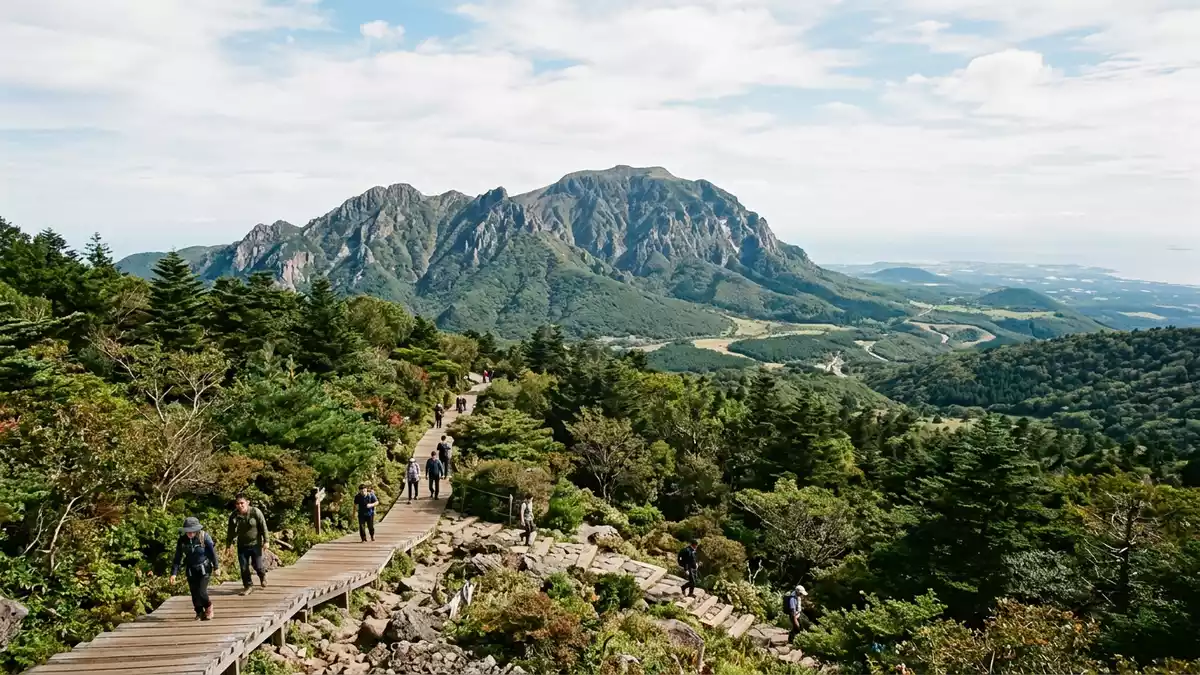
Hallasan is Jeju’s volcanic mountain, rising from the island’s centre as a broad basalt massif with a summit crater. It is the highest mountain in South Korea and one of the clearest landmarks on the island.
Jeju’s central volcanic massif
The mountain is part of the volcanic landscape that defines Jeju. Its slopes are spread with lava fields, rock outcrops and forest, moving from lowland vegetation to alpine conditions near the top.
Hallasan is associated with Jeju National Park, and the mountain’s protected status reflects its geological and ecological importance. The summit area includes Baengnokdam, the crater lake at the top.
Basalt slopes, forest and summit crater
Hallasan’s profile is gentle at a distance and much steeper underfoot. The mountain is made of volcanic material, with lava flows and layered rock visible in different parts of the park.
Along the trails, the vegetation changes from evergreen forest to shrubs and open ground. The higher sections carry a more exposed mountain character, with weather and altitude shaping the scene.
Hallasan in Jeju’s cultural landscape
The mountain has long stood as a defining feature of Jeju’s identity. It appears in landscape views across the island and forms a natural centre point for travel, walking and outdoor photography.
Hallasan is also important as a place of ecological variety, with plant communities shaped by elevation and volcanic soil. Its name belongs to the island’s geography as much as to its tourism.
Visiting Hallasan: what travellers from Western Europe should know
- The site is on Jeju in South Korea and is reached from Jeju City by road.
- Admission arrangements and opening hours are set by the site's operator and change with the season; the official website is the only binding source.
- Late spring and autumn suit mountain walking, while winter brings snow and harsher conditions on the upper slopes.
- The trails involve steep sections, long ascents and altitude, so sturdy footwear and sensible pacing matter.
- Payment and language arrangements vary on site, and basic Korean signage may appear alongside English in visitor areas.
- Entry requirements depend on your nationality. UK travellers should check the FCDO travel advice at gov.uk/foreign-travel-advice; Irish travellers the Department of Foreign Affairs at ireland.ie; EU and EEA citizens their own national foreign ministry.
Searching for Hallasan on social platforms
These links open searches for Hallasan on each platform.
Frequently asked questions about Hallasan
Where is Hallasan?
Hallasan stands in the middle of Jeju in South Korea. It is the island’s highest mountain and a dominant part of the landscape.
What should visitors expect?
Expect a volcanic mountain with forested slopes, exposed upper sections and trails that can demand steady effort. Weather and footing matter more as the altitude increases.
What makes Hallasan distinctive?
Its combination of a central summit, volcanic terrain and a crater lake gives it a strong identity. It is a mountain that shapes Jeju’s geography as well as its outlook.


