
Hallgrimskirkja rises from Reykjavik in concrete and sound
Published on 09/22/2026 at 07:01 | Editorial responsibility: Rafael Müller, Editor-in-Chief AD HOC NEWS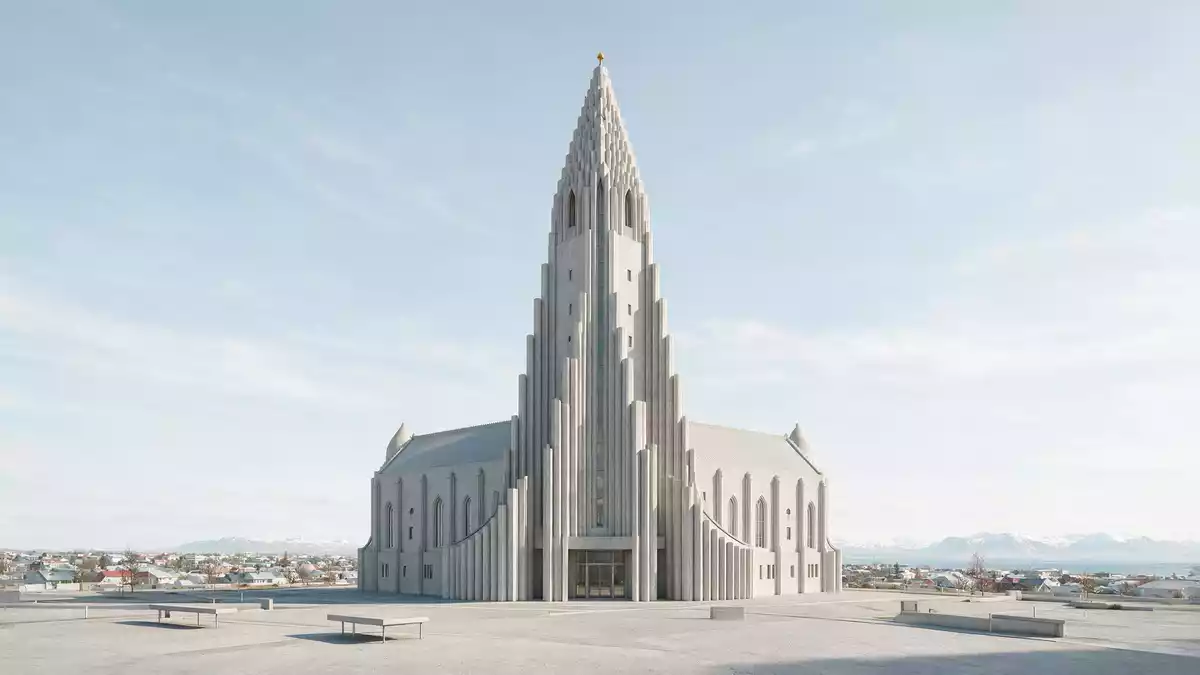
Hallgrimskirkja rises above Reykjavik as a pale concrete church whose stepped sides recall Iceland’s columnar basalt. Guðjón Samúelsson designed the building, and the church was consecrated on 26 October 1986.
Hallgrimskirkja and the geometry of basalt
The church stands on Skólavörðuholt, with its tower, central nave and curved side wings forming a broad composition. White concrete covers the exterior, while vertical ribs climb the frontage and gather around the tall central tower.
Basalt columns are a recognisable feature of Icelandic geology. At Hallgrimskirkja, that geological language appears as architecture: repeated concrete forms rise beside the entrance and step towards the tower. The result is a building that belongs visibly to Reykjavik’s volcanic landscape without imitating a natural rock face.
Guðjón Samúelsson began the design in 1937. Construction began in 1945, and the church received its final consecration in 1986 after work had progressed through several stages. The crypt was consecrated in 1948, while the steeple and side wings were completed in 1974.
Guðjón Samúelsson’s long church project
Hallgrimskirkja is named after Hallgrímur Pétursson, the seventeenth-century Icelandic poet and clergyman. His Passion Hymns remain closely associated with Icelandic Lutheran culture, giving the church a literary name as well as a religious function.
Samúelsson served as Iceland’s State Architect and developed a national architectural language through buildings that joined historical references with Icelandic materials and landscapes. Hallgrimskirkja belongs to that wider body of work, while its scale gives the design a particularly strong presence in the capital.
The completed church is 74.5 m (244 ft) tall, making its tower visible across central Reykjavik. Its façade has no conventional horizontal calm; the concrete rises in ribs, wings and vertical bands, turning the exterior into a composition of repeated lines. The tower contains the belfry, with three large bells and a carillon.
The church’s historical timeline is therefore part of its visible identity. The design belongs to the 1930s, the first building phase belongs to the years after the Second World War, and the complete church belongs to 1986. Hallgrimskirkja carries all three periods in one structure.building and history
A vast nave beneath the concrete tower
Inside, the nave presents a sharp contrast to the dense vertical rhythm of the exterior. Pale walls, high arches and a long central volume create an interior with few decorative distractions. The altar area sits beneath the church’s upward-reaching structure, while daylight enters through high openings.
The dominant interior object is the concert organ in the west gable. Built by the Johannes Klais workshop in Bonn, it was inaugurated in December 1992. The instrument has four keyboards, a pedalboard, 72 stops and 5,275 pipes.
The organ is 15 m (49 ft) high and weighs about 25 tonnes. Its largest pipes reach roughly 10 m (33 ft), placing the instrument among the building’s principal architectural features rather than treating it as hidden equipment.
Hallgrimskirkja also contains a smaller chancel organ, inaugurated in 1985. Together, the instruments connect the church’s religious use with Reykjavik’s musical life. The large organ occupies the western end like a second façade, with ranks of pipes arranged above the nave.
The contrast between concrete ribs outside and ordered pipes inside provides the clearest way to read Hallgrimskirkja. One surface refers to basalt formations, while the other gathers thousands of metal and wooden components into a single musical structure.concert organ details
Visiting Hallgrimskirkja: what travellers from Western Europe should know
- Hallgrimskirkja stands at Hallgrímstorg 1 in central Reykjavik, beside Skólavörðustígur. City buses serve the surrounding central districts.
- The church occupies elevated ground at Skólavörðuholt. The tower and upper viewpoints involve vertical movement, while the nave remains at the main church level.
- The building is an active Evangelical-Lutheran parish church. Religious services, prayer and music form part of its continuing use.
- Reykjavik’s official language is Icelandic and the currency is the Icelandic króna.
Searching for Hallgrimskirkja on social platforms
These links open searches for Hallgrimskirkja on each platform.Frequently asked questions about Hallgrimskirkja
Where is Hallgrimskirkja?
Hallgrimskirkja stands at Hallgrímstorg 1 in central Reykjavik, on the elevated ground of Skólavörðuholt.
What can visitors expect inside?
The interior contains a high nave, pale concrete surfaces, a chancel and the large Klais concert organ in the west gable.
What makes Hallgrimskirkja distinctive?
Its stepped concrete exterior recalls Icelandic basalt columns, while its 74.5 m tower and 5,275-pipe organ give the church a powerful vertical presence.


