
Hallstatt between lake and mountain salt history
Published on 08/15/2026 at 14:44 | Editorial responsibility: Rafael Müller, Editor-in-Chief AD HOC NEWS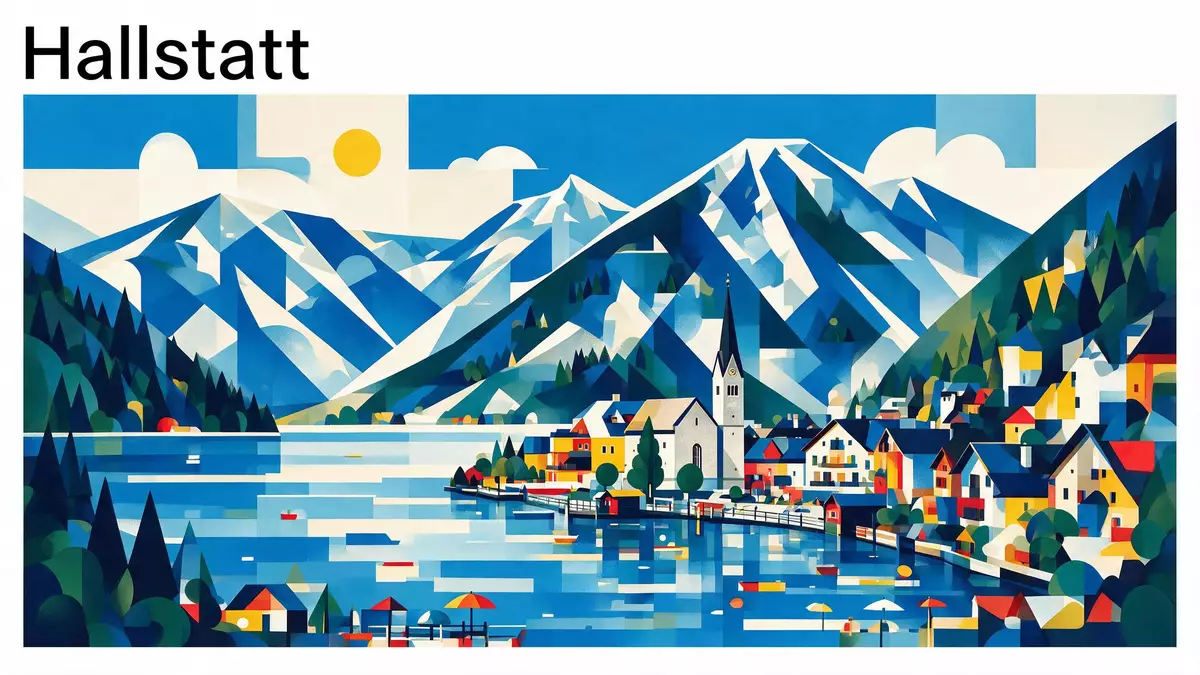
Hallstatt is a small market town in Austria’s Salzkammergut region, squeezed between Lake Hallstatt and steep limestone slopes of the Dachstein massif. The village owes its name and long history to salt, extracted from the surrounding mountains since prehistoric times and still present in the landscape today. It forms part of the Hallstatt-Dachstein / Salzkammergut Cultural Landscape, inscribed on the UNESCO World Heritage List in 1997 as a cultural site where settlement, mining and alpine scenery meet.
Village between cliff and lake
Hallstatt occupies a narrow strip of ground on the west bank of Lake Hallstatt, where the mountains drop sharply towards the water and leave only limited space for houses and lanes.The mining town of Hallstatt is located on the west bank of the fjord-like lake, with the village centre pressed close to the shore. Lake Hallstatt itself lies in the Upper Austrian Salzkammergut in the district of Gmunden, at the northern foot of the Dachstein massif, and is framed by peaks such as the Sarstein and the Plassen, giving the water a long, enclosed form between steep slopes.The lake lies at around 508 m above sea level and stretches several kilometres from south to north.
The village is part of a wider World Heritage region that includes Bad Goisern, Gosau and Obertraun, a cluster of settlements around the lakes and peaks of the Inner Salzkammergut.In 1997 most of this historic cultural landscape was listed as a UNESCO World Heritage Site, recognising both its scenery and its long human presence. Hallstatt’s waterfront is characterised by tightly grouped houses, a lakeside church and small landing places for boats, all backed by the rising mountain face.
Salt mine above the rooftops
High above the village, the Hallstatt salt mine occupies galleries within the mountain and has been worked in various forms for millennia.Hallstatt’s wealth in prehistoric times was based on extensive reserves of salt, and organised mining is documented from the Bronze Age onward. Archaeological research has established that by around 1,500 BC there was a fully developed salt mining industry in the area, making the prehistoric salt mine at Hallstatt the oldest known salt mine in the world.Evidence points to mining activity as early as 5,000 BCE, with later phases in the Hallstatt period of the Iron Age.
The mine extends deep into the mountain, with galleries reaching several hundred metres underground where miners pursued solid deposits of rock salt.Miners of the Hallstatt period extracted salt exclusively in dry mining and worked up to 330 m below the surface, breaking salt into solid chunks. Finds from burial grounds and mining installations have given their name to the Hallstatt period, a major phase of the European Iron Age dated roughly from 800 to 400 BC.The burial site at Hallstatt has been known in scientific circles since the nineteenth century and continues to yield artefacts linked to mining and trade.
World Heritage cultural landscape
Hallstatt stands at the core of the Hallstatt-Dachstein / Salzkammergut Cultural Landscape, one of Austria’s World Heritage Sites recognised for the interaction of natural setting and human activity.The UNESCO inscription for this alpine landscape dates to 1997, under cultural criteria that highlight the archaeological remains, long mining history and continued settlement in a dramatic mountain environment. The protected area covers tens of thousands of hectares, encompassing lakes, valleys, high plateaus and caves, with Hallstatt as an archaeological centre point.
The lake itself forms part of this heritage ensemble.Lake Hallstatt has a surface of about 8.55 km² and a maximum depth of 125 m, and is traversed by the Traun river, which ultimately drains into the Danube. The shoreline includes the settlements of Hallstatt, Bad Goisern and Obertraun, with the village of Hallstatt occupying much of the western bank. Above, the Dachstein massif rises to nearly 3,000 m, adding high alpine terrain to the mix of lake, forest and cliff.
Visiting Hallstatt: what travellers from Western Europe should know
- Hallstatt lies in Upper Austria’s Salzkammergut, on the western shore of Lake Hallstatt; it is reached by road connections from Gmunden and by regional rail and bus links via nearby stations.
- The settlement occupies steep lakeside terrain; many paths involve stairways and short climbs, and the ascent towards the salt mine leads over mountain ground above the village.
- The official language is German and the currency is the euro.
Searching for Hallstatt on social platforms
These links open searches for Hallstatt on each platform.Frequently asked questions about Hallstatt
Where is Hallstatt located?
Hallstatt is in the Salzkammergut region of Upper Austria, on the western shore of Lake Hallstatt in the district of Gmunden.
What can visitors expect in Hallstatt?
Visitors encounter a compact lakeside village backed by steep mountains, with access to the historic salt mine and views across Lake Hallstatt and the Dachstein massif.
What makes Hallstatt distinctive?
Hallstatt is distinctive for its combination of prehistoric salt mining, the Hallstatt period burial grounds and its role within the Hallstatt-Dachstein / Salzkammergut UNESCO World Heritage cultural landscape.


