
Hallstatt between lake and salt mountain
Published on 09/21/2026 at 21:48 | Editorial responsibility: Rafael Müller, Editor-in-Chief AD HOC NEWS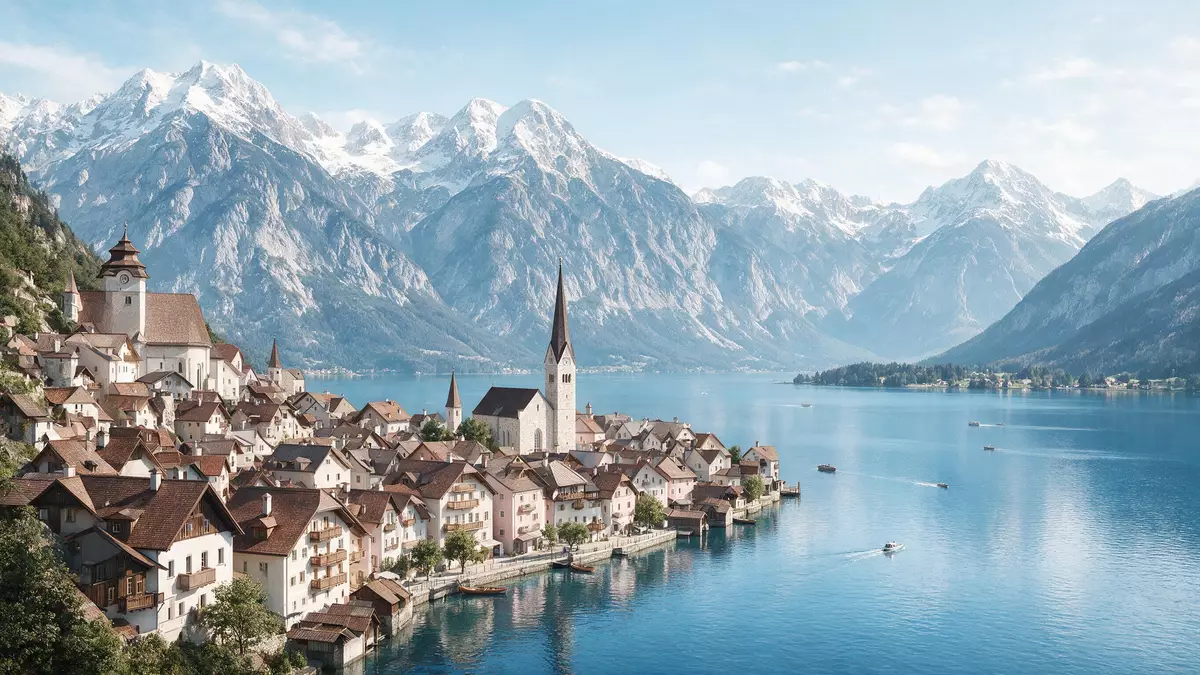
Hallstatt in Austria is a lakeside village pressed between steep mountains and the water of Lake Hallstatt, framed by an ancient salt mine that has shaped its history for thousands of years. It forms part of the Hallstatt-Dachstein / Salzkammergut Cultural Landscape, inscribed as a UNESCO World Heritage Site in 1997, bringing together the settlement, the surrounding peaks and the salt-bearing mountain as one protected ensemble.Hallstatt-Dachstein / Salzkammergut Cultural Landscape
Lakeside village squeezed into alpine slopes
Hallstatt lies on the western shore of Lake Hallstatt in the Salzkammergut region of Upper Austria, with houses and lanes arranged in a narrow strip between the lake and the rising flanks of the Salzberg. The setting is defined by abrupt contrasts: the water surface at the front of the village, and immediately behind it the steep, forested slopes and cliffs that rise into the Dachstein massif, an Eastern Alps landscape where mountains climb sharply from confined valleys.Eastern Alps landscape
The historic core of Hallstatt developed along a lakeside road and a small central square, with buildings set close to one another and to the water because of the limited space between mountain and lake. Much of the present appearance reflects rebuilding in the eighteenth century after a major fire, which led to a largely Baroque ensemble of facades and roofs that gives the compact village its characteristic architectural rhythm.Baroque ensemble after an eighteenth-century fire
Salt mountain and the Hallstatt culture
Above the village rises the Salzberg, the salt mountain whose deposits have been worked for thousands of years and which underpin Hallstatt’s long-standing connection with salt. Archaeological investigations have identified mining activity there dating back to the Neolithic period, with developed underground salt extraction evidenced around 1500 BC, forming what is recognised as the oldest known salt mine in the world.prehistoric salt mine at Hallstatt Continuous use of the salt resources over millennia links the high valley tunnels, the burial grounds and the later industrial workings into a single historical landscape.
The richness of the finds in the cemetery above the mine led nineteenth-century scholars to use the name “Hallstatt culture” for a broad Iron Age cultural horizon in central Europe. From 1846, mine overseer Johann Georg Ramsauer excavated and documented close to 1,000 graves, producing detailed records that helped define this period, dated broadly between 800 and 450 BC, and adding an archaeological dimension to the village that reaches far beyond its physical size.Johann Georg Ramsauer’s Iron Age cemetery excavations
World Heritage cultural landscape of lake, village and mine
The Hallstatt-Dachstein / Salzkammergut Cultural Landscape brings together several elements: the lakeside village of Hallstatt, the salt mountain with its prehistoric and historic workings, Lake Hallstatt itself, and the surrounding alpine terrain. UNESCO recognised this cultural landscape as a World Heritage Site in 1997, describing it as a cultural property under criteria that reflect both the outstanding archaeological record and the long continuity of salt mining, as well as the way the settlement and environment form a visually dramatic whole.UNESCO inscription of Hallstatt-Dachstein / Salzkammergut
Salt production on the Salzberg expanded markedly in the sixteenth century and remained central to the Salzkammergut region for centuries, providing brine that was piped to nearby salt works and reinforcing Hallstatt’s identity as a salt town.Hallstatt history as a salt town Modern industrial production at the mine above Lake Hallstatt ceased in the twentieth century, yet brine extraction continues and the mining tunnels, archaeological remains and lakeside settlement together express a long industrial and cultural story in a tight geographical frame.
Visiting Hallstatt: what travellers from Western Europe should know
- Hallstatt is in Upper Austria on the western shore of Lake Hallstatt in the Salzkammergut, reached by regional roads along the lake and by regional rail and bus connections that link to larger transport hubs in the area.
- The village occupies a narrow ledge between lake and mountain, so streets, paths and stairways rise steeply from the waterfront and many routes involve significant gradients and flights of steps.
- The official language is German and the currency is the euro.
Searching for Hallstatt on social platforms
These links open searches for Hallstatt on each platform.Frequently asked questions about Hallstatt
Where is Hallstatt located?
Hallstatt is a lakeside village in the Salzkammergut region of Upper Austria, on the shore of Lake Hallstatt and within the Hallstatt-Dachstein / Salzkammergut Cultural Landscape.
What should visitors expect on a visit to Hallstatt?
Visitors encounter a compact lakeside settlement with eighteenth-century architecture, steep streets and stairways, and the presence of an ancient salt mine above the village.
What makes Hallstatt distinctive?
Hallstatt is distinctive for its combination of a long-recorded salt-mining history, the Iron Age Hallstatt culture cemetery, and its inclusion in a UNESCO-listed cultural landscape that unites village, lake and mountain.


