
Hampi’s granite landscape of temples and ruins
Published on 09/23/2026 at 22:30 | Editorial responsibility: Rafael Müller, Editor-in-Chief AD HOC NEWS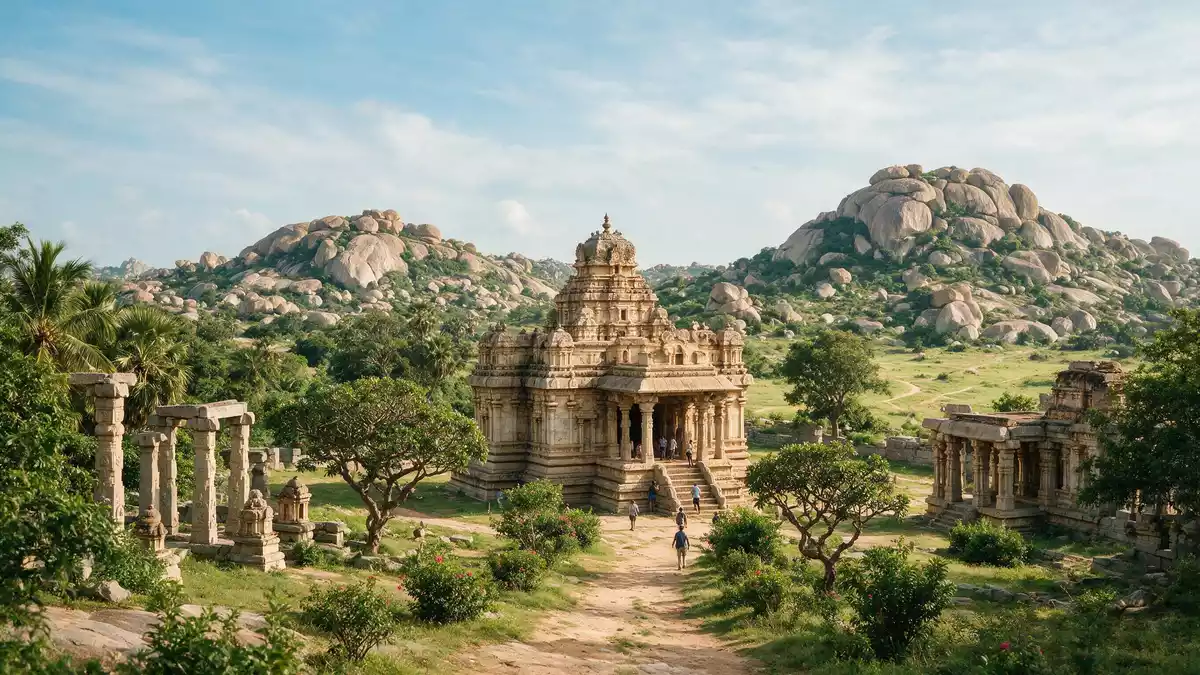
Hampi is a vast archaeological landscape in Karnataka, where granite boulders, temple towers and ruined avenues occupy the banks of the Tungabhadra. The remains belong to Vijayanagara, a southern Indian empire whose capital stood here from 1336 to 1565.
Granite boulders and the Tungabhadra
Hampi is read across a landscape rather than inside a single monument. Granite outcrops rise beside paths, shrines and open courtyards, while the Tungabhadra forms a natural edge to the historic settlement. The Group of Monuments at Hampi covers 4,187.24 hectares in the Tungabhadra basin of central Karnataka.Hampi’s UNESCO area
The boulder fields give the ruins their distinctive setting. Stone gateways, pillared halls and temple compounds appear between rocky ridges and cultivated ground. The landscape contains sacred buildings, royal structures, fortifications, waterworks and market spaces, with no single viewpoint explaining the whole city.
Vijayanagara’s capital in stone
Vijayanagara was founded in 1336 and became the capital of a powerful Hindu kingdom in southern India. Its monuments belong mainly to the fourteenth to sixteenth centuries, with Dravidian forms visible in gopurams, mandapas, carved pillars and temple enclosures.
Krishnadevaraya ruled from 1509 to 1530, a period associated with major royal and religious buildings at Hampi. The Virupaksha Temple remains an active place of worship, while the Vittala Temple is known for its sculpted stone chariot and elaborate pillared halls. The Lotus Mahal and Elephant Stables show a different architectural vocabulary within the royal area.Vijayanagara’s architectural remains
Temples, markets and waterworks
Hampi’s surviving structures reveal a city organised around religious, royal and public spaces. Long market streets lead towards temple gateways, and stepped tanks, channels and reservoirs remain among the visible elements of its urban fabric.
The Achyutaraya Temple stands beside a former bazaar, while the Hazara Rama Temple contains carved panels associated with the Ramayana. At the Royal Centre, the Queen’s Bath, underground chambers and audience buildings occupy a separate group of ruins. UNESCO inscribed Hampi as a World Heritage Site in 1986, recognising the remains of the Vijayanagara capital.Hampi’s World Heritage status
The city was conquered in 1565 and its capital functions ended. What remains is a dispersed record of imperial architecture, sacred practice and urban planning, set among granite formations and the Tungabhadra’s river landscape.Hampi’s historical setting
Visiting Hampi: what travellers from Western Europe should know
- Hampi lies in Karnataka, beside the Tungabhadra River. The nearest major rail connection is at Hosapete, with road links continuing towards the monument area.
- The site is spread across rocky ground, temple compounds and open paths. Uneven granite surfaces, exposed steps and strong heat make walking a central part of seeing the ruins.
- The historic area includes both active shrines and archaeological remains. Virupaksha Temple belongs to the living religious landscape, while royal buildings and market streets survive as ruins.
- The official language is Kannada and the currency is the Indian rupee.
- Entry requirements depend on your nationality; UK travellers can check the FCDO travel advice at gov.uk/foreign-travel-advice, Irish travellers the Department of Foreign Affairs at ireland.ie.
Searching for Hampi on social platforms
These links open searches for Hampi on each platform.Frequently asked questions about Hampi
Where is Hampi?
Hampi is in Karnataka, southern India, beside the Tungabhadra River. The ruins lie near Hosapete in the Vijayanagara district.
What can visitors see at Hampi?
The site includes temples, gopurams, pillared halls, royal buildings, market streets, waterworks and fortifications among granite boulders.
What makes Hampi distinctive?
Hampi combines the remains of a former imperial capital with an extensive granite landscape. Its temples and civic ruins occupy the same riverine setting as the boulder fields.


