
Harmandir Sahib and the shimmering pool at Amritsar
Published on 09/23/2026 at 19:45 | Editorial responsibility: Rafael Müller, Editor-in-Chief AD HOC NEWS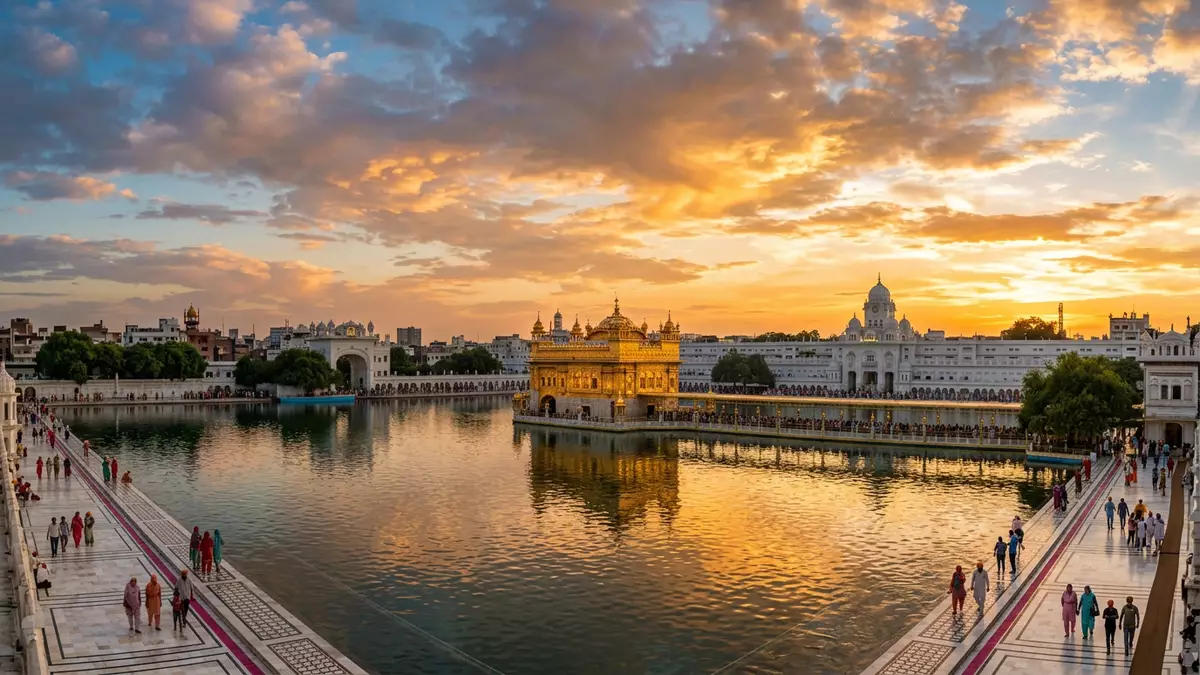
Harmandir Sahib stands within the Amrit Sarovar, the sacred pool at the centre of Amritsar. Its gilded upper storeys, white marble surfaces and low position beside the water create a landmark defined by reflection, colour and layered history.
Harmandir Sahib beside the Amrit Sarovar
The shrine occupies the middle of the pool, reached across a causeway from the surrounding complex. Water forms a continuous frame around the building, while the parikrama, the marble walkway encircling the sarovar, marks the edge of the sacred space.
The building has entrances on all four sides. This arrangement is a visible expression of welcome within Sikh religious architecture, and it remains central to the character of the complex. The shrine is a gurdwara, a Sikh house of worship, and the most important pilgrimage site in Sikhism.
Harmandir Sahib is lower than the surrounding walkway, so the approach descends towards the central sanctuary. The relationship between pool, marble platform, causeway and gilded façade gives the complex its recognisable composition. At night, the illuminated structure appears again in the dark surface of the Amrit Sarovar.
From Guru Arjan to Maharaja Ranjit Singh
The history of Harmandir Sahib is closely connected with the foundation of Amritsar. Guru Ram Das, the fourth Sikh Guru, established the settlement around the pool in the late sixteenth century. The city developed around this religious centre and became known as Amritsar.
Guru Arjan, the fifth Sikh Guru, supervised the construction of the central shrine. The foundation stone was laid in 1588, and the Adi Granth was installed inside Harmandir Sahib in August 1604. The scripture became the central focus of worship within the building.
The site passed through periods of destruction and rebuilding. The shrine was reconstructed by the eighteenth century, and its appearance changed substantially during the rule of Maharaja Ranjit Singh, founder of the Sikh Empire.
During the early nineteenth century, marble inlay, frescoes, mirror decoration and gilded copper panels were added to the complex. These layers brought together the white surfaces of the lower storeys and the gold-covered upper structure that shaped the shrine’s familiar appearance.
A meeting of Sikh, Mughal and Rajput forms
Harmandir Sahib combines features associated with Mughal and Rajput architecture. Its domes, arches, marble surfaces, painted decoration and metalwork belong to a visual language formed across Punjab and northern India.
The central building is compact beside the broad sarovar, yet its surfaces carry dense decoration. Marble panels contain inlaid patterns, while painted interiors and reflective details cover parts of the sanctuary. The gilded exterior is not the whole building: white marble, stone paving, carved elements and the surrounding water remain equally important.
The causeway leads directly towards the Darshani Deori and the sanctuary. The route passes through the sacred pool before reaching the central building, placing water and architecture within a single composition. The Akal Takht stands within the wider complex and represents an important centre of Sikh authority.
Harmandir Sahib is also a living place of worship. Recitation from the Guru Granth Sahib, devotional music and the movement around the parikrama belong to its religious function. The surrounding courtyards contain spaces associated with prayer, community service and the daily life of the gurdwara.
Visiting Harmandir Sahib: what travellers from Western Europe should know
- Harmandir Sahib is in the old city of Amritsar, Punjab, in north-western India. The complex lies near the historic streets around Atta Mandi and is reached through the city’s road, rail and local transport network.
- The central shrine is approached across a causeway and surrounded by the marble parikrama. The route includes changes of level, extensive walking and stairs in parts of the wider complex.
- Visitors enter a functioning Sikh place of worship. Head covering, removal of footwear and respectful clothing form part of the customary etiquette within the complex.
- The official language is Punjabi and the currency is the Indian rupee.
- Entry requirements depend on your nationality; UK travellers can check the FCDO travel advice at gov.uk/foreign-travel-advice, Irish travellers the Department of Foreign Affairs at ireland.ie.
Searching for Harmandir Sahib on social platforms
These links open searches for Harmandir Sahib on each platform.
Frequently asked questions about Harmandir Sahib
Where is Harmandir Sahib?
Harmandir Sahib is in Amritsar, Punjab, in north-western India. It occupies the centre of the Amrit Sarovar within the historic gurdwara complex.
What can visitors expect at Harmandir Sahib?
Visitors enter a functioning Sikh place of worship with a marble circumambulatory walkway, a causeway over the pool and devotional activity throughout the complex.
What makes Harmandir Sahib distinctive?
The shrine combines a central position within a sacred pool with gilded upper storeys, white marble decoration and entrances on all four sides.


