
Heiwa Koen in Nagasaki, a landscape of remembrance and peace
Published on 08/16/2026 at 14:56 | Editorial responsibility: Rafael Müller, Editor-in-Chief AD HOC NEWS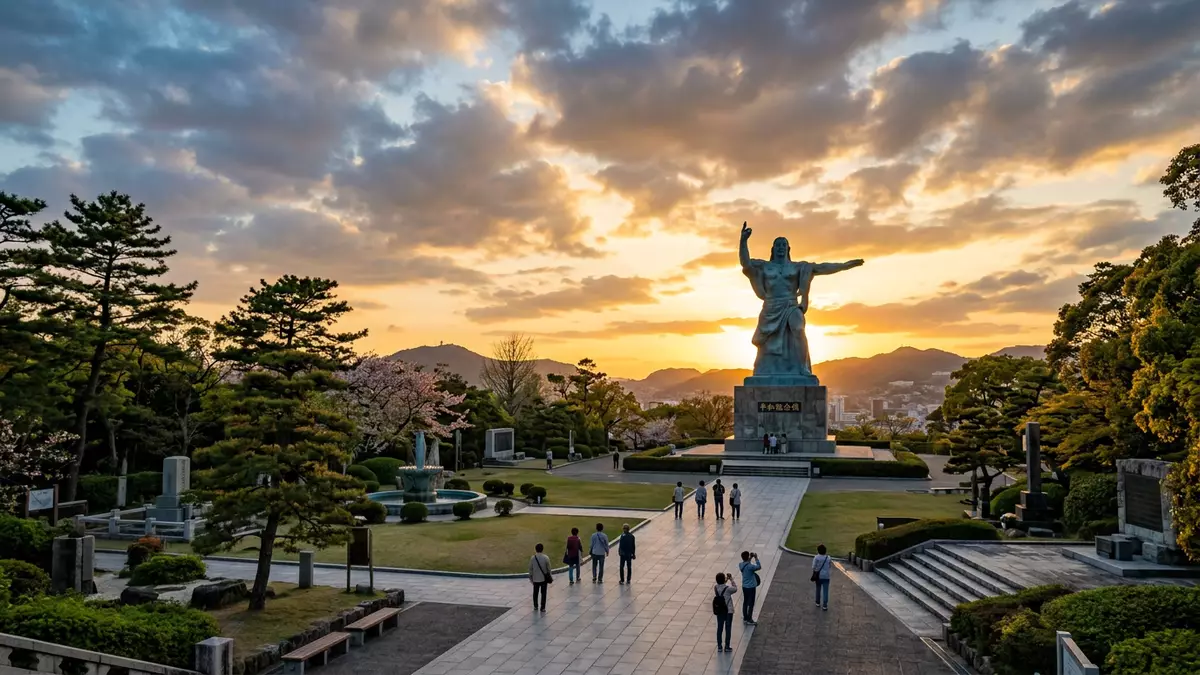
Heiwa Koen in Nagasaki is a landscaped memorial park that marks the area devastated by the atomic bombing of 9 August 1945 and turns it into a space for reflection on peace. Set on a low hill in the Urakami district north of the historic centre, the park is structured around monuments, water and open lawns rather than formal graves, creating a place where the weight of history is carried by shapes in the landscape.
The Peace Statue and the main memorial terrace
The upper part of Heiwa Koen is dominated by the Peace Statue, a large bronze figure seated on a stone base at the end of a rectangular terrace. Designed by sculptor Kitamura Seib? and unveiled in 1955, this statue has become the most recognised symbol of the park and of Nagasaki’s appeal for nuclear disarmament.Kitamura Seib?’s Peace Statue Around the statue, paved walkways frame planted lawns and flower beds, with steps leading up from the surrounding paths to the main viewing area.
Directly facing the Peace Statue stands the Fountain of Peace, a broad basin edged by stone where water rises and falls in repeating patterns. The fountain was completed in 1969 and its flowing water is described as a memorial to the thirst of the bombing victims and the tears shed for them.The Fountain of Peace Together, the statue and fountain form a clear axis in the upper park: a long open plaza aligned between bronze, water and the distant city, with international peace monuments arranged around it.
International sculptures and the Peace Symbol Zone
Heiwa Koen is not a single monument but a collection of memorials distributed through lawns, trees and paved paths. One of its defining areas is the Peace Symbol Zone, a garden-like section where sculptures donated from countries around the world stand among planting. Each contribution reflects the donor nation’s interpretation of peace, ranging from abstract stone forms to figurative works in bronze or steel.Peace Symbol Zone sculptures The arrangement encourages slow movement: paths branch between the works, benches are placed at intervals and mature trees cast shade over the grass.
The park’s international character sits alongside very local elements. Monuments from Nagasaki’s own organisations and survivor groups stand beside the global sculptures, forming a mosaic of memorial stones and plaques across the site.Statues and monuments commemorating the bombing This combination of global and local memorials gives Heiwa Koen a layered appearance: between stretches of grass, clusters of stone markers and statues rise at different scales, with planting softening the edges of each small enclave.
The hypocentre, atomic bomb museum and surrounding city
South of the main terrace, Heiwa Koen merges into a smaller landscaped area that marks the hypocentre of the atomic explosion. Here, a black granite monument indicates the point above which the bomb detonated, and fragments of structures damaged by the blast are arranged as exhibits around it.Granite monument at the hypocentre This section is lower than the Peace Statue plaza and forms a quieter counterpart, where lawns and trees surround the central marker.
Close to the park stands the Nagasaki Atomic Bomb Museum, housed in a modern building that presents documents, photographs and artefacts related to the bombing.Complex of two parks and the Nagasaki Atomic Bomb Museum The museum, hypocentre area and Peace Statue terrace together form a continuous memorial landscape in Matsuyama-cho. From the higher paths, visitors see residential districts of Urakami and parts of the wider city beyond the trees, a reminder that Heiwa Koen occupies ordinary urban ground as well as symbolic terrain.
Visiting Heiwa Koen: what travellers from Western Europe should know
- Heiwa Koen lies in the Matsuyama-cho area of Nagasaki, north of the historic city centre. It is reached by local tram and bus services, including stops named Peace Park (Heiwa Koen) close to the entrances.
- The park extends over a low hill, with flights of steps linking the main terrace, side paths and the hypocentre area. Some routes involve uphill walking on paved slopes and stairways.
- The official language is Japanese and the currency is the yen.
- Entry requirements depend on your nationality; UK travellers can check the FCDO travel advice at gov.uk/foreign-travel-advice, Irish travellers the Department of Foreign Affairs at ireland.ie.
Searching for Heiwa Koen on social platforms
These links open searches for Heiwa Koen on each platform.
Frequently asked questions about Heiwa Koen
Where is Heiwa Koen located in Nagasaki?
Heiwa Koen is in the Matsuyama-cho area of Nagasaki, on a low hill in the Urakami district north of the traditional city centre.
What should visitors expect when walking through the park?
Visitors move between lawns, memorial statues, fountains and stone markers along paved paths and steps, with the Peace Statue terrace and hypocentre monument as focal points.
What makes Heiwa Koen distinctive among war memorials?
The combination of Kitamura Seib?’s Peace Statue, the Fountain of Peace, international sculpture donations and the nearby atomic bomb museum creates a continuous memorial landscape within an ordinary urban neighbourhood.


