
Heng Shan and the granite peaks of sacred Hunan
Published on 09/24/2026 at 00:55 | Editorial responsibility: Rafael Müller, Editor-in-Chief AD HOC NEWS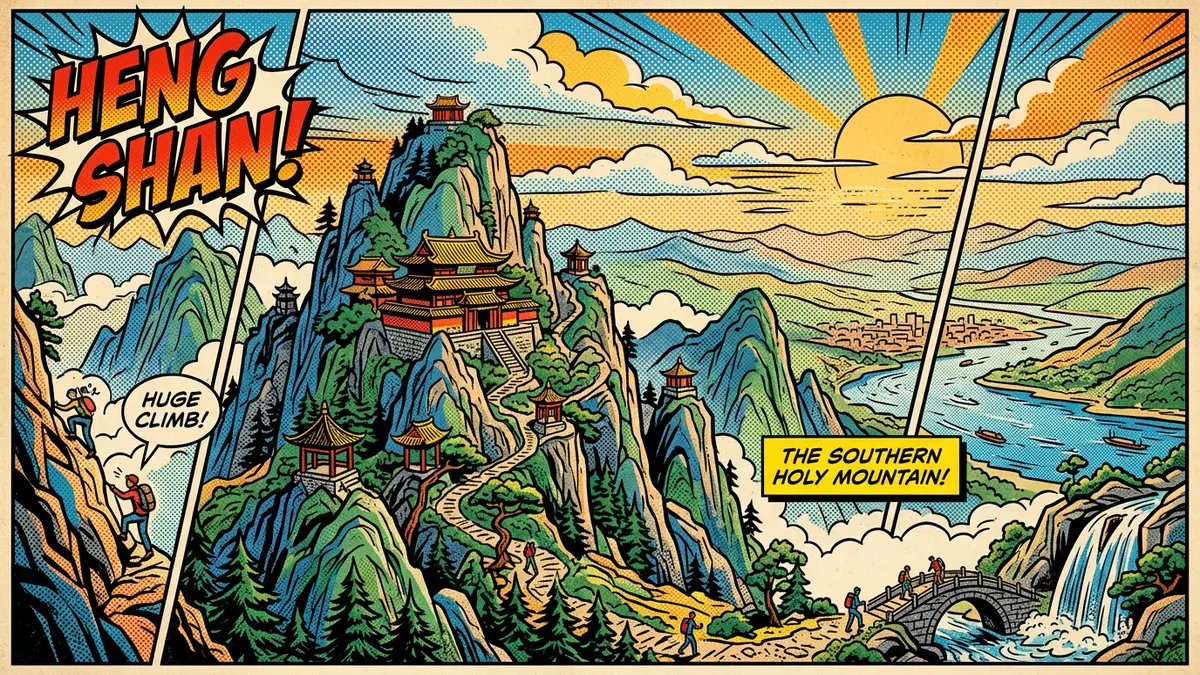
Heng Shan rises above Hengyang in Hunan as a granite mountain range whose ridges carry temples, shrines and paths towards Zhurong Peak. Known in Chinese tradition as Nanyue, or the Southern Mountain, it forms the southern member of China’s Five Great Mountains. The landscape joins a 1,300 m (4,265 ft) summit with a religious history reaching back to the Zhou dynasty.
Heng Shan: granite ridges around Zhurong Peak
Heng Shan extends through southern Hunan between Hengyang and Changsha. Its range is described as about 150 km (93 mi) long, with Zhurong Peak as its highest summit at roughly 1,300 m (4,265 ft) above sea level. The mountain lies west of the Xiang River, and its slopes form the central landscape of Nanyue District in Hengyang.
Granite forms much of the mountain’s underlying rock. Forested slopes rise through a humid subtropical landscape, while streams and lakes on the northeastern, eastern and southeastern sides drain towards the Xiang River. The mountain range includes named peaks such as Huiyan Peak, Zhurong Peak and Yuelu Mountain, linking the Hengyang area with the hills near Changsha. Mount Heng’s recorded dimensions include its 1,300.2-metre summit and broad mountain area.
Nanyue and the religious geography of the mountain
Heng Shan is the southern mountain in the traditional group of Five Great Mountains. The other sacred mountains are associated with the east, west, north and centre of the Chinese cultural landscape. Heng Shan’s title Nanyue identifies its position as the southern peak within that system.
Religious activity on Heng Shan includes Taoist and Buddhist traditions, alongside local practices connected with the mountain deity Zhu Rong. Zhu Rong is associated with fire in ancient Chinese mythology and remains central to the identity of the mountain. The range contains temples, monasteries and ritual places scattered across its slopes and foothills.
Written references connect Heng Shan with classical Chinese literature, including the Shijing, or Book of Songs, and the Erya. The mountain’s sacred associations are traditionally dated to the Zhou dynasty, a historical period spanning the eleventh to third centuries BC. Taoist practice on Heng Shan is also recorded during the Han dynasty, which began in 206 BC.
Nanyue Temple and the buildings at the southern foot
Nanyue Temple stands at the southern foot of Heng Shan in Nanyue District. Its red walls, axial arrangement and rows of halls give the complex a formal architectural presence within the mountain landscape. The temple was built in the Tang dynasty and has been reconstructed and extended across its long history.
The complex covers a large rectangular precinct and contains halls, gates and courtyards arranged along a central axis. Its architecture is associated with imperial temple traditions, while its religious life connects the mountain with Taoism, Buddhism and local belief. Nanyue Temple at Heng Shan forms the principal historic building group at the mountain’s foot.
Higher on the mountain, Shangfeng Temple stands near Zhurong Peak. South Heaven Gate marks a prominent point on the route towards the summit. The Sarira Tower rises at Ruiying Peak, while Chuanyanshilin contains natural holes in crags connected by stone paths. These places combine built religious monuments with granite formations and wooded slopes.
Visiting Heng Shan: what travellers from Western Europe should know
- Heng Shan lies in Nanyue District of Hengyang City, Hunan Province. The mountain area is reached through Hengyang, with the Xiang River forming a major regional reference point.
- The ascent includes stone paths, stairs and steep mountain sections. Zhurong Peak reaches about 1,300 m (4,265 ft), and routes pass through forest, exposed rock and temple precincts.
- Nanyue Temple stands at the southern foot, while South Heaven Gate and Shangfeng Temple lie higher on the mountain near the route towards Zhurong Peak.
- The official language is Mandarin Chinese and the currency is the renminbi.
- Entry requirements depend on your nationality; UK travellers can check the FCDO travel advice at gov.uk/foreign-travel-advice, Irish travellers the Department of Foreign Affairs at ireland.ie.
- Conditions on the mountain change with the seasons; the local cable-car operators and alpine clubs provide information.
Searching for Heng Shan on social platforms
These links open searches for Heng Shan on each platform.
Frequently asked questions about Heng Shan
Where is Heng Shan?
Heng Shan is in Hunan Province, central-southern China, within Hengyang City’s Nanyue District. The mountain lies west of the Xiang River and extends towards Changsha.
What can visitors expect on Heng Shan?
The mountain combines forested granite slopes, stone paths, stairs, temples and summit routes. Nanyue Temple stands at the southern foot, while higher sites include South Heaven Gate and Shangfeng Temple.
What makes Heng Shan distinctive?
Heng Shan is the southern member of China’s Five Great Mountains and carries the name Nanyue. Its 1,300 m (4,265 ft) summit, granite ridges and Taoist and Buddhist heritage occupy one connected landscape.


