
Heng Shan in Hengyang, China’s southern sacred mountain of granite peaks
Published on 09/01/2026 at 18:24 | Editorial responsibility: Rafael Müller, Editor-in-Chief AD HOC NEWS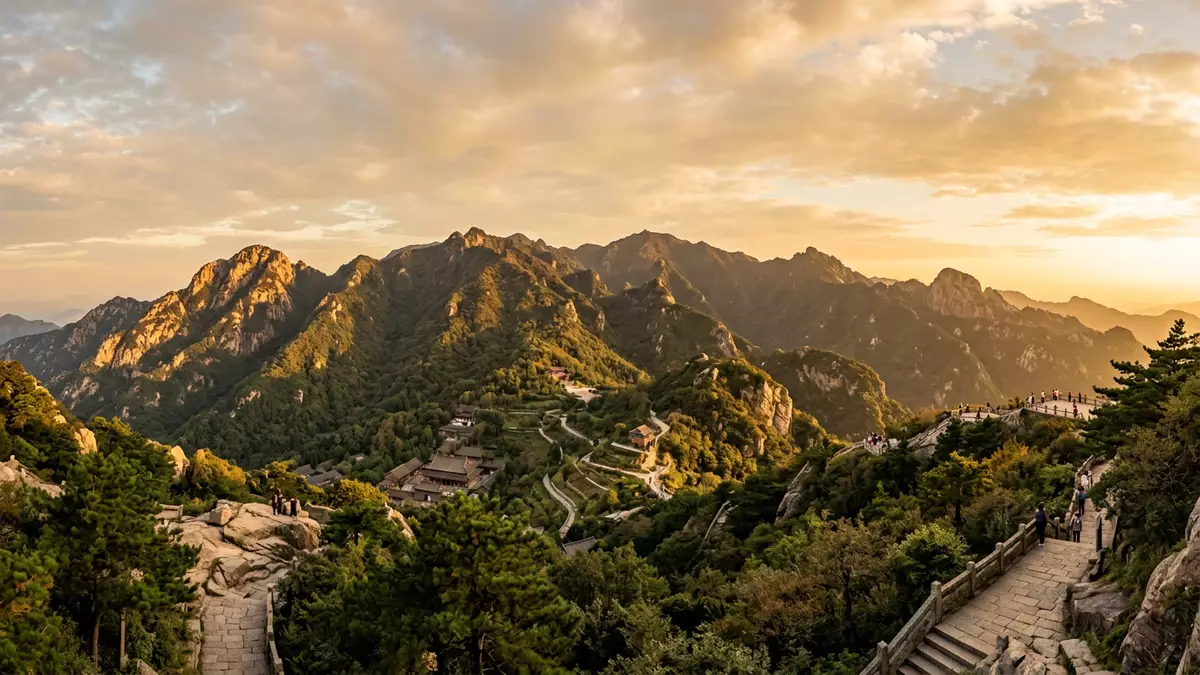
Heng Shan near Hengyang in Hunan Province rises as a long granite mountain range where sacred peaks, stone stairways and temple courtyards share one continuous landscape. It is known in Chinese as Nanyue, the Southern Mountain, and forms the southern member of the traditional Five Great Mountains of China, a group of sites associated with state ritual and pilgrimage.
Granite ridges and the long mountain range
Heng Shan is a mountain range in south-central Hunan that stretches between the lowlands around Hengyang and the hills towards Changsha. The range is conventionally described as running for about 150 km (93 mi), forming a chain of peaks and ridges that rise clearly above the surrounding basins.chain of 72 peaks Geographers and local descriptions describe 72 named summits within this range, which gives Heng Shan a broad footprint and a sense of progression as travellers move from one sector to another.mountain range 150 kilometres long
The highest point in the Heng Shan range is Zhurong Peak, which rises to about 1,300 m (4,265 ft) above sea level and forms the focus of many summit walks and viewpoints.altitude of 1,300.2 metres The lower slopes and foothills contain smaller peaks such as Huiyan Peak, which is often mentioned as the first summit encountered when climbing from the main access area at Nanyue.Huiyan Peak is the first mountain peak Together, these peaks create a layered terrain of granite outcrops, forested ridges and stepped paths.
Nanyue Temple and the built sacred landscape
At the foot of Heng Shan stands Nanyue Temple, a major religious complex that anchors the mountain in both architectural and ritual terms.biggest temple in southern China The temple grounds, located in Nanyue District of Hengyang City, comprise extensive courtyards, halls and side buildings aligned along an axial layout, with gateways framing views towards the mountain slopes behind. The complex is recognised as the largest group of ancient buildings in Hunan Province, and its scale reflects the status of Heng Shan within Chinese religious geography.
Beyond Nanyue Temple, smaller temples, pavilions and shrines appear on terraces and shoulders of the mountain. Paths and stairways link these built elements to the main complex and to each other, so that a visit becomes a sequence of moves between stone architecture and wooded slopes. Taoist and Buddhist traditions are both present here, with long-established sites of worship distributed along the range and around the principal peaks.mountain sacred to Taoists From the courtyards at Nanyue Temple up to summit shrines near Zhurong Peak, the sacred landscape of Heng Shan is composed of both the granite forms of the mountain and the built fabric of its religious sites.
Five Great Mountains and cultural significance
Heng Shan is counted as the southern member of China’s traditional Five Great Mountains, a group known collectively as Wuyue and associated with imperial ritual and long-distance pilgrimage routes.one of the famous mountains Wuyue In this system, Heng Shan represents the south, complementing other mountains that mark the east, west, north and centre. This position has given the range a prominent role in ceremonial journeys and seasonal observances over generations, with rulers and officials travelling to Nanyue for offerings and formal rites.
The mountain’s religious importance is reinforced by its association with specific deities and cults. Zhurong Peak takes its name from Zhurong, a fire deity honoured in Chinese tradition, and the summit area includes sites linked to this figure.principal summit named after Zhurong The combination of Taoist sacred status, Buddhist temples and local cults means that Heng Shan’s paths and halls have carried layered forms of devotion across different periods. In parallel, its granite ridges and forest cover have made it a destination for walking beyond strictly religious travel, with summit routes, ridge traverses and shorter climbs around the Nanyue area.
Visiting Heng Shan: what travellers from Western Europe should know
- Heng Shan lies in Hunan Province in south-central China, with the main scenic and temple area around Nanyue Town in Nanyue District of Hengyang. The principal gateway for visits is the Nanyue area at the foot of the mountain.
- The terrain on Heng Shan combines long flights of stone steps, forested slopes and higher sections at over 1,000 m (3,281 ft), so visiting often involves sustained climbing on stepped paths and walking across uneven ground.
- Nanyue District is administered as part of Hengyang City, and Heng Shan also extends into nearby Hengshan and Hengdong counties, forming a continuous range between the Hengyang and Xiangtan basins.
- The official language is Chinese and the currency is the yuan (CNY).
- Entry requirements depend on your nationality; UK travellers can check the FCDO travel advice at gov.uk/foreign-travel-advice, Irish travellers the Department of Foreign Affairs at ireland.ie.
Searching for Heng Shan on social platforms
These links open searches for Heng Shan on each platform.
Frequently asked questions about Heng Shan
Where is Heng Shan located?
Heng Shan lies in Hunan Province in south-central China, with its main scenic and temple area around Nanyue Town in Nanyue District of Hengyang City.
What should visitors expect on a visit to Heng Shan?
A visit to Heng Shan combines extensive temple architecture at Nanyue Temple with long stairways, forested slopes and summit trails on a granite mountain range that includes peaks such as Zhurong Peak.
What makes Heng Shan distinctive among China’s mountains?
Heng Shan is recognised as the southern mountain in the traditional Five Great Mountains of China, bringing together a long granite range, major religious complexes and a system of peaks described as numbering 72.


