
Hierve el Agua and its petrified waterfalls above the Oaxaca valleys
Published on 09/17/2026 at 10:45 | Editorial responsibility: Rafael Müller, Editor-in-Chief AD HOC NEWS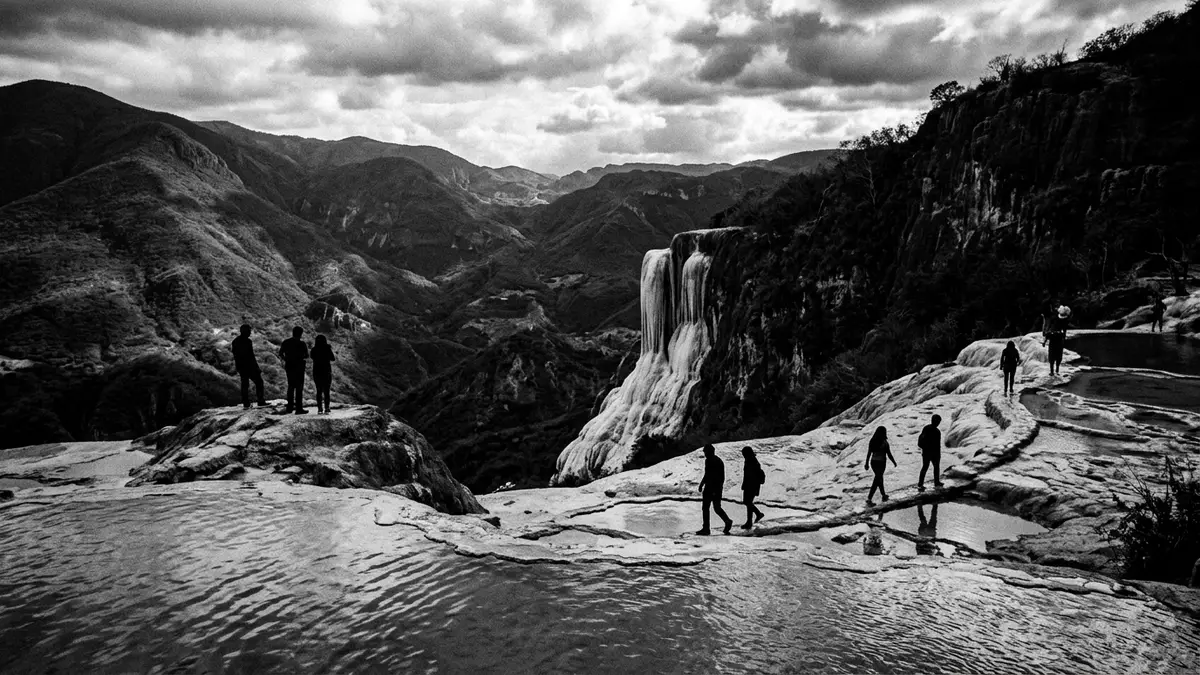
High in the mountains of Oaxaca, Hierve el Agua is a cliff?edge plateau where mineral springs have built vast petrified waterfalls that seem frozen in mid?flow above a broad valley in Mexico. The name, Spanish for “the water boils”, refers to the way the spring water appears to bubble from the ground before it spills towards the precipice as pale mineral?rich streams.
Petrified waterfalls on a mountain shelf
Hierve el Agua lies in the municipality of San Lorenzo Albarradas in Oaxaca state, on a natural shelf cut into the flank of the Sierra Norte mountains east of Oaxaca City, looking out across cultivated valleys and rounded ridges.San Lorenzo Albarradas in Oaxaca The site is built around a series of mineral springs that reach the surface close to the cliff edge and feed shallow pools before overflowing across the drop. As the water descends it leaves behind calcium carbonate and other minerals, gradually building thick white and cream deposits that hang from the escarpment like great curtains of stone.
The two best known formations, locally called Cascada Grande and Cascada Chica, extend from near?vertical cliffs so that they read from a distance as pale waterfalls paused in motion.Cascada Grande and Cascada Chica Cascada Grande is the larger of the pair, dropping tens of metres from the plateau in a broad fan of mineral deposits, while Cascada Chica forms a shorter, more compact cascade on an adjacent section of cliff. From lower paths on the slope below, the formations appear as bands of almost white rock against darker mountain stone, emphasising how the mineral water has carved its own vertical route down the face.
Travertine pools and mineral springs
The same springs that feed the petrified waterfalls also form a series of travertine pools along the edge of the plateau, where mineral?rich water gathers before continuing towards the drop.mineral springs on the cliff Some pools are rimmed by low, rounded walls built up over time by the constant deposition of minerals at the waterline, producing basins with a gentle lip that separates them from the surrounding rock. The water that emerges at the springs is not scalding despite the site’s name; its temperature sits close to the warmth of a mild bath, and gases bubbling through the surface give it the appearance of boiling without the heat.
As the water trickles over the plateau and towards the edge, it follows channels etched into the rock by earlier flows, so that older deposits provide the routes for newer films of water.calcium carbonate and magnesium deposits Evaporation leaves behind successive layers of calcium carbonate and magnesium, producing surfaces that resemble cave formations transposed into the open air. The result is a landscape where liquefied minerals, flowing over many generations, have sculpted both the vertical cascades and the horizontal terraces into a single coherent structure of pale, textured stone.
Landscape setting above the Oaxaca valleys
Hierve el Agua stands at an elevation of around 1,500 m (4,921 ft) in the Sierra Norte, giving it a broad vantage across fields, scrub and distant peaks in Oaxaca.about 70 kilometres east of Oaxaca City The plateau itself is stepped, with flat areas near the springs and steeper sections dropping away towards the valley floor. Paths lead from the upper pools along the cliff edge and then descend towards lower viewpoints, where the petrified waterfalls can be seen in profile against the open landscape. The underlying rock is karstic limestone, shaped by water over long periods, and the mineral formations of Hierve el Agua sit like additional layers draped over this older geological structure.karstic limestone beneath the falls
The wider setting belongs to the mountains east of Oaxaca de Juárez, where valleys open between ridges and agricultural plots climb the slopes in patches of green and brown. From the upper pools, the view stretches along the valley that runs below the cliff and out towards further mountain chains, so that the petrified cascades appear both anchored to the rock and suspended above the landscape. The contrast between the pale mineral surfaces and the darker, vegetation?covered slopes around them gives Hierve el Agua a visual character that is strongly tied to its location rather than to any built structure.
Visiting Hierve el Agua: what travellers from Western Europe should know
- Hierve el Agua lies east of Oaxaca City in the municipality of San Lorenzo Albarradas, reached by road through Mitla and mountain villages to the plateau above the valley.
- The terrain around the petrified waterfalls includes steep paths, rocky ground and sections of narrow track descending from the upper pools to viewpoints below the cliffs.
- The region belongs to the mountains of southern Mexico, where weather can vary with altitude; sun exposure on the open plateau contrasts with more sheltered sections on the descent.
- The official language is Spanish and the currency is the Mexican peso.
- Entry requirements depend on your nationality; UK travellers can check the FCDO travel advice at gov.uk/foreign-travel-advice, Irish travellers the Department of Foreign Affairs at ireland.ie.
Searching for Hierve el Agua on social platforms
These links open searches for Hierve el Agua on each platform.
Frequently asked questions about Hierve el Agua
Where is Hierve el Agua located?
Hierve el Agua is in the municipality of San Lorenzo Albarradas in Oaxaca state, in the mountains east of Oaxaca City in southern Mexico.
What should visitors expect on a visit?
Visitors encounter travertine pools fed by mineral springs, steep paths along and below cliff edges and wide views across valleys framed by the petrified waterfalls.
What makes Hierve el Agua distinctive?
Hierve el Agua is distinctive for its twin cascades, Cascada Grande and Cascada Chica, where mineral deposits have built formations that resemble waterfalls solidified into pale stone.


