
Highclere Castle and its Jacobethan silhouette near Newbury
Published on 09/21/2026 at 06:34 | Editorial responsibility: Rafael Müller, Editor-in-Chief AD HOC NEWS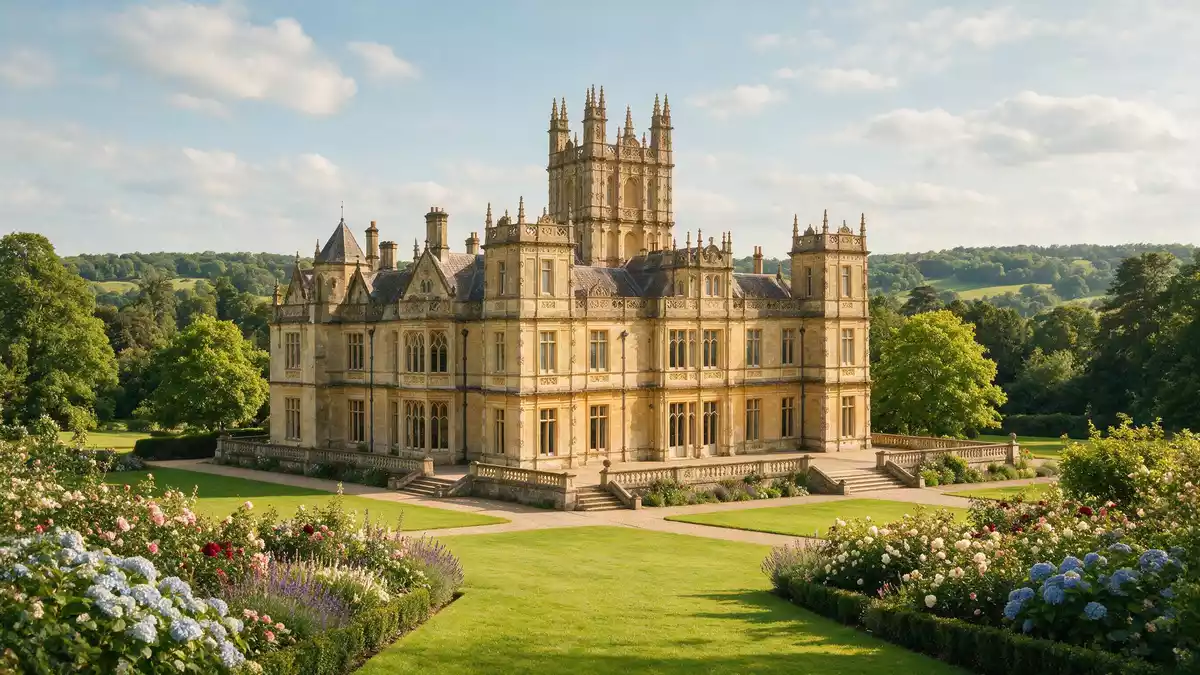
Highclere Castle near Newbury in southern England is a Victorian Jacobethan country house set within extensive parkland on land with medieval roots. The mansion is the seat of the Earls of Carnarvon and took on its present form in the nineteenth century under the architect Sir Charles Barry.
A Victorian Jacobethan mansion in the English countryside
Highclere Castle stands a short distance south of Newbury, in the county of Hampshire close to the North Wessex Downs, forming a prominent country house above open pasture and woodland. The building is a Grade I listed country house, recognised for its architectural interest and historic importance within England’s heritage.Grade I listed country house The estate extends over thousands of acres, with the main house approached through sweeping drives that reveal its full height and intricate skyline.
The exterior is characterised by Bath stone ashlar walls and strong vertical lines that rise to a central tower and a forest of pinnacles along the roofline. Historic England’s architectural record describes Highclere as an experiment in Elizabethan and Tudor forms, refaced by Sir Charles Barry into elevations reminiscent of Wollaton Hall in Nottingham.Elizabethan elevations in the style of Wollaton The overall effect is a Jacobethan or neo-Elizabethan mansion, combining symmetry, gables, towers and elaborate stone carving.
From bishops’ estate to the seat of the Earls of Carnarvon
The land at Highclere entered written history in the eighth century, when it formed part of a larger estate known as Clere that was granted to the Bishops of Winchester.estate called Clere gifted in 749 By the medieval period a bishop’s palace stood in the area, marking Highclere as a significant ecclesiastical holding. In the seventeenth century the site shifted into secular hands when Sir Robert Sawyer, Attorney General to Charles II and James II, acquired the property and rebuilt the existing house as Highclere Place House.rebuilt as Highclere Place House by Sir Robert Sawyer His descendants became the Herbert family, later ennobled as the Earls of Carnarvon.
During the eighteenth century the house evolved into a three-storey Georgian mansion, and the surrounding parkland was shaped in line with a design by the celebrated landscape architect Capability Brown, who worked at Highclere in the 1770s.park laid out by Capability Brown In the nineteenth century Henry Herbert, 3rd Earl of Carnarvon, commissioned Sir Charles Barry, already renowned for co-designing the Houses of Parliament in London, to remodel the existing house completely. By the middle of that century Barry’s transformation had given Highclere its present Jacobethan appearance, with the central tower and enriched skyline recognisable in film and television adaptations set at the castle.remodelled in the Elizabethan or Jacobethan style
Architecture, interiors and landscape
The architectural composition of Highclere Castle centres on a broad, rectangular block organised around a top-lit central hall, reflecting Barry’s interest in balanced plans and grand circulation spaces.three-storeyed country house arranged round a central top-lit hall The elevations express this arrangement through regular bays, projecting sections and the dominant tower that marks the main frontage. Internally, the principal rooms open off the central hall and staircase, creating sequences suited to large gatherings, while service corridors and secondary staircases reflect Victorian concerns with separating household work from reception spaces.
The house sits within an estate of around 5,000 acres (2,000 hectares), combining formal gardens with broad parkland and agricultural land.estate of 5,000 acres Capability Brown’s eighteenth-century landscape design introduced sweeping lawns, clumps of trees and serpentine drives, framing the castle as the visual focus of the wider scene. Near the house, terraces and planting create a transition between architecture and park, while views from the upper levels reach towards the surrounding downs. The relationship between the Jacobethan stonework and the rolling landscape gives Highclere Castle much of its character as a stately home rooted in both architectural ambition and long-established countryside.
Visiting Highclere Castle: what travellers from Western Europe should know
- Highclere Castle stands south of Newbury in Hampshire, with access by road through the village of Highclere from routes that link Newbury with Andover and the North Wessex Downs.
- The approach to the house involves walking through parkland and gravel paths, and visitors encounter staircases inside the mansion, including long flights between the principal floors.
- The estate lies among gentle hills; views from the grounds take in pasture and woodland that form part of the wider North Wessex Downs landscape.
- The Vereinigtes Königreich is England; the official language is English and the currency is the pound sterling.
Searching for Highclere Castle on social platforms
These links open searches for Highclere Castle on each platform.
Frequently asked questions about Highclere Castle
Where is Highclere Castle located?
Highclere Castle stands near the village of Highclere in Hampshire, a few miles south of Newbury, on the northern edge of the North Wessex Downs.
What should visitors expect on a visit?
Visitors encounter a large Victorian Jacobethan mansion with formal interiors, expansive parkland shaped by Capability Brown and views across a long-established English estate landscape.
What makes Highclere Castle distinctive?
The combination of Sir Charles Barry’s neo-Elizabethan architecture, the Grade I listed status and the historic estate landscape gives Highclere Castle a distinctive character among English country houses.


