
Hopewell Rocks and the tides that reshape a New Brunswick shore
Published on 08/30/2026 at 14:52 | Editorial responsibility: Rafael Müller, Editor-in-Chief AD HOC NEWS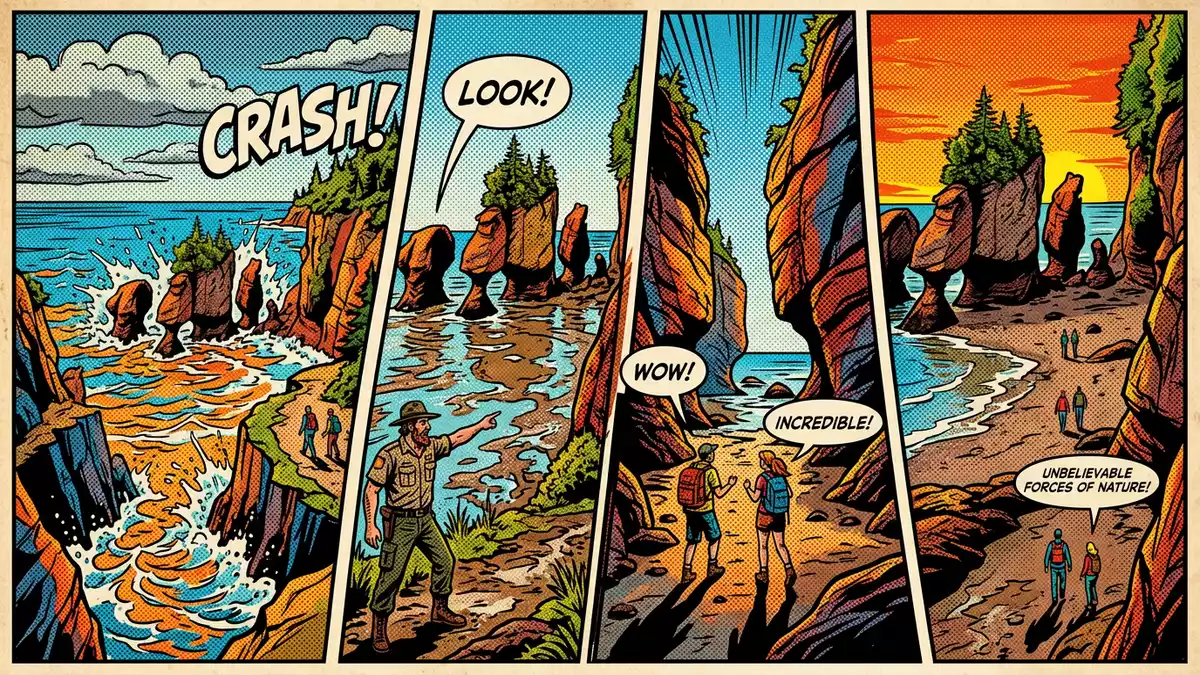
Hopewell Rocks at Hopewell Cape in New Brunswick is a shoreline where the Bay of Fundy’s huge tides carve sandstone cliffs into tall sea stacks and periodically expose the sea floor. The formations stand along the upper reaches of the bay, in a provincial park that focuses on the dramatic contrast between low and high tide.
Sea stacks called the Flowerpot Rocks
The rock pillars at Hopewell Cape are widely known as the Flowerpot Rocks, a name that reflects the vegetation rooted in the tops of many of the formations.Flowerpot Rocks They rise from a shore of mudflat and shingle where the upper Bay of Fundy narrows, concentrating the tidal range along this stretch of coast.upper shores of the Bay of Fundy
Each stack is an isolated column of rock separated from the adjacent cliffs by prolonged erosion. Seen from the main viewpoints on the clifftop, the pillars form a scattered group along a curved section of coast, with distinct profiles that include narrow necks and broader caps supporting trees and shrubs.
Geology shaped by a vast tidal range
The formations belong to the Hopewell Cape Formation, a Lower Carboniferous sequence made up mainly of reddish-brown conglomerate and sandstone with some mudstone layers.red-brown sedimentary conglomerate This rock unit is part of the Mabou Group, a wider set of sedimentary deposits laid down in the Carboniferous period when rivers and lakes occupied this part of what is now Atlantic Canada.Hopewell Cape Formation
At Hopewell Rocks the Bay of Fundy’s extreme tidal range repeatedly submerges and exposes the base of the cliffs, eroding the lower sections more quickly than the upper parts and accentuating the overhanging caps. In combination with glacial and weathering processes this has produced the group of sea stacks now seen along the shore, with their characteristic contrast between slender bases and broader tops.
Walking the ocean floor and watching the tide return
When the tide is low, long flights of wooden stairs lead from the clifftop paths down to the beach, where a broad expanse of exposed seabed surrounds the rock pillars. Visitors can walk between the stacks on firm sections of the sea floor, with the cliffs rising behind and the main body of the bay stretching away beyond the formations.walk on the ocean floor
As the water returns, the lower parts of the rocks gradually disappear until the stacks stand as islands in a flooded inlet. The difference between exposed mudflat and high-water shoreline is one of the strongest impressions of a visit, and it has made Hopewell Rocks a place closely associated with the Bay of Fundy’s very large tides.very large tides of the Bay of Fundy
Visiting Hopewell Rocks: what travellers from Western Europe should know
- Hopewell Rocks lies on the coast of New Brunswick at Hopewell Cape, on the shores of the upper Bay of Fundy, reached by road along provincial routes from Moncton and other nearby towns.
- Access from the visitor area leads along forested clifftop paths with viewpoints and down stairways to the sea floor, so visiting the shore involves long flights of steps and walking on uneven, sometimes muddy ground.
- The surrounding coastline includes other Fundy attractions such as Fundy National Park and the Fundy Trail, which stand along the same stretch of shoreline as Hopewell Cape.
- The official language in this part of Canada is English and the currency is the Canadian dollar.
- Entry requirements depend on your nationality; UK travellers can check the FCDO travel advice at gov.uk/foreign-travel-advice, Irish travellers the Department of Foreign Affairs at ireland.ie.
Searching for Hopewell Rocks on social platforms
These links open searches for Hopewell Rocks on each platform.
Frequently asked questions about Hopewell Rocks
Where are Hopewell Rocks?
Hopewell Rocks stands on the Bay of Fundy shoreline at Hopewell Cape in the Canadian province of New Brunswick, within a provincial park.
What can visitors expect to see?
Visitors see tall sea stacks known as the Flowerpot Rocks, forested clifftops with viewing platforms, and a wide stretch of exposed sea floor at low tide.
What makes Hopewell Rocks distinctive?
The combination of Carboniferous sandstone pillars, vegetation-topped “flowerpots” and the Bay of Fundy’s dramatic tidal range gives Hopewell Rocks a striking, repeatedly changing shoreline scene.


