
Huacachina, the desert lagoon of Ica
Published on 09/21/2026 at 17:34 | Editorial responsibility: Rafael Müller, Editor-in-Chief AD HOC NEWS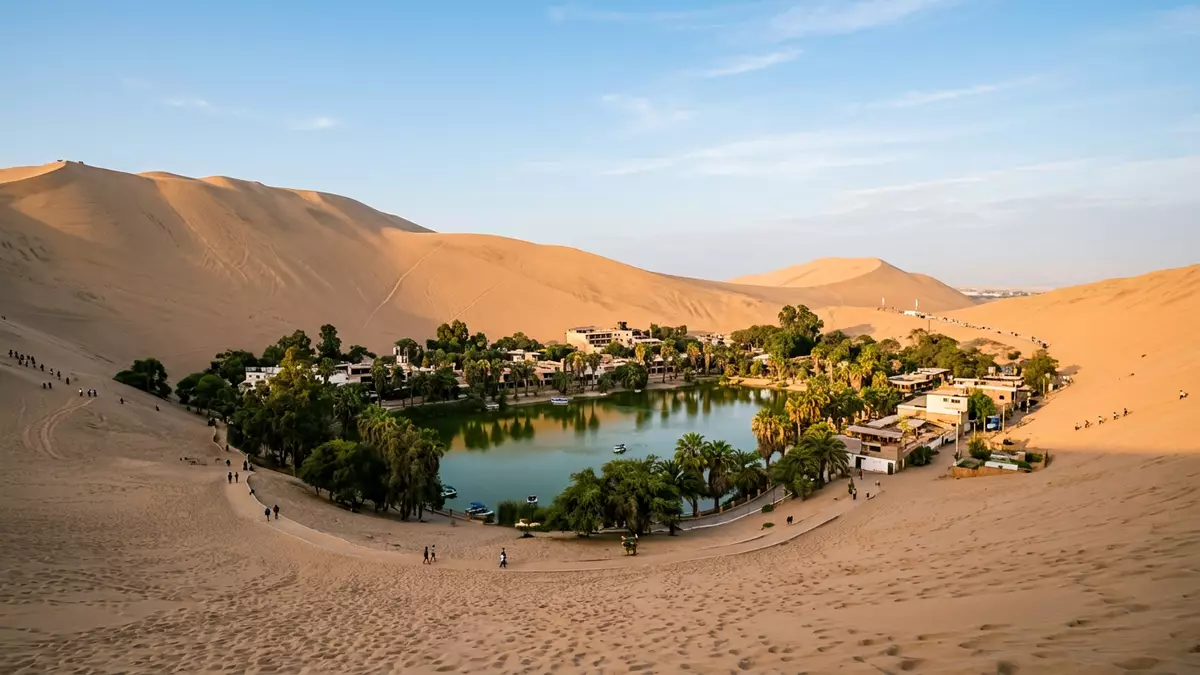
Huacachina is a compact oasis village west of Ica in southern Peru, gathered tightly around a natural lagoon and enclosed on all sides by high sand dunes. The basin’s green water, palms and low buildings sit in striking contrast to the steep walls of sand that rise directly behind them, making the relationship between water and desert the defining experience of the place.
An oasis village in the coastal desert
Huacachina lies a few kilometres from the city of Ica in southwestern Peru, on the inland edge of the country’s coastal desert belt. The settlement occupies the floor of a shallow depression, with the lagoon at its centre and a ring of streets and small structures pressed between the shore and the encircling dunes.Located in southwestern Peru The wider region lies near the boundary of the Atacama Desert, one of the driest landscapes on earth, which makes the presence of a permanent body of water here especially notable.
The lagoon is a small natural desert lake that has long been known locally as the “Oasis of America”, a name now used widely in tourism material.Oasis of America Official Peruvian tourism inventories describe the water as having an emerald-green colour, framed by vegetation and simple piers for pedal boats.Emerald-green lagoon Around the lake, narrow streets and low-rise accommodation complete a village whose permanent population is small but whose identity is closely tied to the surrounding desert.
Sand dunes, lagoon and legend
The most immediate feature of Huacachina is the steep sand that towers above the basin, with dunes that rise several hundred metres from the desert floor and form a continuous rim around the settlement.Home to the biggest sand dunes in the continent From the streets below, the sand appears in sculpted ridges and long slopes, shaped by wind and gravity into forms that change subtly with light and weather. Paths and tracks climb these faces, and visitors frequently walk or ride up the slopes to reach viewpoints on the crest.
Local tradition links the lagoon to a story about a young woman named Huacay China whose tears, shed for a fallen warrior, are said to have formed the water in the hollow.Legend of Huacay China In versions of the tale collected in Ica, the woman becomes a mermaid in the lagoon and is described as emerging under the moon to mourn her lost love. The name Huacachina itself has been related to Quechua words for “crying” and “woman”, a reminder of how language and landscape are often intertwined in Andean coastal culture.Name linked to Quechua
Desert activities around the lagoon
Although the lagoon lies at the centre of Huacachina, most visitors divide their time between the shore and the surrounding sand. The dunes have become a recognised setting for activities such as sandboarding, with boards hired in the village and runs traced down the long slopes around the basin.Sandboarding on surrounding dunes Specially adapted vehicles also follow established routes over the ridges, climbing and descending in rapid succession; the tracks they leave behind are quickly softened by the wind, so the surface rarely appears static.
On and around the water, activity is gentler. Simple pedal boats operate on the lagoon, following short circuits close to the shore.Pedal boats on the lagoon The shore itself changes character along its small circumference: in some places, concrete edges and steps meet the water; elsewhere, clusters of palms and shrubs loosen the transition between land and lake. In the late afternoon, light on the sand and on the water can differ noticeably from one side of the basin to the other, as the height of the dunes alters the angle at which the sun reaches the houses.
Visiting Huacachina: what travellers from Western Europe should know
- Huacachina lies just outside the city of Ica in southern Peru, reached by road from Ica along a short paved connection through the desert.
- The basin is enclosed by steep sand dunes, and reaching viewpoints on the rim involves walking up soft, inclined slopes or using established vehicle tracks.
- The surrounding desert is dry and exposed, with little natural shade on the higher dunes, so time spent on the sand involves direct sun and loose footing.
- The official language is Spanish and the currency is the Peruvian sol.
- Entry requirements depend on your nationality; UK travellers can check the FCDO travel advice at gov.uk/foreign-travel-advice, Irish travellers the Department of Foreign Affairs at ireland.ie.
Searching for Huacachina on social platforms
These links open searches for Huacachina on each platform.Frequently asked questions about Huacachina
Where is Huacachina located?
Huacachina is in southwestern Peru, a short distance west of the city of Ica in the country’s coastal desert region.
What should visitors expect on a visit?
Visitors encounter a small village wrapped around a natural lagoon, with steep sand dunes rising immediately above the streets and a mix of water-based and desert activities.
What makes Huacachina distinctive?
The combination of a permanent lagoon, tall dunes and a legend tied to a mourning woman gives Huacachina a character that is closely linked to its desert setting.


