
Inle Lake’s floating villages and leg?rowers of Shan State
Published on 09/05/2026 at 21:15 | Editorial responsibility: Rafael Müller, Editor-in-Chief AD HOC NEWS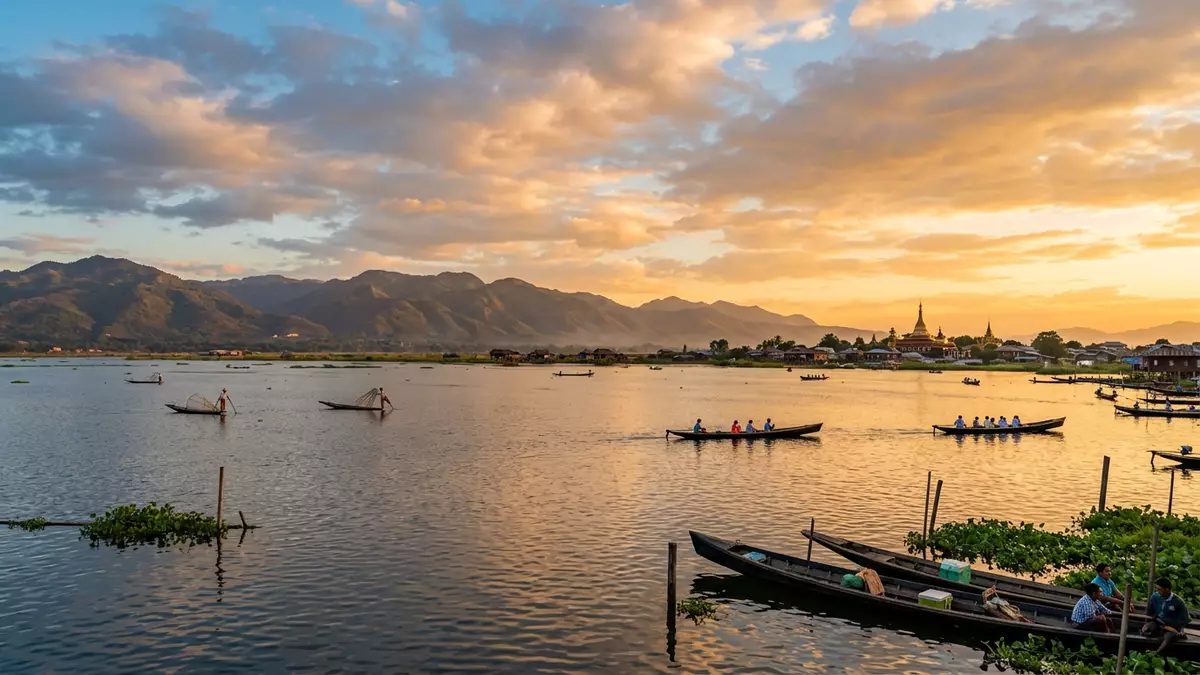
Inle Lake in Myanmar’s Shan State is a highland freshwater basin where everyday life unfolds directly on the water surface, from stilt houses and monasteries to cultivated gardens and narrow fishing boats. Set within Nyaungshwe Township in the Taunggyi District, the lake forms a long valley of shallow water framed by hills and dotted with villages built on timber piles above the surface.freshwater lake located in the Nyaungshwe Township It is widely associated with the Intha people, whose leg?rowing fishermen and floating agriculture have become defining images of this highland landscape.
Life on the water surface
Inle Lake stretches for over 20 km through the Shan Hills, forming a long, relatively narrow ribbon of water with a network of natural channels and open expanses.Inle Lake is 22km long and about 11km wide The lake sits at roughly 880 m (2,900 ft) above sea level, giving it a noticeably cooler climate than many of Myanmar’s lowland regions.at an elevation of 2,900 feet (880 m) Water depth is modest, with figures around a few metres even at the deepest points, which makes the extensive areas of reed beds and cultivated strips both possible and visually prominent.
Villages around and within the lake sit on timber stilts, with houses, small workshops and monasteries rising above the surface along narrow waterways. Boats act as the main means of transport, threading between dwellings, landing platforms and patches of cultivated vegetation.floating villages and on-water gardens For travellers, approaching these settlements by boat reveals how closely domestic life, agriculture and transport share the same aquatic space, with children commuting to school, goods moving along the channels and fishermen working within sight of front verandas.
Floating gardens and leg?rowing fishermen
One of the most distinctive features of Inle Lake is its system of floating gardens, where crops are grown on elongated rafts made of lake weeds, mud and other vegetation rather than on solid shore ground.floating gardens and “leg rowers” Intha farmers bind layers of aquatic plants and sediment into buoyant strips, anchor them with bamboo poles and plant vegetables and flowers into the soft material, creating parallel bands with narrow boat channels between them.floating gardens anchored with bamboo poles These cultivated rafts follow the surface of the lake, rising and falling with seasonal changes in water level and forming long runs of greenery that cut across the water like fields.
The Intha are also known for a distinctive form of leg?rowing, which has become one of the visual emblems of Inle Lake. Fishermen and boatmen stand towards the stern of their narrow wooden craft, wrap one leg around the oar and use a circular motion to propel the boat, keeping their hands free for nets or baskets.unique leg rowing of the Inthas The elevated stance helps them navigate around reed patches and floating gardens while scanning the surface for fish or openings in the vegetation, and their silhouette against the water is one of the most widely recognised scenes associated with the lake.
Highland ecology and sacred sites
Inle Lake’s position within the Shan Hills gives it the character of a highland wetland, with a mix of open water, reed beds, inflowing streams and cultivated margins forming a varied environment.highland sanctuary at coordinates 20° 46? N, 97° 01? E It has been recognised as part of the ASEAN Heritage Parks network and was designated a UNESCO Biosphere Reserve in 2015, reflecting both its ecological significance and its long?established human use.declared a UNESCO Biosphere Reserve in June 2015 Birdlife, aquatic plants and endemic fish species share the lake with transport routes, agricultural plots and fishing grounds, creating a landscape where conservation concerns and traditional livelihoods intersect.
Religious sites form another visible layer of life around the lake. Phaung Daw Oo Pagoda, located near the centre of the water, is among the most prominent, drawing pilgrims from the surrounding Shan State to its gilded shrines.high historical cultured vale of PhaungDawOo Pagoda Monasteries stand on stilts above the water or rise on small islands and shore promontories, and boat journeys pass clusters of stupas as well as more utilitarian structures such as boat sheds and market platforms. Together, these religious and everyday buildings convey how strongly spiritual practice, trade and transport are intertwined with the lake’s geography.
Visiting Inle Lake: what travellers from Western Europe should know
- Inle Lake lies in Nyaungshwe Township in southern Shan State, with Nyaungshwe town acting as the main access point on the northern stretch of the water; boats for lake trips depart from canals on the edge of the town.
- The lake surface forms a long basin at high altitude, and reaching stilt villages or pagodas usually involves travel by narrow motor boats, which thread along channels between floating gardens and reed beds.
- The nearest airport serving the area is Heho Airport, from which road transport runs to Nyaungshwe; there are also long?distance bus routes linking Nyaungshwe with cities such as Yangon, Mandalay and Bagan.
- The official language is Burmese and the currency is the Myanmar kyat.
- Entry requirements depend on your nationality; UK travellers can check the FCDO travel advice at gov.uk/foreign-travel-advice, Irish travellers the Department of Foreign Affairs at ireland.ie.
Searching for Inle Lake on social platforms
These links open searches for Inle Lake on each platform.
Frequently asked questions about Inle Lake
Where is Inle Lake and how is it situated within Myanmar?
Inle Lake lies in Nyaungshwe Township in Shan State, part of the Shan Hills of eastern Myanmar, forming a long highland basin surrounded by hill country.
What can visitors expect when travelling on the lake itself?
Boat journeys pass stilt villages, floating gardens and pagodas, with Intha leg?rowers and narrow wooden craft working among reed beds and cultivated strips anchored to the lake surface.
What makes Inle Lake distinctive compared with other lakes in Myanmar?
Its combination of highland ecology, floating agriculture, leg?rowing fishermen and religious sites on and beside the water gives Inle Lake a strongly aquatic way of life.


