
iSimangaliso Wetland Park’s lakes, dunes and Indian Ocean edge
Published on 09/18/2026 at 14:41 | Editorial responsibility: Rafael Müller, Editor-in-Chief AD HOC NEWS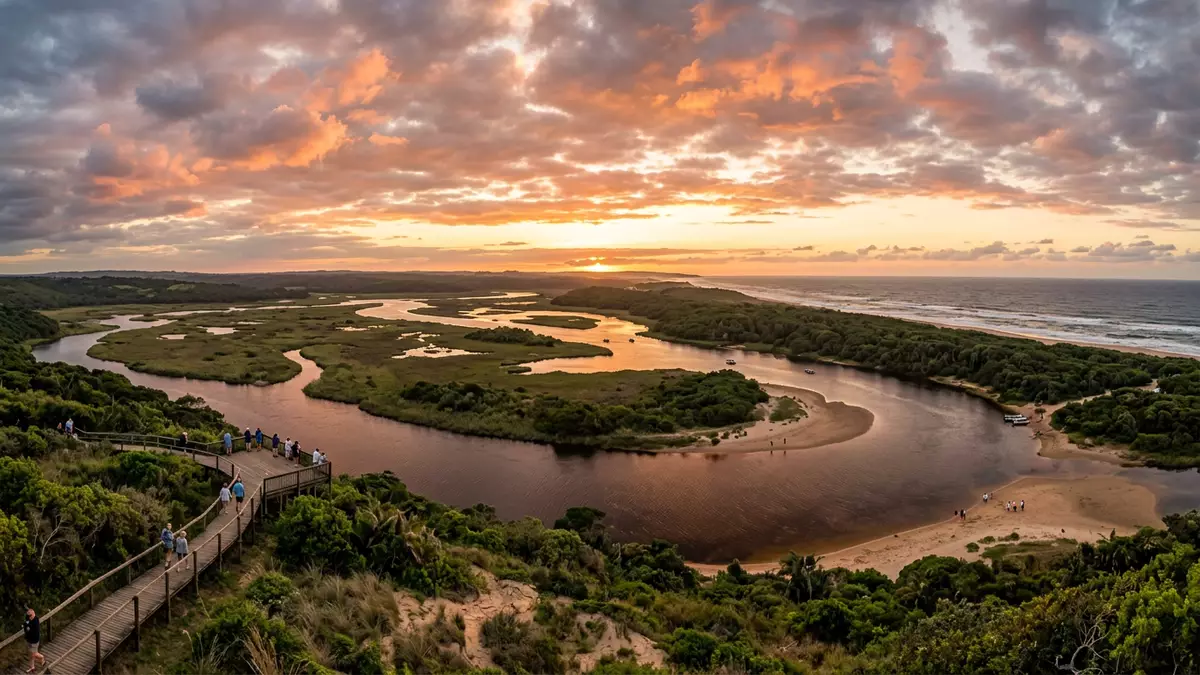
On the Indian Ocean coast of KwaZulu-Natal in South Africa, iSimangaliso Wetland Park forms an elongated protected landscape where lake systems, wetlands, forests and offshore reefs are drawn together along the shoreline near St. Lucia. Declared South Africa’s first UNESCO World Heritage Site in 1999, the park runs along the coast towards the Mozambican border and safeguards a strip of land and sea where several distinct ecosystems meet within one reserve.
Coastline of lakes, dunes and estuaries
iSimangaliso Wetland Park follows the KwaZulu-Natal shoreline for more than 200 km (about 124 mi), enclosing coastal lowlands between Maphelane in the south and Kosi Bay on the border with Mozambique.This KwaZulu-Natal wetland park stretches along the Zululand coast from Maphelane in the south to Kosi Bay in the north Within this narrow footprint lie long sandy beaches, parallel barrier dunes, enclosed lagoons and estuarine channels that connect inland waters to the sea.The site contains coral reefs, sandy beaches, coastal dunes, lake systems, swamps and extensive reed wetlands
At the heart of the park sits Lake St Lucia, one of Africa’s major estuarine systems, which is linked to the Indian Ocean by a long tidal channel and bordered by wetlands, woodlands and dune forest.The park covers the St Lucia estuary and surrounding swamps, grasslands and dune forest as part of a 220 km-long coastal strip Other lake basins, such as Kosi Bay and Sibaya, lie behind the coastal dunes and form enclosed water bodies fringed by reedbeds, swamp forest and sand forest on higher ground.
Five meeting ecosystems in a single World Heritage Site
iSimangaliso Wetland Park is recognised by UNESCO for combining several large-scale ecosystems within a single protected property, including marine, coastal dune, lake, swamp and inland savanna environments.iSimangaliso protects ocean and coral reef, coastal dune and forest, lake and wetland, savannah and grassland habitats in northern KwaZulu-Natal Warm Indian Ocean waters support coral communities along the offshore reefs, which represent the southernmost extension of such reef formations on the east African coast.The marine ecosystem includes warm seas with coral reefs and long beaches, backed by coastal dunes and subtropical forests
Inland from the shore, savanna woodlands and grasslands occupy ancient shoreline terraces and rise gently towards the Lubombo Mountains, while swamp systems such as uMkhuze carry extensive reed and papyrus wetlands linked to the lake basins.The World Heritage datasheet notes marine, coastal, wetland, estuarine and terrestrial environments within the 239,566 ha property This juxtaposition of habitats across a relatively narrow coastal corridor supports a high diversity of species associated with savanna, wetland and marine environments.
From St. Lucia to Kosi Bay: a chain of destinations
The park is managed by the iSimangaliso Wetland Park Authority as a continuous conservation area, but visitors encounter it as a sequence of named destinations along the coast, including Lake St Lucia and its estuary near the town of St. Lucia, Cape Vidal and the Eastern Shores, Sodwana Bay, uMkhuze, Lake Sibaya, Coastal Forest sections and Kosi Bay.The Greater St. Lucia Wetlands Park description lists eight interlocking ecosystems and ten destinations from Maphelane through Lake St Lucia to Kosi Bay Each part presents a different combination of lakes, wetlands, forest and shore, with the estuarine channels around St. Lucia contrasting with the more open ocean frontage at Sodwana Bay and the lagoon system of Kosi Bay.
UNESCO inscribed iSimangaliso Wetland Park on the World Heritage List in 1999 under natural criteria (vii), (ix) and (x), recognising its scenic qualities, ongoing ecological processes and biodiversity.The iSimangaliso Wetland Park – Maputo National Park property is recorded as a World Heritage Site inscribed in 1999 under natural criteria vii, ix and x The designation covers a formally defined area extending along the Indian Ocean coast and includes both terrestrial and marine components that reflect the broader St. Lucia system.
Visiting iSimangaliso Wetland Park: what travellers from Western Europe should know
- iSimangaliso Wetland Park lies on the Indian Ocean coast of KwaZulu-Natal in South Africa, near the town of St. Lucia north of Durban, and is reached by road from regional centres.
- The terrain ranges from flat coastal plains and sandy beaches to undulating savanna and forested dunes, and many paths and viewpoints involve walking on sand or unpaved surfaces.
- Within the park, different sections front lakes, estuaries or open ocean, so travel between destinations such as St. Lucia, Cape Vidal, Sodwana Bay and Kosi Bay involves separate road approaches.
- English is widely used in South Africa and the national currency is the South African rand.
- Entry requirements depend on your nationality; UK travellers can check the FCDO travel advice at gov.uk/foreign-travel-advice, Irish travellers the Department of Foreign Affairs at ireland.ie.
Searching for iSimangaliso Wetland Park on social platforms
These links open searches for iSimangaliso Wetland Park on each platform.Frequently asked questions about iSimangaliso Wetland Park
Where is iSimangaliso Wetland Park located?
iSimangaliso Wetland Park lies on the east coast of KwaZulu-Natal in South Africa, near the town of St. Lucia north of Durban, and extends towards the Mozambican border along the Indian Ocean.
What can visitors expect on a visit to iSimangaliso Wetland Park?
Visitors encounter a chain of coastal destinations with lakes, estuaries, wetlands, dune forests, savanna and Indian Ocean beaches, with different sections presenting combinations of inland waters and marine frontage.
What makes iSimangaliso Wetland Park distinctive among South African protected areas?
The park is distinctive for bringing together several large ecosystems, including coral-rich marine areas, extensive wetlands, major lake systems and inland savanna, in a single UNESCO-listed coastal reserve along the St. Lucia system.


