
iSimangaliso Wetland Park’s shifting waters and wild coast
Published on 08/15/2026 at 14:14 | Editorial responsibility: Rafael Müller, Editor-in-Chief AD HOC NEWS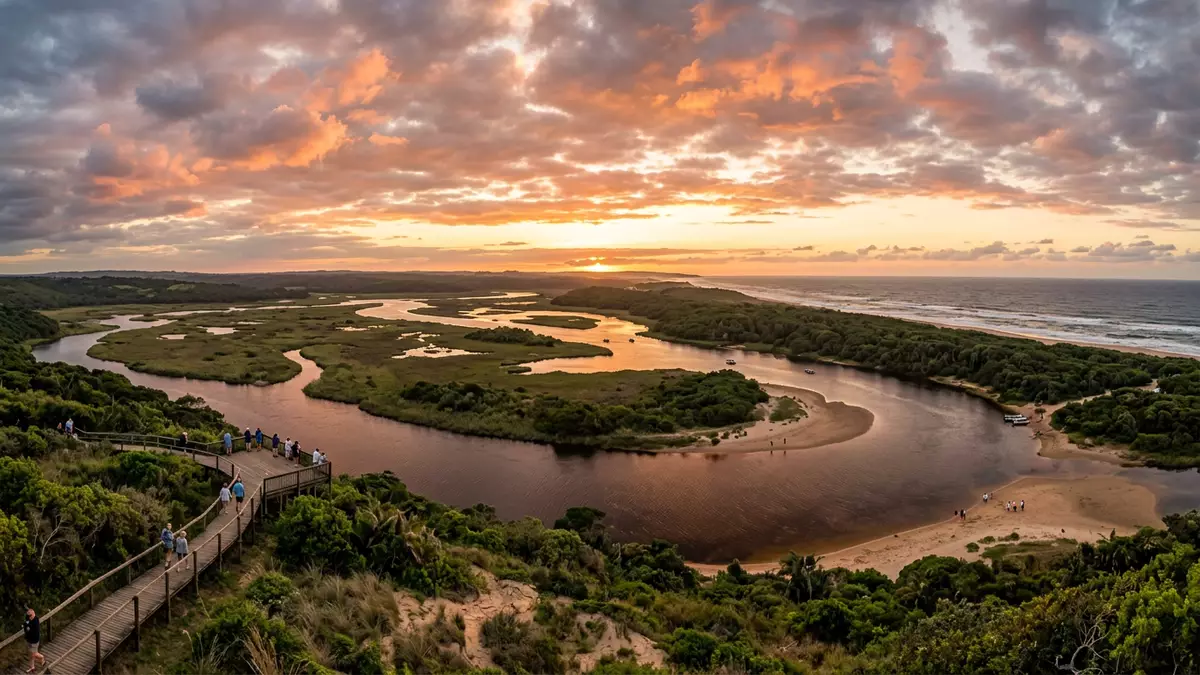
On the Indian Ocean coast near St. Lucia in South Africa’s KwaZulu-Natal province, iSimangaliso Wetland Park brings together a chain of lakes, estuaries, dunes and offshore reefs in a single protected landscape recognised as a UNESCO World Heritage Site since 1999.UNESCO World Heritage Site At its heart lies Lake St Lucia, Africa’s largest estuarine system and the centrepiece of South Africa’s first World Heritage inscription.
Where lake, estuary and ocean meet
iSimangaliso stretches along the east coast of South Africa, north of Durban, following the shoreline for well over 200 km (about 124 mi) from near the Mozambican border to Mapelane south of the Lake St Lucia estuary.spanning 280 km of coastline Within this elongated footprint sit three major lake systems, extensive wetlands and a broad marine zone in the Indian Ocean.
Lake St Lucia dominates the southern part of the park as an estuarine coastal lake connected to the sea through a shifting mouth and fed by several rivers from the hinterland.coastal wetlands and lake systems The estuary has been protected since 1895 and is described as Africa’s largest estuarine system, with its waters oscillating between fresher and more saline states as river flows and sea incursions change.Africa’s largest estuarine system
Dunes, wetlands and savannah in succession
One of the striking aspects of iSimangaliso is the way different ecosystems follow each other in narrow bands, often within sight of one another: offshore coral reefs and warm tropical seas, long sandy beaches, towering coastal dunes, reed and papyrus wetlands, and inland woodlands and savannah.coral reefs, beaches and papyrus wetlands The park’s coastal dunes have been dated to around 25,000 years in age and rise to heights that place them among the tallest such formations on the continent.25,000-year-old coastal dunes
Behind the dune cordon, broad belts of wetlands and swamps extend around the lakes and along river floodplains, with extensive stands of papyrus and reed marking permanently waterlogged ground.swamps, reed and papyrus wetlands On slightly higher terrain, dry savannah and thornveld support a different set of plants and animals, illustrating how small changes in elevation and soil translate into sharp ecological contrasts.
Wildlife shaped by shifting water
iSimangaliso’s inscription under World Heritage natural criteria (vii), (ix) and (x) reflects its scenic landforms, its ongoing ecological processes and its high biodiversity, from marine life to savannah species.criteria (vii), (ix) and (x) The park protects critical habitats for species associated with coral reefs, estuaries, wetlands and grasslands, and its transitional location between subtropical and tropical Africa contributes to exceptional species variety.exceptional species diversity
Lake St Lucia itself supports more than 150 recorded fish species in its estuarine system, with dozens using the lake as a nursery before moving into coastal fisheries in the Indian Ocean.fish species in Lake St Lucia Around the lake and its fringing wetlands, extensive birdlife takes advantage of the mix of open water, reeds, forest and shoreline, and swamp forests shelter trees adapted to saturated soils.
Visiting iSimangaliso Wetland Park: what travellers from Western Europe should know
- iSimangaliso Wetland Park lies on the east coast of South Africa in northern KwaZulu-Natal, with the town of St. Lucia serving as a gateway close to the Lake St Lucia estuary.
- Access to viewpoints and lakeshores often involves driving on gravel roads and walking short distances over sand or uneven ground, with some boardwalks and low bridges across wetland areas.
- In many parts of the park the terrain shifts from beach and dune to wetland and savannah within a short span, so footwear suitable for both sandy surfaces and damp ground is useful.
- The official language of South Africa is English alongside several other languages, and the currency is the South African rand.
- Entry requirements depend on your nationality; UK travellers can check the FCDO travel advice at gov.uk/foreign-travel-advice, Irish travellers the Department of Foreign Affairs at ireland.ie.
Searching for iSimangaliso Wetland Park on social platforms
These links open searches for iSimangaliso Wetland Park on each platform.
Frequently asked questions about iSimangaliso Wetland Park
Where is iSimangaliso Wetland Park?
It is on the east coast of South Africa in northern KwaZulu-Natal, extending along the shoreline near the town of St. Lucia and northwards towards Mozambique.
What can visitors expect on a visit?
Visitors encounter a sequence of coastal and inland landscapes, including beaches, dunes, wetlands, lakes and savannah, with opportunities to view wildlife adapted to each environment.
What makes iSimangaliso Wetland Park distinctive?
The park is notable for its large estuarine lake system, its combination of marine and terrestrial habitats within one protected area, and its recognition as South Africa’s first World Heritage Site.


