
Islas Galapagos and Puerto Ayora’s living laboratory of islands
Published on 09/02/2026 at 18:22 | Editorial responsibility: Rafael Müller, Editor-in-Chief AD HOC NEWS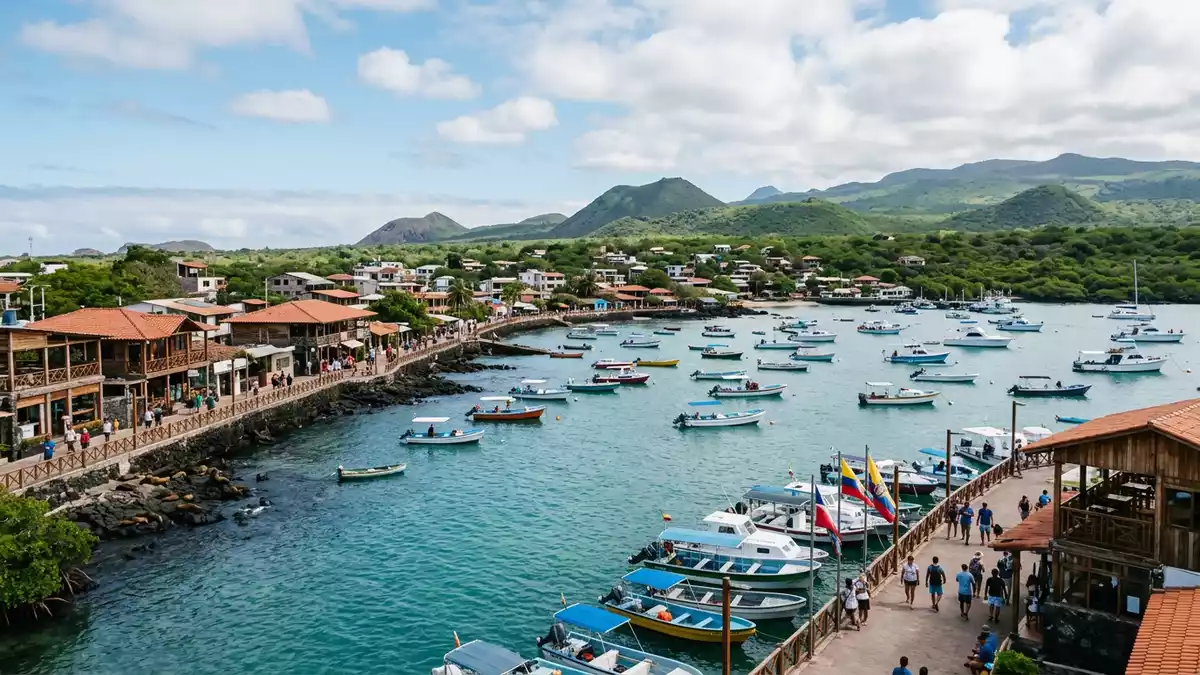
Islas Galapagos, the Galapagos Islands, rise from the Pacific Ocean far off the coast of Ecuador as a volcanic archipelago where wildlife, lava landscapes and small towns meet in remarkable proximity. From Puerto Ayora on Santa Cruz Island, the largest urban centre in the province, visiting travellers encounter giant tortoises, marine iguanas and reminders of Charles Darwin’s visit within a compact stretch of shore and highland.
Volcanic islands at the equator
The Galapagos archipelago lies in the eastern Pacific Ocean, roughly 1,000 km (about 620 mi) west of mainland Ecuador, at the confluence of several ocean currents that shape its climate and marine life.Situated in the Pacific Ocean some 1,000 km from the South American continent The group forms part of Ecuadorian territory under the official name Archipiélago de Colón, but the familiar name Islas Galapagos has long taken hold in travel writing.
Geographers describe 13 larger islands, a set of medium-sized islands and more than 200 smaller islets and rocks, all of volcanic origin, spread across a wide marine reserve that extends over more than 9,800,000 ha.The archipelago comprises 13 large islands The largest island, Isabela, covers well over half the land area of the archipelago, while Santa Cruz, San Cristobal, Fernandina and others form a broken crescent of dark lava rising from the sea.The largest islands are Isabela, Santa Cruz, Fernandina, San Salvador, San Cristobal and Floreana
A protected World Heritage seascape
The Galapagos Islands gained early international recognition when they were inscribed on the UNESCO World Heritage List in 1978 as one of the first natural sites to receive that status.1978: Inscribed on the World Heritage List The marine reserve surrounding the land area was added in 2001, creating a combined protected zone where terrestrial and marine ecosystems are treated as a single conservation unit.The archipelago became a UNESCO Biosphere Reserve and Ramsar Site
UNESCO’s listing emphasises both dramatic volcanic scenery and exceptional biodiversity, noting that the islands illustrate geological processes and hold habitats for native and endemic species across more than 14,000,000 ha of protected land and sea.Inscribed as UNESCO World Heritage Site in 1978 Conservation management falls under the Galapagos National Park and its marine reserve, based in Puerto Ayora on Santa Cruz Island, where administrative offices and ranger teams coordinate regulations across the islands.The Director, Galápagos National Park & Marine Reserve, Puerto Ayora
Puerto Ayora, Darwin and the animals of Santa Cruz
Puerto Ayora stands on the southern shore of Santa Cruz Island, overlooking Academy Bay as a port town and the seat of Santa Cruz Canton within the Galapagos Province.Located on the southern shore of Santa Cruz Island The town functions as the main urban hub in the islands, with streets running up from the waterfront, small harbours where boats anchor and a mix of residential and commercial districts framed by low volcanic hills.Puerto Ayora, located on the southern end of Santa Cruz Island, is the largest town
Just outside the town, the Charles Darwin Research Station works alongside the Galapagos National Park headquarters on long-term scientific programmes, reinforcing the association between Islas Galapagos and evolutionary biology that dates back to Darwin’s 1830s voyage on HMS Beagle.The Director, Charles Darwin Research Station, Puerto Ayora In and around Puerto Ayora, visitors encounter marine iguanas basking on black lava, sea lions stretched out on harbour steps and giant tortoises in highland reserves, bringing the archipelago’s wildlife into everyday view.
Visiting Islas Galapagos: what travellers from Western Europe should know
- Islas Galapagos belong to Ecuador in the eastern Pacific Ocean, and most visitors reach Puerto Ayora by flying to Seymour Airport on Baltra Island before crossing by land and water to Santa Cruz.
- The terrain around Puerto Ayora combines paved streets and harbour promenades with rough lava paths, rocky shorelines and inland trails that can involve uneven surfaces and moderate gradients.
- Outside the town, highland areas on Santa Cruz rise into humid zones where forests, agricultural land and tortoise habitats sit above drier coastal strips of shrub and lava.
- The official language is Spanish and the currency is the United States dollar.
- Entry requirements depend on your nationality; UK travellers can check the FCDO travel advice at gov.uk/foreign-travel-advice, Irish travellers the Department of Foreign Affairs at ireland.ie.
Searching for Islas Galapagos on social platforms
These links open searches for Islas Galapagos on each platform.Frequently asked questions about Islas Galapagos
Where are Islas Galapagos and Puerto Ayora located?
Islas Galapagos lie in the Pacific Ocean about 1,000 km west of continental Ecuador, and Puerto Ayora stands on the southern coast of Santa Cruz Island.
What can visitors expect on a visit to Puerto Ayora?
Visitors find a small port town with harbourfront streets, access to nearby wildlife sites on Santa Cruz and boat connections to other islands within the Galapagos National Park.
What makes Islas Galapagos distinctive compared with other island groups?
The combination of active volcanic landscapes, endemic species and long-standing scientific research, encapsulated around Puerto Ayora and Santa Cruz, gives this archipelago a character found in few other places.


