
Islas Galapagos: islands shaped by living volcanoes
Published on 09/24/2026 at 12:25 | Editorial responsibility: Rafael Müller, Editor-in-Chief AD HOC NEWS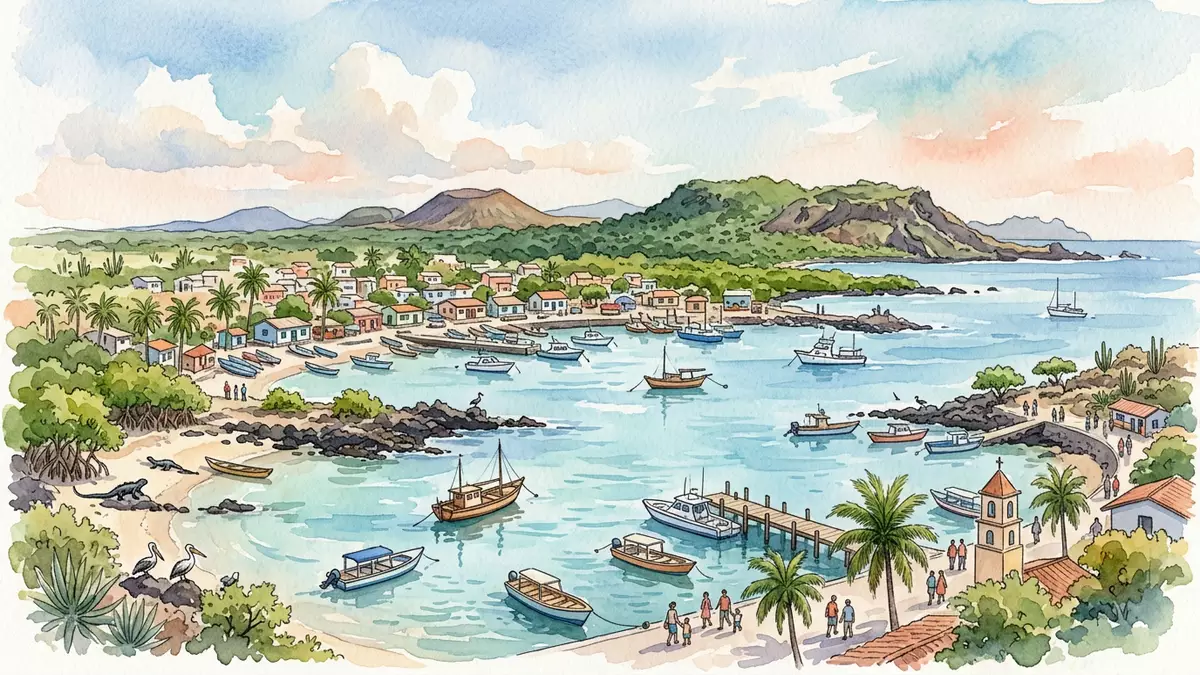
Islas Galapagos form an archipelago of volcanic islands in the eastern Pacific Ocean, about 1,000 km west of continental Ecuador. Their black lava, pale beaches, cactus country and humid highlands belong to the same landscape, while Puerto Ayora on Santa Cruz provides a settled base beside the archipelago’s protected environments.
Volcanic islands across the Equator
The Galapagos archipelago includes 19 large islands within a wider group of islands, islets and rocks. The islands rise from the Nazca tectonic plate above a volcanic hot spot, and their landforms include craters, lava fields, cliffs and volcanic cones.
Isabela is the largest island and was formed from several volcanoes joined above sea level. The eastern islands are older than the western islands, while parts of the western archipelago remain geologically active. Galapagos volcanic history records the relationship between the moving plate and the island chain.
Wildlife across land and sea
Isolation produced a striking range of native species. Giant tortoises, marine iguanas, sea lions, penguins, flightless cormorants and finches belong to the archipelago’s natural identity, alongside plants adapted to dry lowlands and wetter uplands.
Charles Darwin visited the islands in 1835 during the voyage of HMS Beagle. The differences between island populations contributed to the observations that later informed his work on natural selection. Charles Darwin’s 1835 visit remains part of the islands’ historical connection with evolutionary science.
Puerto Ayora and the protected archipelago
Puerto Ayora lies on Santa Cruz Island and is associated with the Charles Darwin Research Station and the Galapagos National Park. Streets, harbour facilities and research buildings meet a landscape where giant tortoises, lava formations and coastal wildlife belong to the wider setting.
Ecuador established the Galapagos National Park in 1959, and the islands entered the UNESCO World Heritage List in 1978. The designation covers the natural values of the archipelago, while the surrounding marine environment forms an essential part of its ecological character. UNESCO World Heritage status identifies the Galapagos as a protected natural site about 1,000 km from mainland Ecuador.
The land area includes dry forests, mangroves, scalesia woodland, grassland and highland vegetation. On the coast, lava shelves, coves and beaches meet waters inhabited by sea turtles, rays, sharks and penguins. Galapagos National Park covers the terrestrial landscapes and native species of the island province.
Visiting Islas Galapagos: what travellers from Western Europe should know
- Islas Galapagos lie on the Equator in the Pacific Ocean, west of continental Ecuador. Puerto Ayora is on Santa Cruz Island, and air connections reach the archipelago from mainland Ecuador.
- Travel between islands involves boats or aircraft, while many natural areas are reached on foot. Volcanic ground includes lava, sand, rock and uneven paths.
- The landscape changes sharply across short island routes, from dry cactus vegetation near the coast to greener highland forest on Santa Cruz.
- The official language is Spanish and the currency is the US dollar.
- Entry requirements depend on your nationality; UK travellers can check the FCDO travel advice at gov.uk/foreign-travel-advice, Irish travellers the Department of Foreign Affairs at ireland.ie.
Searching for Islas Galapagos on social platforms
These links open searches for Islas Galapagos on each platform.Frequently asked questions about Islas Galapagos
Where are Islas Galapagos?
Islas Galapagos lie in the eastern Pacific Ocean on the Equator, about 1,000 km west of continental Ecuador. Puerto Ayora is on Santa Cruz Island.
What can travellers expect on a visit?
Travellers encounter volcanic landscapes, coastal habitats, dry forests, highland vegetation and native wildlife. Routes between settlements and protected areas include boat journeys, flights and walks across uneven ground.
What makes Islas Galapagos distinctive?
The archipelago combines active volcanic geology with species shaped by long isolation. Its links with Charles Darwin and its UNESCO World Heritage status connect natural history, science and conservation.


