
Itchan Kala and the brick walls of Khiva
Published on 09/18/2026 at 17:42 | Editorial responsibility: Rafael Müller, Editor-in-Chief AD HOC NEWS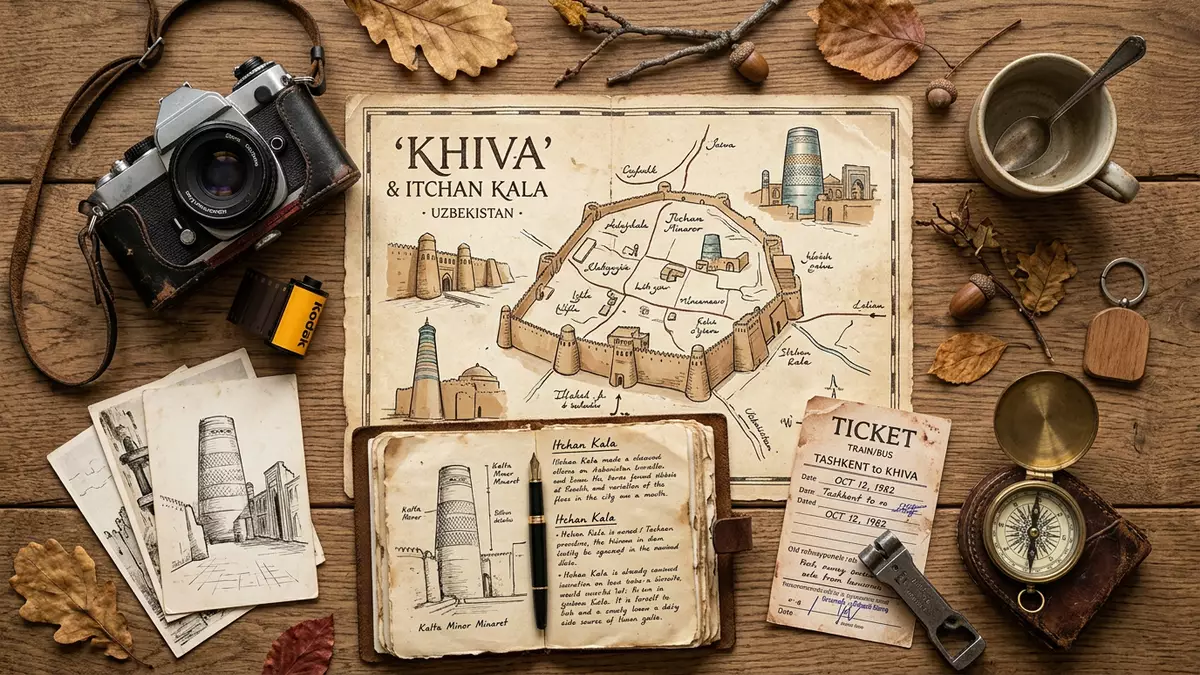
Itchan Kala is the inner town of Khiva, enclosed by brick walls that rise to about 10 m (33 ft). Inscribed on the UNESCO World Heritage List in 1990, it brings together Islamic architecture, courtyard houses and a dense street pattern inside a rectangular plan.
The walled inner town of Khiva
The UNESCO description places Itchan Kala south of the Amu Darya in the Khorezm region of Uzbekistan, where caravans once stopped before crossing the desert. The protected area has been presented as a coherent example of Central Asian Muslim architecture, with mosques, mausoleums, madrasas and palaces.
The town’s outline is part of its identity: a rectangle measuring about 650 by 400 metres, with walls and gates on all four sides. That compact form keeps the major monuments close together and makes the historic core legible at street level. brick walls and rectangular plan are among the clearest defining features.
Monuments, courtyards and carved timber
Inside the walls, Itchan Kala contains a concentration of named monuments that gives the old town its character. The Djuma Mosque, the madrasas of Alla-Kulli-Khan and Muhammad Amin Khan, the mausoleums of Pahlavon Mahmoud and Sayid Allavuddin, and the palaces of the early nineteenth century all belong to the same historic fabric.
The UNESCO account records 51 monumental structures and 250 dwellings within the property. It also singles out the Djuma Mosque for its covered courtyard and 212 columns, while the domestic buildings show enclosed houses with courtyards, porticos and carved wooden posts. 51 ancient structures and 212 columns give a sense of that density.
Khorezm, the Khans and the long urban story
Itchan Kala is tied to the history of Khorezm and the Khanate of Khiva. Its documented protection began in 1967, when it received the status of State Architectural and Historic Reserve, and it became a museum and reserve in 1969. UNESCO inscribed it in 1990 under cultural criteria iii, iv and v.
That sequence places the place in a clear historical frame: a medieval and early modern townscape, a nineteenth-century palatial layer, and a twentieth-century regime of formal protection. The result is a historic core that still reads as a city, not as a single monument. State Architectural and Historic Reserve and inscribed in 1990 anchor that chronology.
Visiting Itchan Kala: what travellers from Western Europe should know
- Itchan Kala lies in Khiva, in the Khorezm region of Uzbekistan. Entry to the historic core is through city gates, with the western gate serving as the usual main approach.
- The walls are high brick fortifications, and the old town is compact enough for walking. Narrow streets, uneven surfaces and courtyards are part of the terrain.
- The official language is Uzbek and the currency is the Uzbekistani som.
- Entry requirements depend on your nationality; UK travellers can check the FCDO travel advice at gov.uk/foreign-travel-advice, Irish travellers the Department of Foreign Affairs at ireland.ie.
Searching for Itchan Kala on social platforms
These links open searches for Itchan Kala on each platform.
Frequently asked questions about Itchan Kala
Where is Itchan Kala?
Itchan Kala is the walled inner town of Khiva in the Khorezm region of Uzbekistan. It stands south of the Amu Darya and forms the historic core of the city.
What does a visit involve?
The place is a compact historic town with walls, gates, mosques, madrasas and palaces. Most of it is read best on foot, along streets that keep close to the old urban grain.
What makes Itchan Kala distinctive?
Its distinctiveness comes from the combination of brick fortifications, a rectangular urban plan and a dense group of Islamic monuments. The covered Djuma Mosque and the nineteenth-century palaces are part of that ensemble.


