
Jardin des Tuileries and the geometry of a royal garden
Published on 09/23/2026 at 06:08 | Editorial responsibility: Rafael Müller, Editor-in-Chief AD HOC NEWS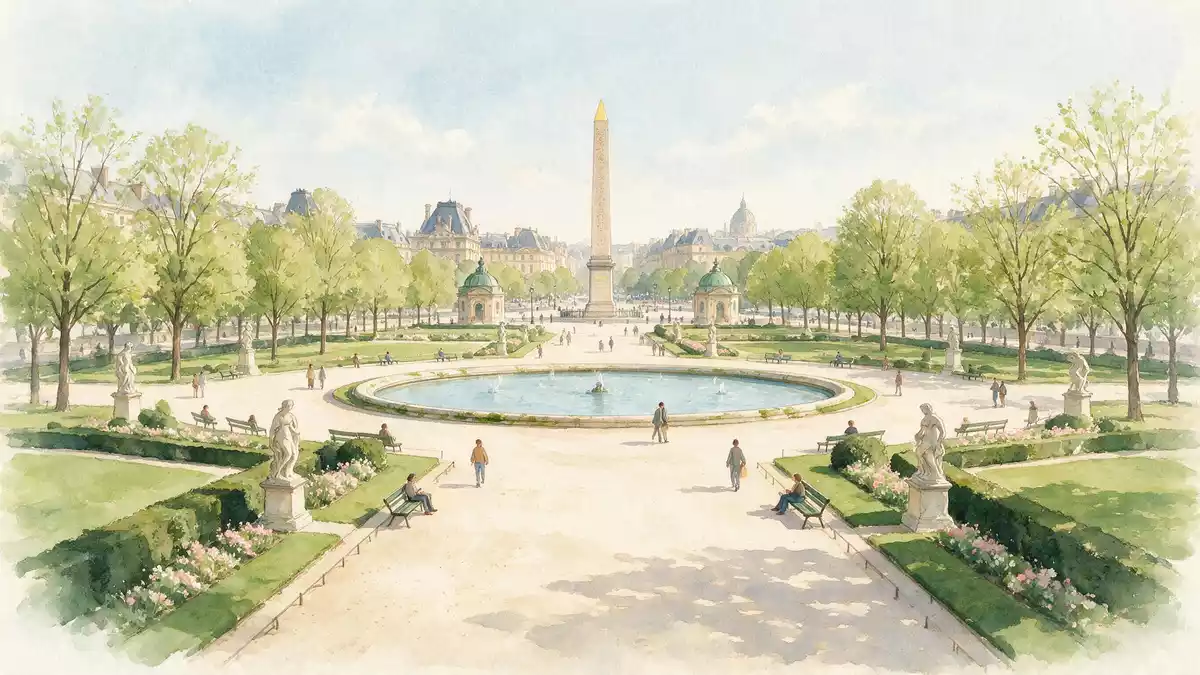
Jardin des Tuileries is a formal garden between the Louvre and Place de la Concorde in Paris. Its long central axis, clipped trees, broad terraces, fountains and sculpture create a measured landscape shaped across several centuries.
Jardin des Tuileries: a garden built around an axis
The garden stretches beside the Seine and Rue de Rivoli, forming a broad green interval between the Louvre complex and the western edge of the historic centre. Gravel paths divide lawns, tree-lined walks and planted beds, while pools punctuate the central perspective.
The landscape belongs to the tradition of the French formal garden. Its geometry is legible from ground level: straight avenues meet at clear angles, rows of trees frame views, and open spaces alternate with enclosed planted areas. Chairs around the basins, sculptures along the paths and terraces facing the Louvre add human scale to the composition.
From Catherine de’ Medici to André Le Nôtre
Catherine de’ Medici established the garden in 1564 beside the Tuileries Palace. The name recalls tile makers and pottery workshops associated with the area. The palace no longer exists, but the garden retains its name and its position within the royal landscape of Paris.
In 1664, Louis XIV and Jean-Baptiste Colbert commissioned André Le Nôtre’s redesign. Le Nôtre extended the garden’s perspective and organised its paths, terraces and planting in the formal manner associated with Versailles, Vaux-le-Vicomte and Chantilly.
The garden opened to a wider public in the seventeenth century. After the French Revolution, its royal setting became part of a public urban landscape. The change in use did not erase the formal plan: the long avenue, basins and planted rooms remain central to the experience of the site.
Sculpture, water and museums along the Louvre axis
Jardin des Tuileries contains works associated with several periods of French sculpture. Marble and bronze figures stand beside paths, lawns and basins, creating a sequence of separate encounters instead of a single gallery-like display.
The Musée de l’Orangerie occupies the garden’s western side. Its galleries are associated with Claude Monet’s Water Lilies, while the Jeu de Paume occupies a building nearby and presents photography and related visual arts. These museums give the garden a cultural connection beyond its planting and architecture.
At the eastern end, the garden connects with the Louvre and the Jardin du Carrousel. At the western end, the axis continues towards Place de la Concorde and the Champs-Élysées. The garden therefore functions as both a designed landscape and a passage through Paris’s monumental centre.
Jardin des Tuileries is protected as a historic monument, and the river landscape around it forms part of the UNESCO-listed Banks of the Seine. The garden’s heritage setting beside the Seine places its formal design within a much larger urban composition.
Visiting Jardin des Tuileries: what travellers from Western Europe should know
- Jardin des Tuileries lies in the 1st arrondissement between the Louvre Museum and Place de la Concorde. Metro stations serve the Louvre, Tuileries and Concorde approaches.
- The garden is mostly level, with gravel avenues, paved routes, lawns, terraces and steps around selected raised sections. Wheelchairs and pushchairs may encounter different surfaces along the paths.
- The Seine borders the garden’s southern side, while Rue de Rivoli runs along its northern edge. The Louvre, Musée de l’Orangerie and Jeu de Paume are nearby named landmarks.
- French is the official language of France and the currency is the euro.
Searching for Jardin des Tuileries on social platforms
These links open searches for Jardin des Tuileries on each platform.
Frequently asked questions about Jardin des Tuileries
Where is Jardin des Tuileries?
Jardin des Tuileries is in central Paris, between the Louvre Museum and Place de la Concorde. The Seine borders its southern side, with Rue de Rivoli along the north.
What can visitors expect in the garden?
Visitors encounter formal avenues, clipped trees, lawns, fountains, sculpture, terraces and chairs beside the pools. The Musée de l’Orangerie and Jeu de Paume are located at the western end.
What makes Jardin des Tuileries distinctive?
Its distinctive feature is the combination of a sixteenth-century royal foundation with André Le Nôtre’s 1664 formal redesign. The long axis remains visible across the garden’s paths, basins and planted spaces.


