
Jardin Majorelle, Marrakesch’s cobalt-blue garden of art and memory
Published on 09/17/2026 at 19:49 | Editorial responsibility: Rafael Müller, Editor-in-Chief AD HOC NEWS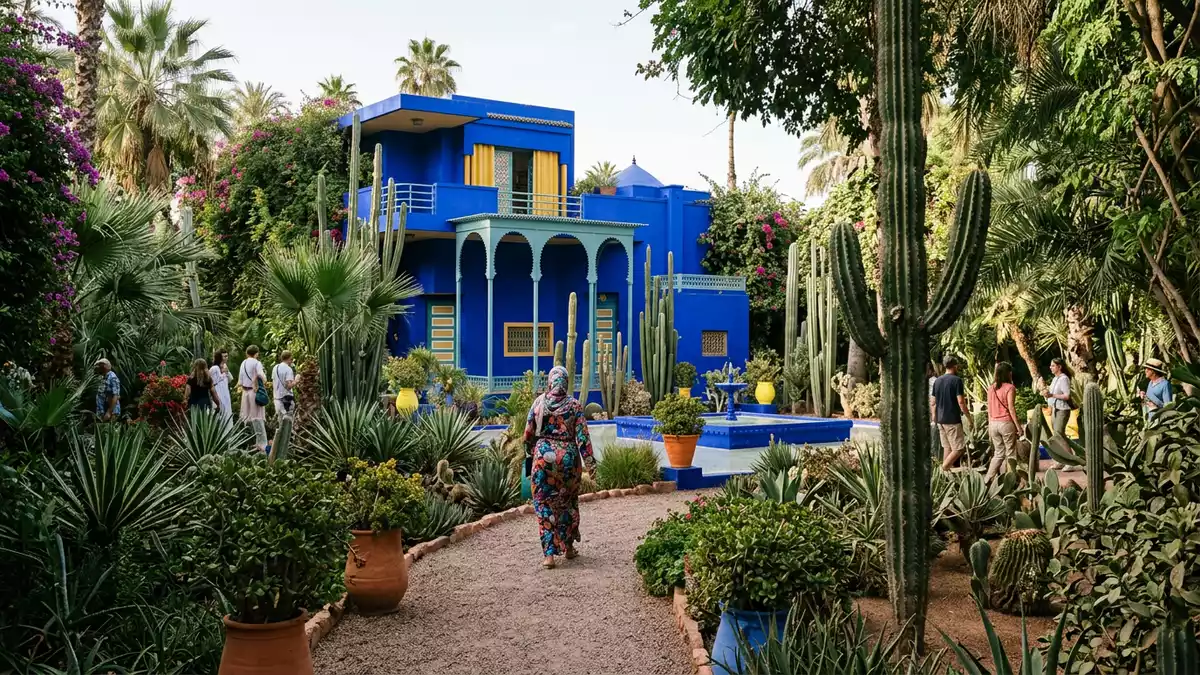
Jardin Majorelle in Marrakesch is a compact botanical garden where intense cobalt-blue architecture, dense planting and quiet paths share a single enclosed space. Conceived by the French painter Jacques Majorelle in the early twentieth century and later restored by Yves Saint Laurent and Pierre Bergé in 1980, it links Moroccan craft traditions with a modern artistic eye.
A painter’s garden in Ville Nouvelle
Jardin Majorelle lies in the Ville Nouvelle district of Marrakesch, on Rue Yves Saint Laurent north-west of the old medina, surrounded by streets of twentieth-century housing and shops.Rue Yves Saint Laurent marks the boundary of the property and gives a first indication of its later association with fashion.
Jacques Majorelle, born in 1886 in France, came to Marrakesch in 1919 and bought a palm grove on the edge of the city a few years later.the French painter Jacques Majorelle (1886-1962) From the early 1920s he began turning this plot into a personal garden, adding paths, water features and planting that drew on Islamic and Spanish-Moorish garden traditions.jardin islamique et jardin espagnol-hispano-mauresque
Majorelle Blue, architecture and botanical structure
The most immediately recognisable element of Jardin Majorelle is the strong cobalt colour known as “Majorelle Blue”, used on the villa and many structural elements such as walls, pergolas and plant pots.instantly recognizable cobalt blue features This colour sets a deliberate contrast with yellow details and the greens of bamboo, palms and other planting, giving the garden an almost graphic quality when viewed along its straight paths.
At the heart of the property stands a villa built for Majorelle in a modern style with Art Deco and Cubist influences, designed in the 1930s by French architect Paul Sinoir.Cubist villa designed by French architect Paul Sinoir in the 1930s The building rises above planting beds and water basins and forms a visual anchor that visitors glimpse between bamboo stands and palm trunks. Later, Majorelle’s former studio in the garden was converted into a Berber museum presenting artefacts from across Morocco, giving the site a cultural focus alongside its horticultural one.a museum of the History of the Berbers
From private sanctuary to foundation-run garden
Majorelle lived and worked at the garden for decades, opening it to the public in 1947 while still using it as a residence.opened his gardens to the public for the first time in 1947 After his death in 1962 the garden suffered neglect, and some of its structures and planting deteriorated.Following a car accident, Majorelle was repatriated to Paris where he died in 1962. The garden then fell into neglect.
Yves Saint Laurent and Pierre Bergé first discovered Jardin Majorelle in Marrakesch in 1966 and returned over the years, eventually buying the garden and its villa in 1980 to prevent a real-estate project from destroying it.decided to acquire it along with the adjoining villa They restored paths, buildings and planting, increased the number of botanical species and renamed the villa Villa Oasis, making it their Marrakesch home while keeping the garden open as a public space.increased its number of plant species to 300 from 135 Since 2010 the site has been owned by the Fondation Pierre Bergé – Yves Saint Laurent and managed locally by a dedicated foundation, giving it a formal status as a cultural and botanical institution.Since 2010, the property has been owned by the Foundation Pierre Bergé – Yves Saint Laurent
Visiting Jardin Majorelle: what travellers from Western Europe should know
- Jardin Majorelle stands on Rue Yves Saint Laurent in the Ville Nouvelle area of Marrakesch, north-west of the medina, and is reached along city streets by taxi or other local transport.
- The garden is compact but layered, with narrow paths, steps around water basins and dense planting that can require careful footing in places.
- The surrounding district includes other cultural sites linked to Yves Saint Laurent, making it possible to combine a visit to the garden with nearby museums and galleries.
- The official language is Arabic and the currency is the Moroccan dirham.
- Entry requirements depend on your nationality; UK travellers can check the FCDO travel advice at gov.uk/foreign-travel-advice, Irish travellers the Department of Foreign Affairs at ireland.ie.
Searching for Jardin Majorelle on social platforms
These links open searches for Jardin Majorelle on each platform.
Frequently asked questions about Jardin Majorelle
Where is Jardin Majorelle in Marrakesch?
Jardin Majorelle is in the Ville Nouvelle district of Marrakesch, on Rue Yves Saint Laurent north-west of the historic medina.
What should visitors expect on a visit?
Visitors walk through dense planting, water features and paths laid out around a cobalt-blue villa, with a small Berber museum inside the garden complex.
What makes Jardin Majorelle distinctive among gardens in Morocco?
Its combination of Majorelle Blue architecture, twentieth-century artistic origins and the later involvement of Yves Saint Laurent and Pierre Bergé gives it a particular identity.


