
Jigokudani Yaen Koen and the gorge of snow monkeys
Published on 08/18/2026 at 13:54 | Editorial responsibility: Rafael Müller, Editor-in-Chief AD HOC NEWS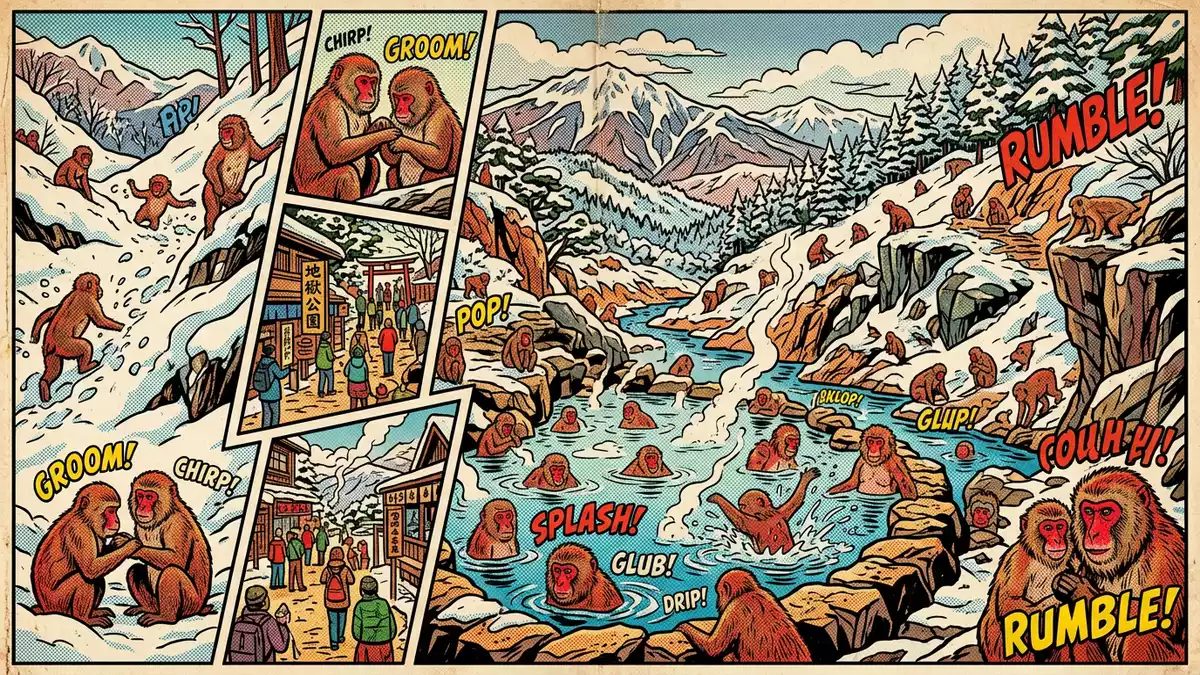
Jigokudani Yaen Koen in Yamanouchi is a gorge-side park in northern Nagano Prefecture, set around the Yokoyu River valley at about 850 metres above sea level. Its most recognisable scene is the mix of hot spring water, rock walls and Japanese macaques in one confined landscape.
Jigokudani Yaen Koen in the valley of the Yokoyu River
The park sits in the Valley of Yokoyu River, within Joshinetsu-Kogen National Park, and the official name appears in Japanese as ???????. The site is in Yamanouchi Town, a mountain area long associated with Jigokudani Onsen and the surrounding ski country.altitude 850 metres
The physical setting matters as much as the animals. Steep rock, flowing water and a narrow gorge give the place a compressed, enclosed look, while the park itself keeps the macaques at the centre of the visitor experience.steep rocky gorge
1964 and the public life of wild macaques
The park opened in 1964 and is closely linked with Hara Sogo, the first director named in accounts of its early years. That date places the site in Japan’s post-war tourism landscape, when wildlife viewing and mountain travel were being reshaped for a wider public.opened in 1964
The park’s identity rests on Japanese macaques, not on buildings or formal gardens. Snow, hot spring water and the animals’ presence create the image most people associate with Jigokudani Yaen Koen, while the site remains a place for observing wildlife in a managed landscape.Japanese macaques
The hot spring landscape and the monkeys
Natural hot springs rise in the Jigokudani area, and the park’s reputation comes from macaques gathering around that water in a setting shaped by rock, steam and winter snow. The park is known in English as the Snow Monkey Park as well as Jigokudani Yaen Koen.natural hot springs
The park’s appeal lies in that direct combination of landscape and animal life. It is a place where the gorge itself becomes part of the setting, with the river valley, the springs and the macaques forming one continuous scene.Valley of Yokoyu River
Visiting Jigokudani Yaen Koen: what travellers from Western Europe should know
- The park is in Yamanouchi, reached through the mountain area around Yudanaka and Kanbayashi Onsen. Access to the gorge is part road, part on foot, and the last approach follows the river valley.
- The terrain is a gorge with rock walls and a walk through mountain ground. The setting is less like a city promenade and more like a route through a natural valley.
- The site sits at altitude and is part of a snowy mountain region. That landscape is a central part of the park’s identity.
- Entry requirements depend on your nationality; UK travellers can check the FCDO travel advice at gov.uk/foreign-travel-advice, Irish travellers the Department of Foreign Affairs at ireland.ie.
Searching for Jigokudani Yaen Koen on social platforms
These links open searches for Jigokudani Yaen Koen on each platform.
Frequently asked questions about Jigokudani Yaen Koen
Where is Jigokudani Yaen Koen?
It is in Yamanouchi Town, in Nagano Prefecture, inside the valley of the Yokoyu River. The park lies in a mountainous area linked with Jigokudani Onsen and Joshinetsu-Kogen National Park.
What does a visit involve?
The place combines a mountain approach, a gorge, and areas where Japanese macaques gather near hot spring water. The experience is shaped by the terrain as much as by the animals.
What makes it distinct?
The park is identified with wild macaques in a steep hot-spring gorge. Its 1964 opening and its connection with Hara Sogo place it in Japan’s modern wildlife tourism history.


