
Jim Thompson House, a teakwood enclave in central Bangkok
Published on 09/05/2026 at 22:10 | Editorial responsibility: Rafael Müller, Editor-in-Chief AD HOC NEWS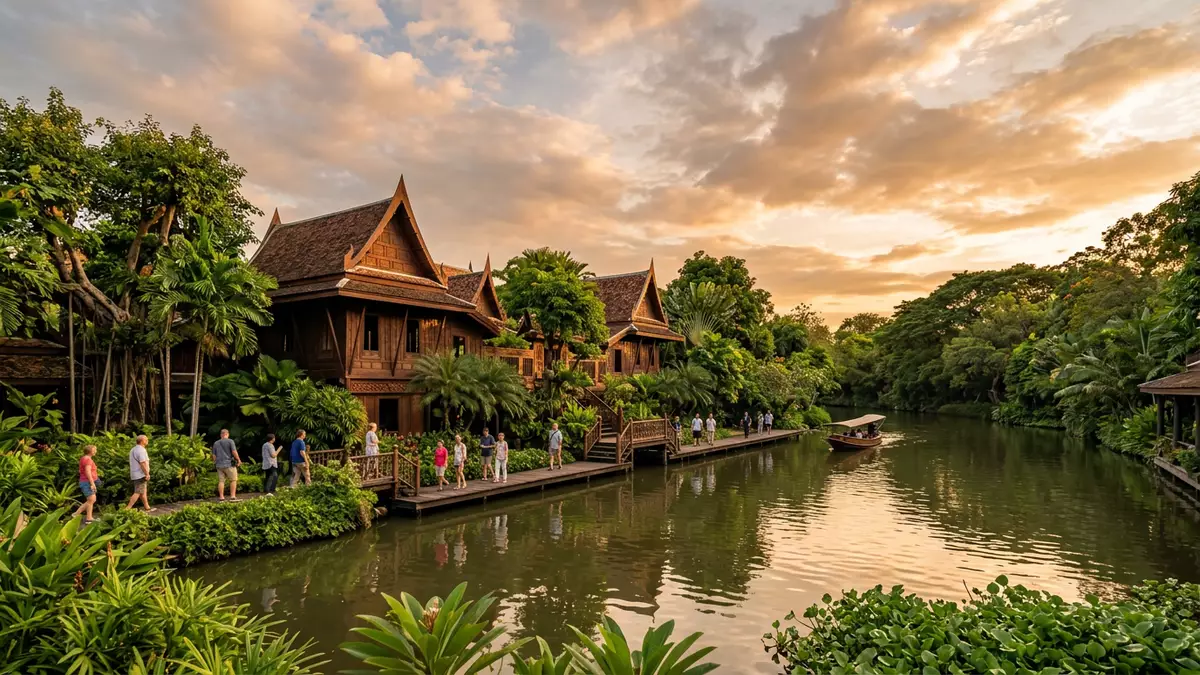
Jim Thompson House in Bangkok is a compact museum compound where traditional Thai teak houses, Asian art and the story of Thai silk are woven into a single, carefully composed residence. Set just off Rama I Road in the Pathumwan district, it was assembled in 1959 as the home of American silk entrepreneur James H.W. Thompson, whose work with Thai textiles in the mid-twentieth century turned this quiet corner beside a canal into an architectural showcase.
A cluster of traditional Thai houses in the city
Jim Thompson House occupies a plot near Soi Kasemsan 2 in central Bangkok, within walking distance of National Stadium and Siam Square. Rather than a single structure, the museum is formed from several traditional Thai wooden houses that were relocated from other parts of central Thailand and reassembled on this site in the late 1950s, creating a compound that feels like a rural dwelling enclosed by trees despite its urban surroundings.traditional Thai wooden houses
The houses are raised on stilts in line with central Thai domestic architecture, leaving shaded space at ground level that is used for circulation and display. Their walls and floors are constructed from dark teak, and the roofs follow the steeply pitched forms associated with Thai craftsmanship, bringing a recognisable vernacular silhouette into a neighbourhood otherwise dominated by modern concrete blocks. Narrow external staircases and covered verandas link the different houses, guiding visitors between rooms and galleries while keeping the compound compact.
The silk entrepreneur behind the museum
Jim Thompson House was designed as the Bangkok residence of James Harrison Wilson Thompson, born in 1906 in the United States, who became closely associated with Thai silk. After the Second World War he settled in Bangkok and in 1948 co-founded the Thai Silk Company Limited, later known as the Jim Thompson Thai Silk Company, helping to restore interest in handwoven Thai silk at a time when the craft had diminished.co-founded the Thai Silk Company Limited
Thompson commissioned the house compound in 1959 as both a residence and a setting for his growing collection of Asian art and antiques, drawing on traditional Thai timber houses sourced from locations such as Ayutthaya and the banks of nearby canals.assembled here in 1959 In 1967 he disappeared during a visit to Malaysia and was later declared dead, but his residence in Bangkok continued to serve as a repository for his collection. The James H.W. Thompson Foundation now runs the property as a museum, preserving both the buildings and the artworks they contain as a record of his involvement in Thai silk and his interest in regional art.James H.W. Thompson Foundation
Asian art and domestic spaces under teak roofs
Inside Jim Thompson House, visitors move through domestic rooms that double as exhibition spaces. Timber-panelled interiors hold Khmer stone sculpture, Thai Buddhist images, Chinese porcelain and paintings from across mainland Southeast Asia, arranged among everyday furnishings so that cabinets, low tables and silk cushions sit alongside devotional objects and ceramics. The art collection reflects Thompson’s interests in regional cultures and his eye for pieces that complemented the architecture of his home.Asian art collection
Windows and verandas open towards a surrounding garden, where dense planting and water features soften the edges of the timber buildings and provide outdoor rooms beneath the eaves. The garden, with its bamboo, tropical shrubs and small ponds, is integral to the experience of the compound, creating layered views between house interiors and greenery. From many points within the museum, visitors can see both carvings and textiles inside and foliage outside, which underlines the way the residence was conceived as a lived-in space rather than a purpose-built gallery.
Visiting Jim Thompson House: what travellers from Western Europe should know
- Jim Thompson House stands off Rama I Road in Bangkok’s Pathumwan district, close to the BTS Skytrain National Stadium station and within walking distance of Siam Square.BTS Sky Train National Stadium station exit no.1
- The compound consists of several raised wooden houses linked by staircases and verandas, so access involves outdoor walkways and steps between different levels.
- Jim Thompson House lies beside a canal and is surrounded by a garden with narrow paths and uneven surfaces, which means some areas involve walking on natural ground rather than paved floors.
- The official language is Thai and the currency is the Thai baht.
- Entry requirements depend on your nationality; UK travellers can check the FCDO travel advice at gov.uk/foreign-travel-advice, Irish travellers the Department of Foreign Affairs at ireland.ie.
Searching for Jim Thompson House on social platforms
These links open searches for Jim Thompson House on each platform.
Frequently asked questions about Jim Thompson House
Where is Jim Thompson House in Bangkok?
Jim Thompson House is located near Soi Kasemsan 2 off Rama I Road in the Pathumwan district of central Bangkok, close to the BTS National Stadium station.Soi Kasemsan 2, near Siam Square
What can visitors expect during a visit?
Visitors walk through interconnected traditional Thai teak houses containing Asian art and antiques, with guided access through rooms, verandas and gardens that once formed Jim Thompson’s private residence.
What makes Jim Thompson House distinctive among Bangkok museums?
Jim Thompson House combines relocated traditional Thai timber architecture from the late 1950s with the personal art collection of the silk entrepreneur who co-founded the Thai Silk Company, all preserved in a single compound.


