
Joshua Tree National Park and its granite desert forms
Published on 09/24/2026 at 02:03 | Editorial responsibility: Rafael Müller, Editor-in-Chief AD HOC NEWS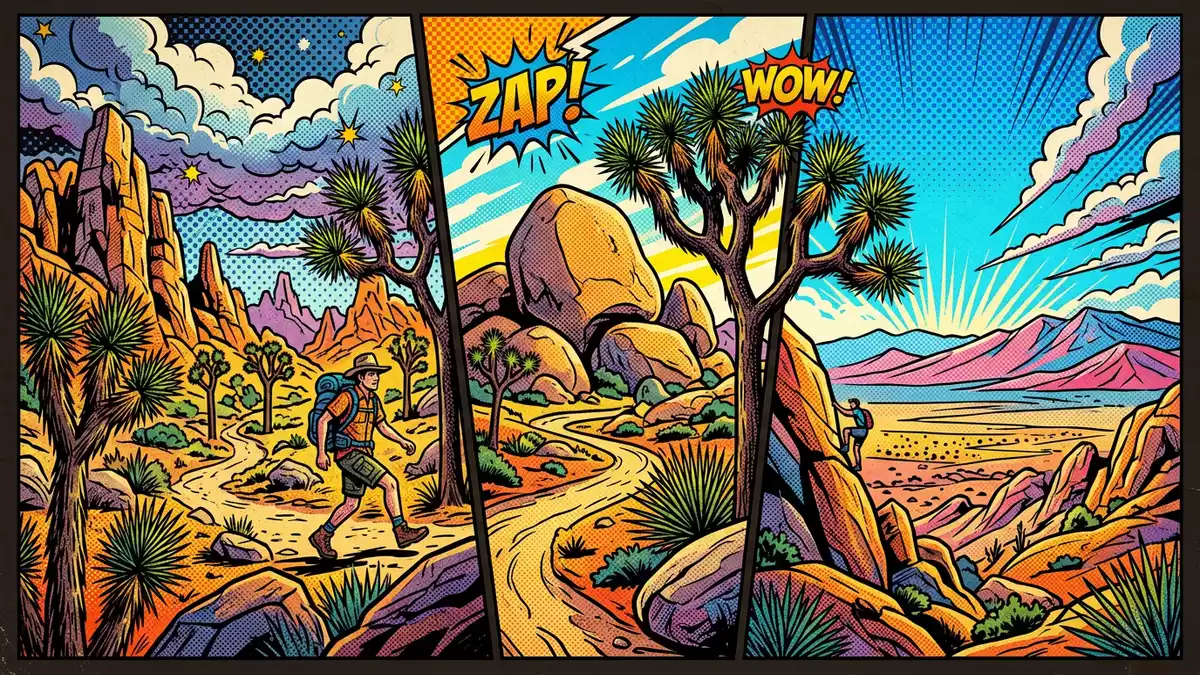
Joshua Tree National Park is a landscape of branching yuccas and rounded granite boulders in southern California. The park’s visible character comes from the meeting of the Mojave and Colorado deserts, with rock formations spread across mountain ranges, basins and open desert.
Rounded granite shapes across the desert
Many of Joshua Tree’s most recognisable formations are made from monzogranite, an intrusive igneous rock that cooled beneath the surface. Fractures divided the rock into large blocks, while erosion and weathering rounded their edges into stacked boulders. The granite formations record geological processes that began more than 100 million years ago.
The park also contains dikes, faults and exposed rock surfaces. Its oldest rocks are metamorphic formations between 1.4 and 1.7 billion years old. Across the landscape, these materials place very old geological history beside younger mountain and desert forms.
Where the Mojave meets the Colorado Desert
Joshua Tree National Park lies along the Little San Bernardino Mountains in southern California. Its western areas belong to the Mojave Desert, while the lower eastern areas lie within the Colorado Desert. The transition can be seen in the vegetation, elevation and arrangement of the landscape.
The park’s namesake is the Joshua tree, Yucca brevifolia, a yucca rather than a true tree. Extensive stands occur in the western part of the park, where the plant rises above the desert floor with branching trunks and clusters of stiff leaves. The Joshua tree species shares its habitat with Mojave yucca, creosote bush, ocotillo and other desert plants.
Elevation varies sharply across the park, from 536 feet to 5,814 feet at Quail Mountain. This range gives the park several ecological zones within one protected area, including desert flats, rocky hills and mountain slopes.
From national monument to national park
Joshua Tree National Monument was established on 10 August 1936 by President Franklin D. Roosevelt. The protected area became Joshua Tree National Park in 1994 through the California Desert Protection Act. Minerva Hoyt played a significant part in the campaign for desert protection during the 1930s.
Human history reaches much further back. Pinto culture sites date back more than 8,000 years, and the territories of the Cahuilla, Chemehuevi and Serrano intersected in the region. Historic remains include mines, ranch buildings, dams, wells and traces of cattle operations from the nineteenth and early twentieth centuries.
Keys Ranch, Barker Dam, Lost Horse Mine and Wall Street Mill connect the desert landscape with mining, ranching and homesteading. The park’s protected history includes both Indigenous heritage and the material remains of later settlement.
Visiting Joshua Tree National Park: what travellers from Western Europe should know
- Joshua Tree National Park lies east of Los Angeles in California. Interstate 10 reaches the southern entrance near Cottonwood Spring, while California State Route 62 leads towards the northern entrances.
- The park combines desert roads, exposed granite, mountain terrain and open distances between named sites. Short walks include Hidden Valley, Barker Dam, Arch Rock and the Discovery Trail.
- The town of Joshua Tree lies beside the western entrance area. Twentynine Palms lies near the northern part of the park, and Palm Springs is south-west of the protected landscape.
- The official language is English and the currency is the US dollar.
Searching for Joshua Tree National Park on social platforms
These links open searches for Joshua Tree National Park on each platform.Frequently asked questions about Joshua Tree National Park
Where is Joshua Tree National Park?
It is in southern California, east of Los Angeles, along the Little San Bernardino Mountains. The park extends across the transition between the Mojave and Colorado deserts.
What can visitors expect to see?
The landscape includes Joshua trees, rounded granite boulders, desert vegetation, mountain terrain and historic mining and ranching sites. Named places include Hidden Valley, Barker Dam, Keys Ranch and Lost Horse Mine.
What makes the park distinctive?
Its identity comes from the combination of branching Joshua trees, sculpted monzogranite and two desert ecosystems. Geological formations more than 100 million years old appear beside cultural remains from Indigenous and historic communities.


