
Kakh-e Golestan, the tiled royal heart of Teheran
Published on 08/16/2026 at 13:46 | Editorial responsibility: Rafael Müller, Editor-in-Chief AD HOC NEWS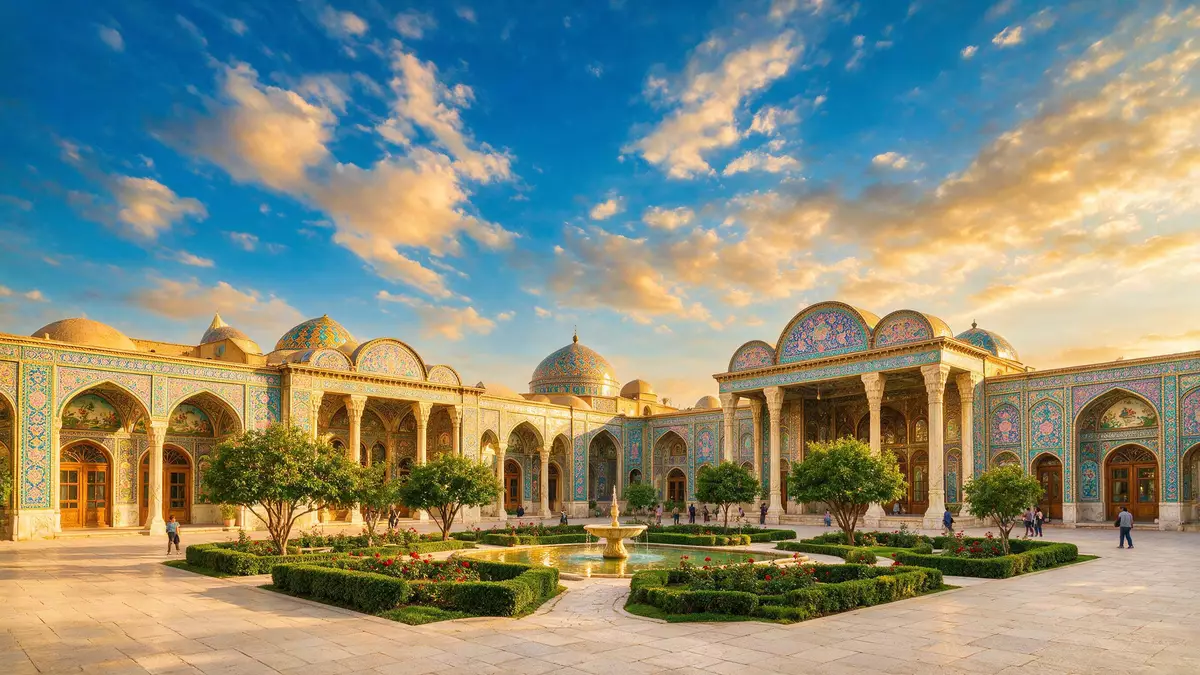
Kakh-e Golestan in Teheran is a royal palace complex where vivid tilework, mirrored interiors and formal gardens capture Iran’s transition from Safavid foundations to Qajar-era kingship. Centred on a walled ensemble in the historic core of Teheran, it became the seat of government for the Qajar dynasty after they made Teheran the capital in 1779.
From Safavid origins to Qajar royal residence
Kakh-e Golestan belongs to a group of palatial buildings that grew out of a Safavid-era citadel, known as the arg, in what is now central Teheran.Safavid origins The complex took on its most distinctive form in the nineteenth century, when the Qajar family established it as their official residence and seat of power after rising to rule in the late eighteenth century.Qajar royal complex
Golestan, meaning “place of flowers”, refers both to the palace’s ceremonial hall and to its gardens, which are laid out as a green central space within high enclosing walls. Within this walled setting stand multiple palaces, museums and reception halls that once formed the core of Iranian monarchy and state ceremony and now hold collections of Iranian crafts and European gifts from the eighteenth and nineteenth centuries.royal buildings and collections
Tiled facades, mirrored halls and the Shams-ol Emareh
The architecture of Kakh-e Golestan is defined by its surface decoration: extensive coloured tiles, carved stone and mirror work on both exteriors and interiors. On the garden side, palace walls are clad with tiles showing courtly scenes, floral arabesques and heraldic emblems, set above stone basements that frame pools and planted borders. This decorative language blends Persian craft traditions with motifs that arrived through nineteenth-century contact with Europe, a mixture that became characteristic of Qajar public architecture.integration of Persian and Western influences
Inside, several halls are lined with mirror mosaics that catch and multiply light around ceremonial spaces, alongside marble thrones and inlaid doors.mirror hall and marble throne iwan Rising above the ensemble, the Shams-ol Emareh tower provides a vertical accent within the complex, signalled by its height and rich tilework. Its upper levels once offered elevated views over the city beyond the palace walls, marking a contrast between the formal royal courts and the dense urban fabric around them.
UNESCO World Heritage status and museum life
Kakh-e Golestan holds formal recognition as a World Heritage Site, inscribed on the UNESCO list in 2013 for its role as a masterpiece of Qajar-era architecture and for the way it embodies the integration of earlier Persian crafts with Western influences.UNESCO inscription It is also classified as a national monument under Iranian heritage law, underscoring its importance in the history of the capital and the country.
Within the walls, several palace buildings and halls function as museums. Collections include ceramics, jewellery and weapons associated with the Qajar period and later dynasties, as well as ethnographic material and royal furnishings.museum collections The gardens, pools and arcades tie these interiors together into a single complex where architecture, decorative arts and landscape are closely intertwined.
Visiting Kakh-e Golestan: what travellers from Western Europe should know
- Kakh-e Golestan stands in central Teheran, close to Arg Square and Fifteen Khordad Street, within the historic core of the city.
- The complex is enclosed by walls and reached through gates that open into courtyards and gardens, with paved surfaces, steps and interior staircases between the palace buildings.
- Teheran is reached by air at Imam Khomeini International Airport; from the wider city, urban roads and the metro network serve the area around Kakh-e Golestan.
- The official language is Persian (Farsi) and the currency is the Iranian rial.
- Entry requirements depend on your nationality; UK travellers can check the FCDO travel advice at gov.uk/foreign-travel-advice, Irish travellers the Department of Foreign Affairs at ireland.ie.
Searching for Kakh-e Golestan on social platforms
These links open searches for Kakh-e Golestan on each platform.Frequently asked questions about Kakh-e Golestan
Where is Kakh-e Golestan located within Teheran?
Kakh-e Golestan stands in the historic centre of Teheran, close to Arg Square and Fifteen Khordad Street, within the area that once formed the city’s citadel.
What can visitors expect on a first visit to Kakh-e Golestan?
Visitors encounter a walled royal complex with gardens, tiled palace facades and museum interiors displaying ceramics, jewellery, weapons and royal furnishings from Iran’s dynastic history.
What makes Kakh-e Golestan distinctive among Teheran’s historic sites?
The palace combines Safavid-era origins, Qajar-period royal architecture, elaborate tilework and mirrored halls, and it carries formal recognition as both a national monument and a UNESCO World Heritage Site.


