
Kapadokya’s valleys of volcanic tuff and carved churches
Published on 09/24/2026 at 04:57 | Editorial responsibility: Rafael Müller, Editor-in-Chief AD HOC NEWS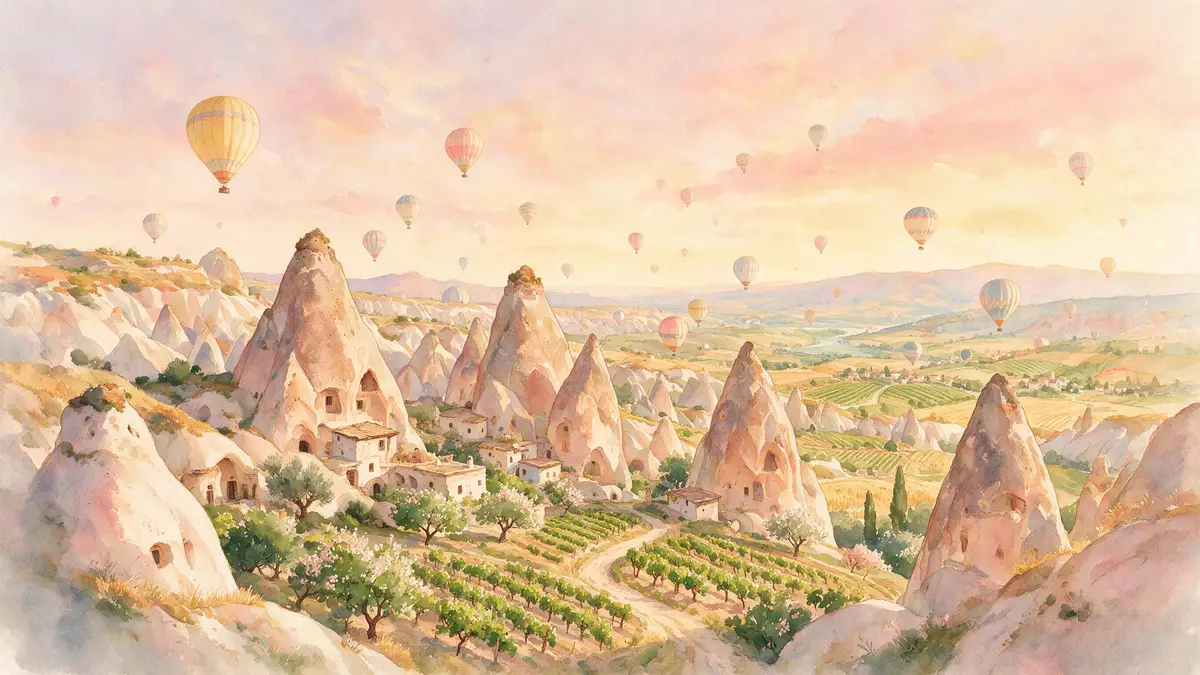
Kapadokya is a central Anatolian landscape where volcanic tuff forms valleys, ridges and tall rock pinnacles around Göreme. The same soft rock contains churches, chapels, monasteries, dwellings and underground settlements, making the region a place where geology and human history occupy the same visible terrain.
Kapadokya: a landscape shaped from volcanic tuff
Göreme lies on a broad plateau created by volcanic deposits. Ash from eruptions hardened into tuff, while darker lava layers formed harder caps above parts of the softer rock. Erosion then cut the plateau into valleys and isolated pinnacles known as fairy chimneys. Göreme’s volcanic landscape belongs to the protected cultural and natural setting recognised as Göreme National Park and the Rock Sites of Cappadocia.
The landscape extends beyond the town into valleys and settlements across central Anatolia. Its visible forms include pointed columns, vertical rock faces, sheltered hollows and broad expanses of pale stone. The texture changes from smooth eroded surfaces to rougher lava remnants, giving the valleys a layered geological appearance.
Göreme’s churches cut into the valleys
Christian communities used the rock around Göreme for religious and communal spaces. The Göreme Open Air Museum preserves a monastic complex with rock-cut churches, chapels, refectories and decorated interiors. The churches are associated with the Byzantine period, particularly the centuries when Christian monastic life developed across Cappadocia.
Inside the excavated spaces, painted scenes cover walls and ceilings. Their subjects include Christ, the Virgin Mary, apostles, saints and episodes from the New Testament. The rooms vary from small chapels to larger churches with columns, apses and connected chambers. the Göreme cave churches form part of the region’s Byzantine artistic heritage.
Kapadokya’s religious architecture cannot be separated from its material. The walls are not built from quarried blocks; they are carved into the tuff itself. Doorways, arches, benches, storage spaces and worship areas appear within the same geological mass that forms the surrounding cliffs.
From early Christianity to a UNESCO cultural landscape
The Cappadocian Fathers Basil the Great, Gregory of Nyssa and Gregory of Nazianzus shaped Christian thought in the fourth century. Their names belong to the history of Cappadocia’s monastic culture, which connected theology, communal life and the use of rock-cut spaces.
Göreme National Park and the Rock Sites of Cappadocia entered the UNESCO World Heritage List in 1985. The recognised area includes Göreme and other cultural landscapes, churches, archaeological sites and underground cities such as Kaymakl? and Derinkuyu. the 1985 World Heritage designation gives the region a formal status that reflects both its geology and its historic settlements.
The underground cities form a different expression of the same relationship between people and rock. Their passages, chambers and storage areas extend below the surface, while the valleys around Göreme preserve open-air settlements and religious complexes. Together, these sites show how Cappadocia contains both monumental landscapes and intimate carved interiors.
Visiting Kapadokya: what travellers from Western Europe should know
- Kapadokya lies in central Anatolia, with Göreme as a principal base for the valleys and rock sites. Nev?ehir is the nearest major regional city, while Ürgüp and Avanos are important nearby towns.
- The terrain combines uneven valley paths, exposed rock, steep slopes and carved interiors. Visits to rock churches and underground cities involve steps, narrow passages or low ceilings.
- The Göreme Open Air Museum is reached from Göreme by road and on foot. The surrounding valleys connect the town with viewpoints, churches and rock formations.
- The official language is Turkish and the currency is the Turkish lira.
- Entry requirements depend on your nationality; UK travellers can check the FCDO travel advice at gov.uk/foreign-travel-advice, Irish travellers the Department of Foreign Affairs at ireland.ie.
Searching for Kapadokya on social platforms
These links open searches for Kapadokya on each platform.
Frequently asked questions about Kapadokya
Where is Kapadokya?
Kapadokya is a historic region of central Anatolia in Türkiye. Göreme lies among its principal valleys and rock-cut sites.
What can visitors expect?
Visitors encounter volcanic valleys, fairy chimneys, carved churches, painted interiors, underground settlements and uneven rocky terrain.
What makes Kapadokya distinctive?
Its distinctive character comes from the close combination of volcanic tuff formations and spaces carved into the same rock. Göreme’s Byzantine churches give the geological landscape a strong cultural dimension.


