

Kapellbrucke in Luzern and its painted wooden span
Published on 08/29/2026 at 16:49 | Editorial responsibility: Rafael Müller, Editor-in-Chief AD HOC NEWS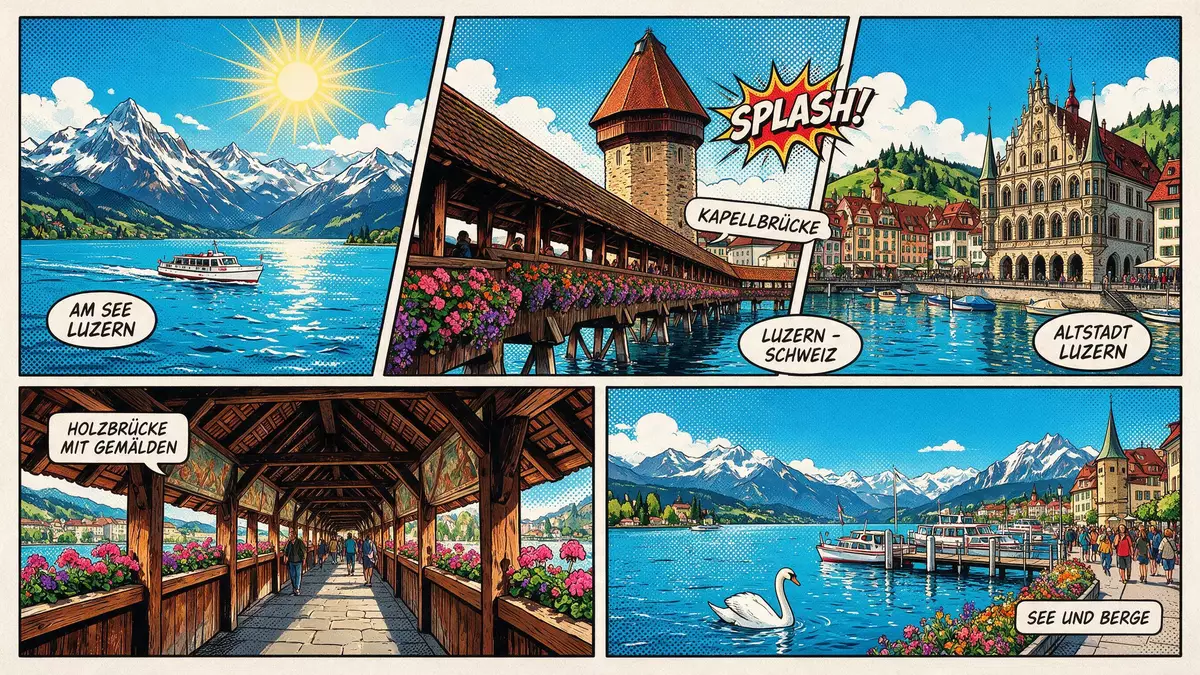
Kapellbrucke in Luzern is a long, covered wooden bridge that crosses the River Reuss at a diagonal, pairing medieval timber engineering with a cycle of historic paintings under its roof. Built in the middle of the fourteenth century and restored after a major fire in the twentieth century, it links the southern bank near Luzerner Theater with the northern bank beside St Peter’s Chapel and has become one of Switzerland’s best known wooden bridges.
A medieval river crossing and fortification
Kapellbrucke was constructed in the middle of the fourteenth century as part of Luzern’s defensive ring and as a footbridge across the Reuss. Dendrochronological analysis of its beams indicates that the bridge was built no earlier than 1356, with written mentions from 1367 identifying it as an integral element of the city’s fortifications.built no earlier than 1356 Running diagonally across the river rather than straight along a single axis, it joined the chapel on the right bank to the former Freienhof complex on the left, closing a gap in the medieval town wall.
The bridge takes its name from St Peter’s Chapel, which stands at the northern bridgehead and anchors its position in Luzern’s historic centre.takes its name from St Peter’s Chapel From the outset, Kapellbrucke served a dual role as a pedestrian route and as an elevated covered walkway from which defenders could watch and protect the approach from the lake. The wall along the lakeside of the bridge is higher than the inner wall, a configuration that reflects this defensive function and once made it easier for soldiers to rest their weapons along the outer edge.the lakeside wall is higher
Length, structure and the Water Tower
Kapellbrucke extends for a little over 200 m (around 670 ft) between its two banks, with its timber deck resting on stone columns set into the riverbed.204.7 metres long In its earlier form the bridge was longer, but nineteenth?century reshaping of the riverfront led to the removal of sections near the banks, leaving the present span as the core of the crossing.nineteenth?century reshaping of the riverfront The bridge’s roof shelters the walkway from rain and frames views along the river and towards the old town, with the timber framing exposed on the inside.
About a third of the way along its zig?zag line stands the octagonal Water Tower, a robust masonry structure that predates the bridge and rises directly from the river. The tower is part of Luzern’s medieval fortifications and has served various roles, including that of a watchtower and store.the Chapel Bridge and its Water Tower As Kapellbrucke bends to pass the tower, its covered walkway briefly narrows, bringing the timber roof, river and stonework into close interplay along the crossing.
Painted panels and twentieth?century reconstruction
Beneath the roof of Kapellbrucke hangs a sequence of triangular paintings mounted on wooden panels, turning the covered bridge into an open?air gallery of civic history. The main cycle was created in the first quarter of the seventeenth century on the initiative of municipal clerk Renward Cysat, with paintings by Hans Heinrich Wägmann and accompanying texts by councilman Hans Rudolf von Sonnenberg.created in the first quarter of the 17th century The scenes depict episodes from the history of Luzern and the Swiss Confederation, along with legends of patron saints such as Mauritius and Leodegar, giving each span between roof supports its own narrative.
A major fire in August 1993 destroyed a substantial portion of the wooden structure and many of the seventeenth?century panels, leaving only the bridgeheads and the Water Tower intact.fire on 18 August 1993 Kapellbrucke was rebuilt and reopened in the mid?1990s, with damaged sections of the timber framing and roof replaced and a selection of surviving paintings reinstalled alongside new panels that mark the loss. Since 1913 the bridge has been protected as a cultural monument of national importance, reflecting both its age and its distinctive combination of timber engineering, fortification and painted narrative.protected as a cultural monument of national importance
Visiting Kapellbrucke: what travellers from Western Europe should know
- Kapellbrucke crosses the River Reuss between the southern bank near Luzerner Theater and the northern bank by St Peter’s Chapel in Luzern’s historic centre.
- The bridge is a covered wooden walkway with steps at its entrances and a timber deck that can be narrow where it passes the Water Tower.
- The surrounding streets include Rathausquai and the riverfront promenade, so Kapellbrucke sits within easy reach of other historic buildings and squares in the old town.
- The official language is German and the currency is the Swiss franc.
Searching for Kapellbrucke on social platforms
These links open searches for Kapellbrucke on each platform.
Frequently asked questions about Kapellbrucke
Where is Kapellbrucke located in Luzern?
Kapellbrucke spans the River Reuss in Luzern’s historic centre, linking the southern bank near Luzerner Theater with the northern bank by St Peter’s Chapel.
What can visitors expect when walking across Kapellbrucke?
Visitors cross a covered wooden bridge with exposed timber framing, views of the river and town, and a sequence of triangular paintings mounted under the roof.
What makes Kapellbrucke distinctive among Swiss bridges?
Kapellbrucke combines a fourteenth?century timber structure, a defensive role within Luzern’s medieval fortifications and a seventeenth?century painted cycle depicting local and Swiss history.


