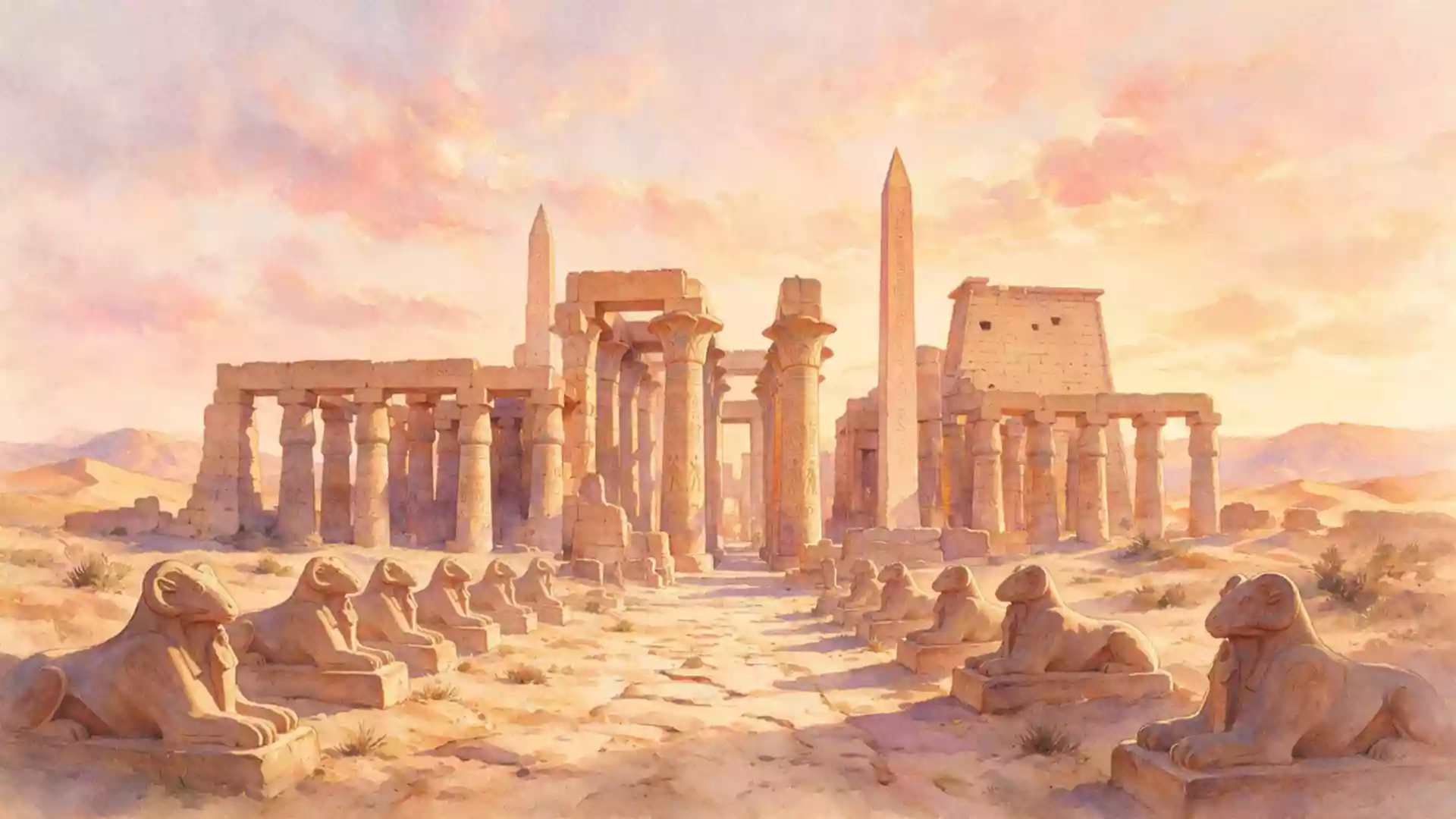
Karnak’s stone avenues and temple halls
Published on 08/07/2026 at 15:00 | Editorial responsibility: Rafael Müller, Editor-in-Chief AD HOC NEWS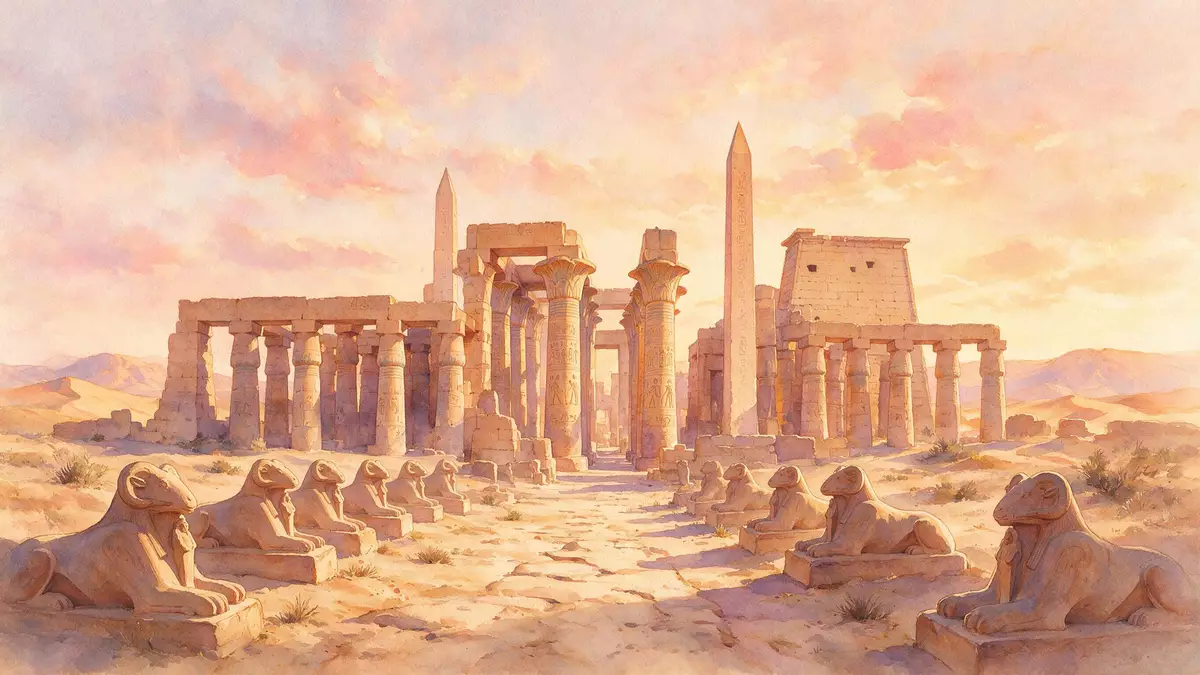
Karnak in Luxor is a vast temple complex of sandstone courts, pylons and hypostyle halls linked to the cult of Amun. Its core monuments belong to the New Kingdom, with major work under Seti I and Ramesses II.
Karnak’s layered temple complex
The name Karnak covers a large sacred area on the east bank of the Nile, within modern Luxor. The site is best known for the Temple of Amun-Re, but it also contains sanctuaries, chapels and processional avenues from several phases of ancient Egyptian building.
The great hypostyle hall is one of its most striking spaces. Dense rows of massive columns rise under a roofed stone interior, while pylons mark successive entrances deeper into the complex.
Seti I, Ramesses II and the New Kingdom
Much of the visible monumental fabric belongs to the New Kingdom, especially the 19th Dynasty. Seti I began important work in the Great Hypostyle Hall, and Ramesses II completed parts of it, leaving reliefs and inscriptions across the stone surfaces.
Karnak also preserves traces from other periods of Egyptian history, including additions by later pharaohs and rulers. The result is a place that reads as a long sequence of sacred construction rather than a single finished monument.
Walking through courts, columns and processional space
Visitors move through open courts, enclosed halls and long axial passages defined by stone gateways. Obelisks, carved walls and ruined shrines create a sequence of surfaces and heights that changes from one part of the site to another.
The complex is tied to ancient ritual movement as well as architecture. Its avenues, gateways and courts present a monumental setting that still makes the layout easy to read on foot.
Visiting Karnak: what travellers from Western Europe should know
- Karnak is in Luxor, on the east bank of the Nile in Egypt. It is reached from Luxor by road.
- Admission arrangements and opening hours are set by the site's operator and change with the season; the official website is the only binding source.
- The best time to go is in the cooler months, or in the early part of the day, when the stone surfaces are less punishing under the sun.
- The site has long walks, uneven ground and many steps and thresholds between its courts and halls.
- Local language use is Arabic, while Egyptian pounds are the normal currency for everyday spending near the site. Restrictions may apply on site.
- Entry requirements depend on your nationality. UK travellers should check the FCDO travel advice at gov.uk/foreign-travel-advice; Irish travellers the Department of Foreign Affairs at ireland.ie; EU and EEA citizens their own national foreign ministry.
Searching for Karnak on social platforms
These links open searches for Karnak on each platform.
Frequently asked questions about Karnak
Where is Karnak?
Karnak is in Luxor, on the east bank of the Nile in southern Egypt. It forms part of the ancient temple landscape of Thebes.
What should visitors expect?
Expect a large archaeological site with gateways, open courts, monumental columns and carved stone walls. The ground is uneven in places, and the scale of the complex is best taken in gradually.
What makes Karnak distinctive?
Its extraordinary depth of history is visible in stone, from the New Kingdom through later additions. The Great Hypostyle Hall and the temple avenues make the complex one of the clearest surviving ritual landscapes from ancient Egypt.