
Kasbah des Oudaias and Rabat’s blue-and-white lanes
Published on 09/23/2026 at 22:48 | Editorial responsibility: Rafael Müller, Editor-in-Chief AD HOC NEWS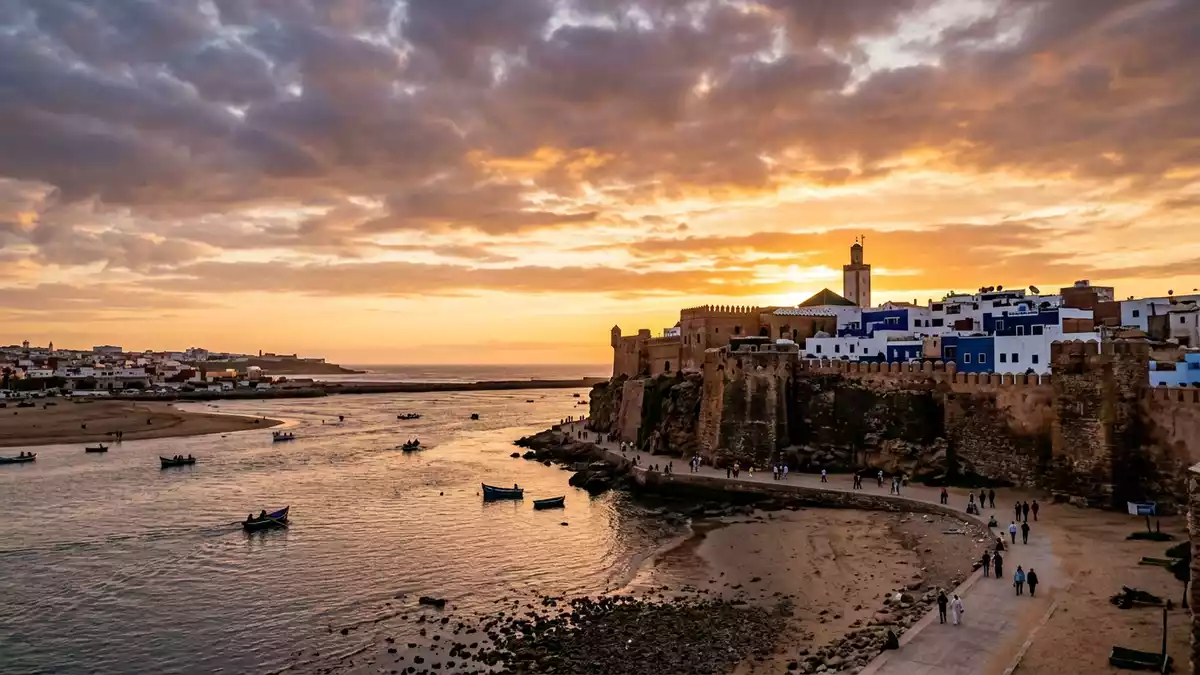
Kasbah des Oudaias occupies a fortified hill at the mouth of the Bouregreg River in Rabat. Its pink ramparts enclose blue-and-white lanes, historic residences, gardens and views towards the Atlantic coast and Salé.
Blue-and-white streets inside a fortified hill
The kasbah combines the firm geometry of a citadel with the close scale of a residential quarter. Whitewashed walls carry blue doors, blue window surrounds and blue-painted passages, while the outer fortifications retain the colour and weight of earthen ramparts.
At the northern edge, Bab Oudaia forms a monumental entrance through the defensive walls. The gate belongs to the Almohad period and carries carved decoration within a broad, sandy-coloured façade. Inside, lanes bend between houses instead of opening into a single formal square.
From the Almohads to Rabat’s heritage landscape
The Almohad caliph Abd al-Mu’min established a kasbah at Rabat in the twelfth century. The fortified settlement expanded through later periods, including the seventeenth-century presence of Andalusian communities and the Alaouite era.
The name refers to the Udaya guich tribe, which settled in the kasbah during the seventeenth century. The site forms part of Rabat’s UNESCO heritage property, inscribed in 2012 as “Rabat, Modern Capital and Historic City: a Shared Heritage”.
Gardens, palace rooms and the river mouth
The Andalusian Garden occupies the southern part of the kasbah. Its planted beds, clipped greenery, tiled paths and shaded passages form a distinct garden composition within the defensive enclosure.
The Oudayas Museum occupies rooms associated with the palace of Sultan Moulay Ismail. Its displays connect jewellery, clothing, ceramics and musical instruments with Moroccan artistic traditions. The kasbah’s position also keeps the Bouregreg estuary, the Atlantic and Salé within the same visual field.
Visiting Kasbah des Oudaias: what travellers from Western Europe should know
- Kasbah des Oudaias lies in northern Rabat beside the Bouregreg estuary and the old Medina. It is reached on foot through the Medina or by road along Avenue Al Marsa.
- The lanes include steps, uneven paving and sloping passages. Comfortable walking shoes suit the stone and tiled surfaces.
- The kasbah is a living residential quarter, with houses, craft spaces, cafés and small galleries among the historic walls.
- The official language is Arabic and the currency is the Moroccan dirham.
- Entry requirements depend on your nationality; UK travellers can check the FCDO travel advice at gov.uk/foreign-travel-advice, Irish travellers the Department of Foreign Affairs at ireland.ie.
Searching for Kasbah des Oudaias on social platforms
These links open searches for Kasbah des Oudaias on each platform.Frequently asked questions about Kasbah des Oudaias
Where is Kasbah des Oudaias?
Kasbah des Oudaias is in northern Rabat, beside the Bouregreg estuary where the river reaches the Atlantic coast. Salé lies across the water.
What can visitors see inside?
The enclosure contains blue-and-white residential lanes, Almohad fortifications, Bab Oudaia, the Andalusian Garden and the Oudayas Museum.
What makes the kasbah distinctive?
Its identity comes from the meeting of a twelfth-century citadel, later palace spaces, Andalusian garden design and a living blue-and-white neighbourhood.


