

Kata Tjuta and its red domes above Yulara
Published on 08/11/2026 at 15:12 | Editorial responsibility: Rafael Müller, Editor-in-Chief AD HOC NEWS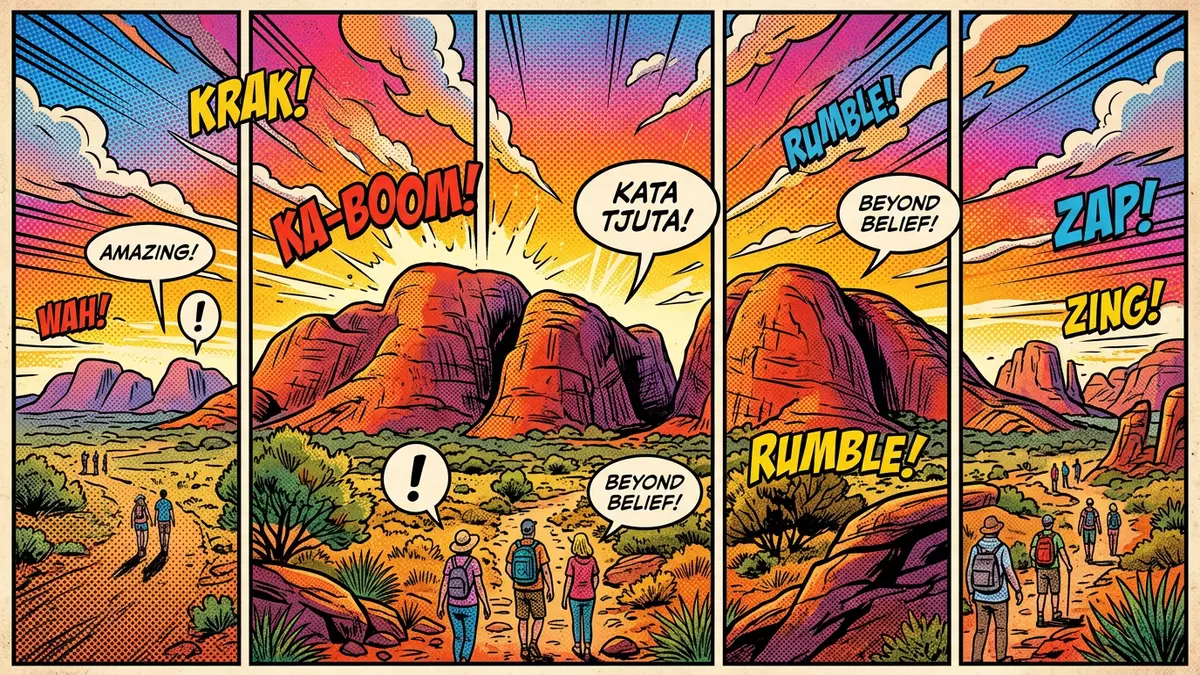
Kata Tjuta rises as a cluster of rounded domes in Australia’s Northern Territory, west of Yulara and within Uluru-Kata Tjuta National Park. Its bulk of conglomerate rock makes the landform read as a single mass from a distance, then as a set of separate ridges, gullies and slopes up close.
Kata Tjuta’s domes and valleys
The site is formed by many steep-sided domes rather than one peak. Walks through Walpa Gorge and the Valley of the Winds pass between rock walls, shaded channels and open desert views.
That contrast between broad desert horizon and enclosed rock corridors is one of the clearest features on site. The domes catch light and shadow in hard lines, while the lower ground carries sparse spinifex and scattered desert shrubs.
An Anangu cultural landscape
Kata Tjuta lies within A?angu country and belongs to a wider living cultural landscape associated with Uluru. The name Kata Tjuta is used alongside the older English name the Olgas, and the place remains tied to traditional knowledge and cultural practice.
The rock formations are not separated from that cultural meaning. They sit within a park where landscape, story and land management are linked, and where the desert forms are read as part of a continuing place rather than a distant relic.
Stone, weather and scale
The domes are made of a coarse rock that contains pebbles and larger fragments held in a finer matrix. Their surfaces show gullies, fractures and weathered slopes, giving the formation a rough texture that differs from the smoother silhouettes seen from afar.
Even without height figures, the scale is obvious when the domes fill the skyline above the plain. The landform extends across several rises, with narrow passes and open basins that make the site feel layered rather than singular.
Visiting Kata Tjuta: what travellers from Western Europe should know
- The site is reached from Yulara by road.
- Admission arrangements and opening hours are set by the site's operator and change with the season; the official website is the only binding source.
- Late afternoon and early morning suit the rock colours and lower heat.
- Tracks can be uneven, exposed and steep in places, with long walks across desert ground.
- Facilities are limited on site, and water, sun protection and sturdy shoes matter.
- Entry requirements depend on your nationality. UK travellers should check the FCDO travel advice at gov.uk/foreign-travel-advice; Irish travellers the Department of Foreign Affairs at ireland.ie; EU and EEA citizens their own national foreign ministry.
Searching for Kata Tjuta on social platforms
These links open searches for Kata Tjuta on each platform.
Frequently asked questions about Kata Tjuta
Where is Kata Tjuta?
It is in central Australia, in Uluru-Kata Tjuta National Park near Yulara in the Northern Territory. The domes sit in a desert setting west of Uluru.
What can visitors expect?
Expect rock domes, walking tracks, open desert views and strong heat in exposed places. Some paths are short and accessible, while others are steep and demanding.
What makes it distinctive?
Its many domes create a landscape that feels both monumental and fragmented. The place also carries Anangu cultural significance, which gives it meaning beyond its form.


