
Katara’s theatres, mosques and sea-facing streets in Doha
Published on 09/22/2026 at 12:07 | Editorial responsibility: Rafael Müller, Editor-in-Chief AD HOC NEWS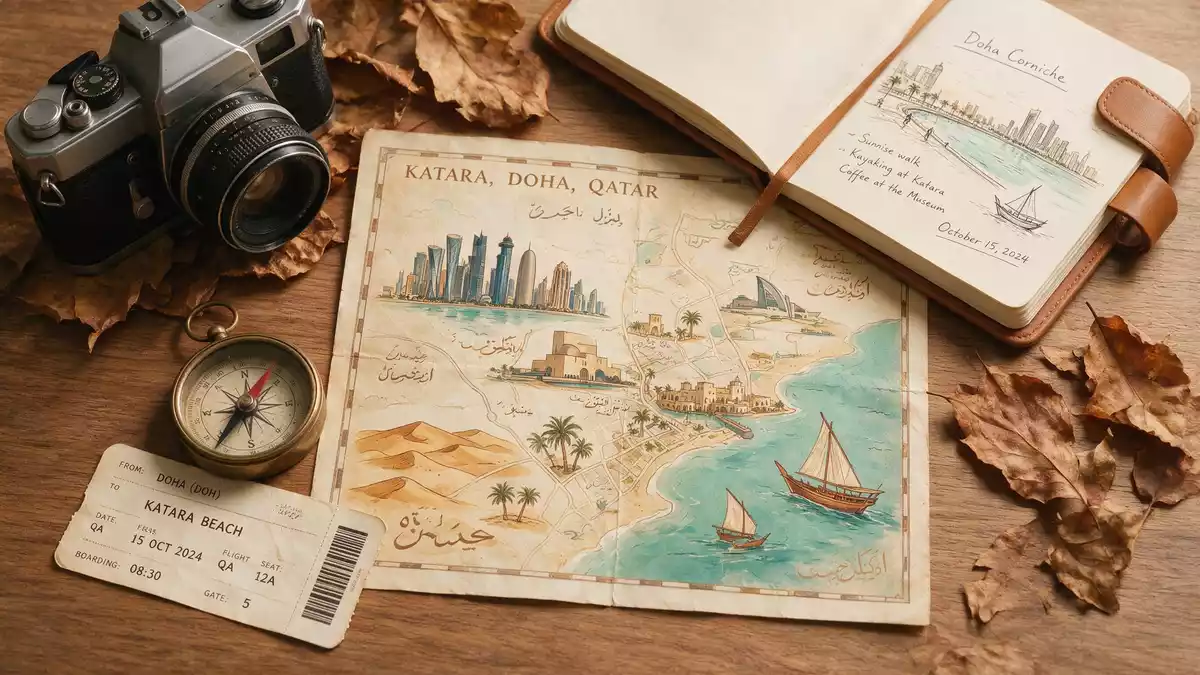
Katara is a cultural district on Doha’s eastern waterfront, set between West Bay and The Pearl. Its sand-coloured streets bring theatres, galleries, mosques, public art and the Arabian Gulf into one walkable urban setting.
The district was founded in 2010 under the direction of Sheikh Hamad bin Khalifa Al Thani. Its buildings and public spaces form a cultural quarter rather than a residential neighbourhood, with architecture drawing on Qatari, Islamic and Mediterranean references.
Katara’s streets between city and sea
Katara occupies a coastal site north of central Doha, along Lusail Street. The district opens towards a broad beach, while Katara Hills rise on the inland side. West Bay’s towers and The Pearl lie at opposite ends of the surrounding urban landscape.
Low buildings, courtyards, arcades and narrow lanes give the quarter a village-like appearance. The colour palette runs through sand, cream and pale stone, with decorated façades and shaded passages around plazas. The setting combines public architecture with cafés, restaurants, galleries and exhibition spaces.
The name Katara has an older cartographic history. Claudius Ptolemaeus used the form Catara for the Qatar peninsula in a map associated with 150 CE, while the spelling Katara appeared in maps of the early eighteenth century. The revived name links the district with an earlier name for the country.
An amphitheatre framed by Islamic architecture
At the centre of Katara stands an open-air amphitheatre that combines classical Greek theatre elements with Islamic architectural details. Arched entrances and stepped seating face the stage, while the upper structure opens towards the sea and surrounding buildings. The amphitheatre covers 3,275 square metres and has seating for up to 5,000 spectators.
Its scale contrasts with the smaller lanes around it. The venue hosts concerts, film screenings and theatrical performances, placing a large performance space inside a compact cultural district. A bronze, stainless-steel and aluminium sculpture by Lorenzo Quinn stands between the amphitheatre and the water.
Katara’s amphitheatre is one of the district’s clearest architectural contrasts: classical seating and arches meet the open coastline, while the adjacent streets contain galleries, restaurants and smaller cultural venues.
Blue tiles, gold mosaics and cultural venues
The Katara Mosque, also known as the Blue Mosque, was designed by Turkish architect Zeynep Fad?ll?o?lu. Persian and Turkish tilework in blue and gold covers the building, including its dome, minaret and prayer niche. Its decoration draws on several traditions of Islamic architecture.
A smaller Golden Mosque faces the amphitheatre. Its surface is covered with gold-coloured tiling, creating a strong visual difference from the blue and turquoise decoration of the Katara Mosque. Pigeon towers near the mosques add another distinctive building type to the district.
Katara’s cultural facilities include an opera house, a drama theatre, galleries, workshops, exhibition areas and the Al Thuraya Planetarium. The opera house is associated with the Qatar Philharmonic Orchestra, whose programme includes Western and Arabic music. The planetarium presents astronomy, geology, the atmosphere and the oceans.
The district also contains the Qatar Museum Gallery, Katara Art Center, Qatar Photography Society, Qatar Music Academy, Doha Film Institute and Qatar Fine Arts Association. Their presence gives Katara a cultural programme extending beyond a single monument or performance venue.
Sheikh Hamad bin Khalifa Al Thani is connected with Katara’s foundation in 2010. The district’s name, architecture and institutions place Qatari heritage alongside international forms of music, theatre, visual art and design.
Visiting Katara: what travellers from Western Europe should know
- Katara lies on Doha’s eastern shoreline between West Bay and The Pearl. Road access and the Doha Metro’s Red Line serve the district, with Katara Station nearby.
- The quarter includes paved lanes, courtyards, steps, beach areas and the raised Katara Hills. The terrain changes between the waterfront, the amphitheatre and the landscaped hills.
- Katara Beach faces the Arabian Gulf, while the northern and southern hills contain planted areas, paths and viewpoints across the district.
- The official language is Arabic and the currency is the Qatari riyal.
- Entry requirements depend on your nationality; UK travellers can check the FCDO travel advice at gov.uk/foreign-travel-advice, Irish travellers the Department of Foreign Affairs at ireland.ie.
Searching for Katara on social platforms
These links open searches for Katara on each platform.
Frequently asked questions about Katara
Where is Katara?
Katara is on Doha’s eastern waterfront between West Bay and The Pearl. Lusail Street and the Doha Metro’s Red Line connect it with the wider city.
What can visitors see at Katara?
The district contains an amphitheatre, mosques, galleries, theatres, a planetarium, public art, Katara Hills and a beach facing the Arabian Gulf.
What makes Katara distinctive?
Katara combines a 3,275-square-metre amphitheatre, blue and gold mosque decoration, sand-coloured streets and cultural institutions in one coastal quarter.


