
Kathmandu Durbar Square and the layered courtyards of royal Kathmandu
Published on 09/01/2026 at 07:38 | Editorial responsibility: Rafael Müller, Editor-in-Chief AD HOC NEWS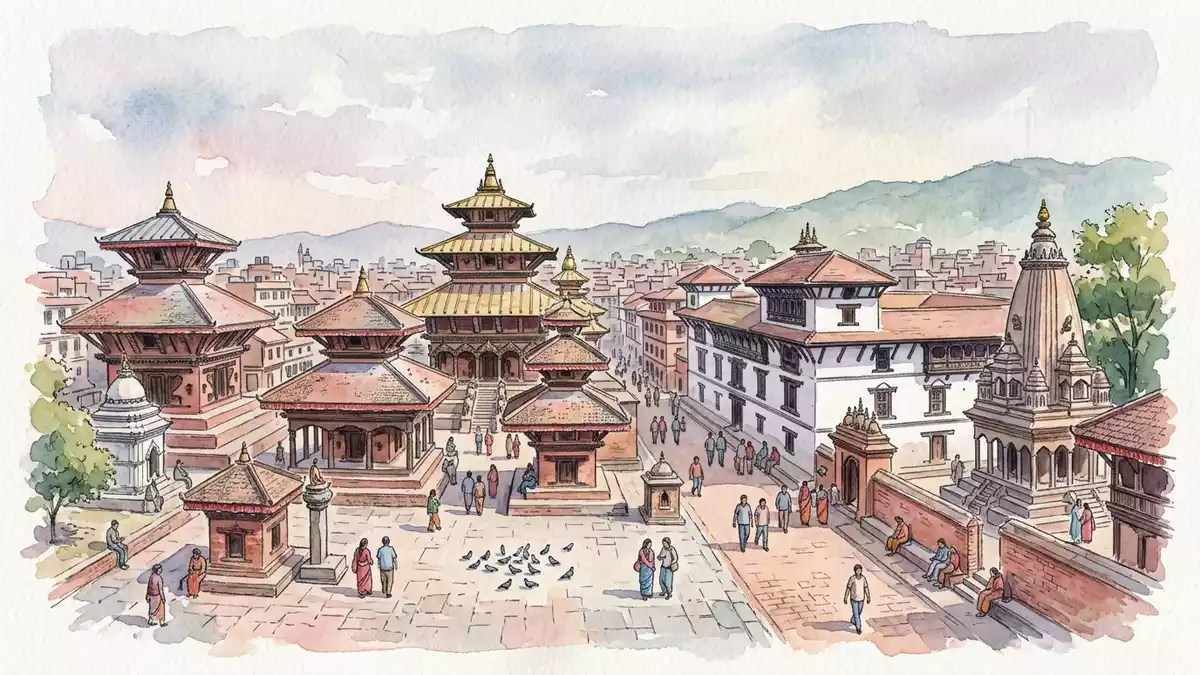
Kathmandu Durbar Square, also known as Hanuman Dhoka or Basantapur Durbar Square, concentrates royal palaces, shrines and stepped courtyards into a tight historic core of Kathmandu. The ensemble grew between the Licchavi era and the rule of the Malla and Shah dynasties, turning this corner of the Kathmandu Valley into a layered record of power, ritual and Newar craftsmanship.
Royal courtyards and the Hanuman Dhoka palace
At the centre of Kathmandu Durbar Square stands the Hanuman Dhoka palace complex, the former royal residence of the Malla kings and later the Shah dynasty who ruled Nepal.Hanuman Dhoka palace Within its courtyards, kings of both dynasties were crowned and enthroned, and the complex remained a seat of royal ceremony into the nineteenth century.kings were crowned
The palaces around the inner square developed over many centuries, with early structures linked to the Licchavi period and major expansions during the Malla era from the twelfth to the eighteenth century.significant developments came under the Malla dynasty In the eighteenth century King Prithvi Narayan Shah, who unified Nepal, commissioned the Nautalle Durbar, a nine-storey palace that still rises over the southern side of the complex and marks the shift from independent Malla courts to a single Shah kingdom.Nautalle Durbar, a nine-story palace
Temples, living traditions and Newar craftsmanship
Around the palace blocks, Kathmandu Durbar Square is lined with temples whose timber fronts and brick plinths carry dense carving, a hallmark of Newar artisanship in the valley.Newari architecture from the 12th to 18th centuries Many of the shrines date from the sixteenth and seventeenth centuries, when Malla rulers such as King Mahendra Malla and King Pratap Malla endowed the square with temples dedicated to deities including Jagannath, Kotilingeswara Mahadev, Mahendreswara and Taleju.oldest temples were constructed by King Mahendra Malla
Along one edge stands the Kumari Ghar, the residence of the Kumari, a girl revered in Kathmandu as a Living Goddess, whose presence connects the square’s carved brick façades with ongoing religious practice.the Kumari Ghar — the residence of the Living Goddess Nearby, the Kasthamandap pavilion, linked in local tradition to the early formation of Kathmandu as a city, anchors the outer quadrangle and gives the capital its name.Kasthamandap
A World Heritage square in the Kathmandu Valley
Kathmandu Durbar Square forms part of the Kathmandu Valley monument zones inscribed on the UNESCO World Heritage List in 1979, recognised for their concentration of palaces, shrines and sacred spaces.Kathmandu Valley World Heritage Property Within the valley, three royal squares stand out: the palace squares of Kathmandu, Patan and Bhaktapur, each reflecting the competitive building culture of the Malla courts.
In Kathmandu, the Durbar Square gathers more than one palace courtyard, clusters of pagoda-roofed temples and free-standing statues around an irregular open space that faces the old city streets.central square is surrounded by palace complexes The mix of Hindu and Buddhist shrines, royal commemorative columns and civic spaces reflects the religious and political life of the valley from the Licchavi period through the end of the monarchy.
Visiting Kathmandu Durbar Square: what travellers from Western Europe should know
- Kathmandu Durbar Square lies in the old city of Kathmandu, south-west of the modern commercial districts, and is reached on foot or by road from other neighbourhoods.Durbar Square of Kathmandu is in the old city
- The palace and temple platforms rise above stone-paved ground, and moving between the courtyards involves stepped thresholds and uneven surfaces that require attention underfoot.architectural complex
- The square stands within the wider Kathmandu Valley at an elevation above sea level that can leave first-time visitors from lowland Western Europe aware of the thinner air during longer walks.Kathmandu
- The official language is Nepali and the currency is the Nepalese rupee.
- Entry requirements depend on your nationality; UK travellers can check the FCDO travel advice at gov.uk/foreign-travel-advice, Irish travellers the Department of Foreign Affairs at ireland.ie.
Searching for Kathmandu Durbar Square on social platforms
These links open searches for Kathmandu Durbar Square on each platform.
Frequently asked questions about Kathmandu Durbar Square
Where is Kathmandu Durbar Square?
Kathmandu Durbar Square stands in the old city of Kathmandu in central Nepal, within the wider Kathmandu Valley surrounded by hills.
What should a visitor expect at Kathmandu Durbar Square?
A visitor encounters palace courtyards, carved brick-and-timber temples, shrines and statues arranged around open stone-paved spaces and narrow city lanes.
What makes Kathmandu Durbar Square distinctive among South Asian squares?
The square’s dense mix of royal palaces, Newar pagoda temples, the Kumari’s residence and its role as a former coronation site give it a layered royal character.


