
Kathmandu Durbar Square and the royal palaces of the Newar kings
Published on 09/18/2026 at 06:02 | Editorial responsibility: Rafael Müller, Editor-in-Chief AD HOC NEWS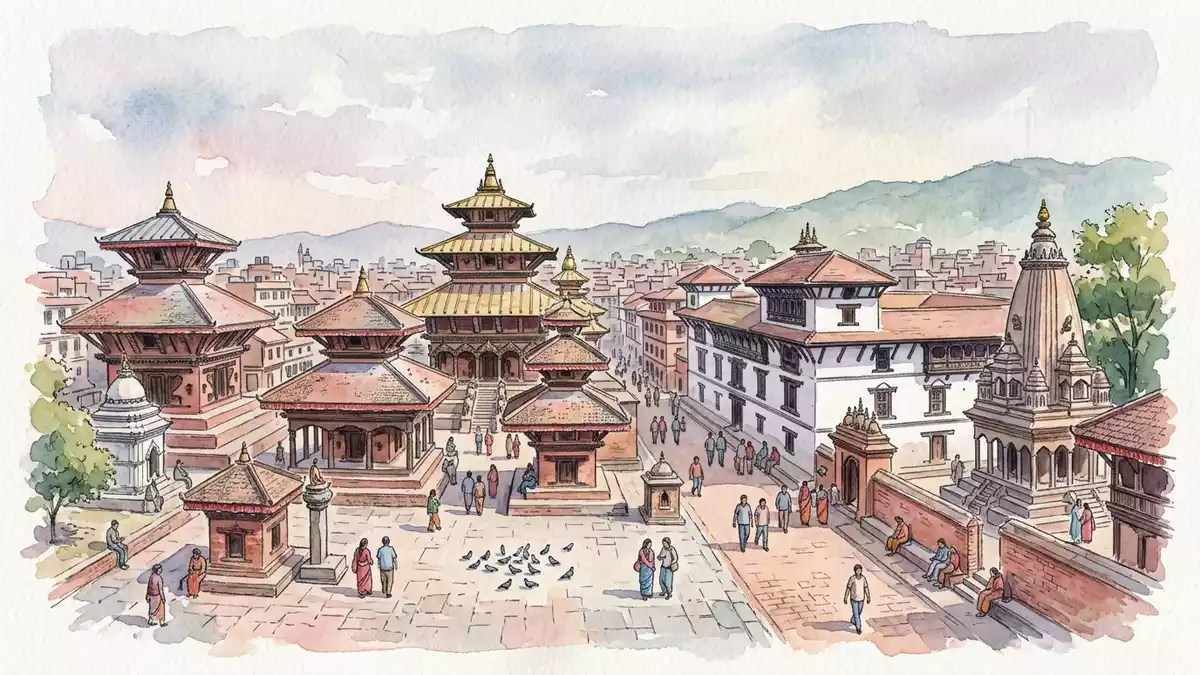
Kathmandu Durbar Square in central Kathmandu is the old royal palace complex of the Malla and Shah dynasties, packed with Newar palaces, temples and courtyards in the heart of the Kathmandu Valley. The square forms one of the monument zones of the Kathmandu Valley UNESCO World Heritage Site, recognised in 1979 for its concentration of historic buildings and urban spaces.Kathmandu Valley inscription
Royal palace square of the Malla and Shah dynasties
The historic core of Kathmandu Durbar Square grew around the Hanuman Dhoka palace, which served as the seat of the kings of Kathmandu for centuries.Hanuman Dhoka palace complex The complex stands within the old city, surrounded by the dense street network of central Kathmandu, and formed the political and ceremonial centre of the Kathmandu Valley kingdom. Its origins lie in the Licchavi era, and many of the palace wings and surrounding temples took shape under the Malla dynasty between the twelfth and eighteenth centuries.Malla-period development
In the mid-eighteenth century Prithvi Narayan Shah unified Nepal under the Shah dynasty, adopting the palace at Kathmandu Durbar Square as the royal residence and ceremonial centre of the new kingdom.Shah dynasty residence The kings of the Shah line continued to use the Hanuman Dhoka complex into the nineteenth century before shifting to newer palaces elsewhere in Kathmandu, leaving the square as a dense record of Newar royal architecture.
Newar architecture in palaces, temples and courtyards
Kathmandu Durbar Square showcases Newar architecture in a compact area, with timber palaces, tiered temples and stone-paved courtyards forming a layered urban ensemble. Many of the structures visible on the square date from the fifteenth to eighteenth centuries, with carved wooden windows, roof struts and doorways displaying highly detailed craftsmanship associated with Newar builders.Newar architectural ensemble Pagoda-roofed temples rise from plinths above the paving, while palace wings frame courtyards used for royal ceremonies and religious festivals.
The square contains a large number of temples and shrines dedicated to Hindu and Buddhist deities, reflecting the religious landscape of the Kathmandu Valley.Hindu and Buddhist shrines Among these stands the Hanuman Dhoka palace itself, with its series of courtyards and reception halls, surrounded by temple platforms and statues. The combination of palaces, public squares and religious buildings gives Kathmandu Durbar Square the character of an open-air museum of Newar architecture, where royal, civic and sacred spaces lie side by side.
Kathmandu Durbar Square within the Kathmandu Valley UNESCO listing
Kathmandu Durbar Square forms part of the wider Kathmandu Valley World Heritage property, which brings together seven protected monument zones across the valley.protected monument zones These include the Durbar Squares of Kathmandu, Patan and Bhaktapur, the Buddhist stupas of Swayambhu and Bauddhanath, and the Hindu temple complexes of Pashupati and Changu Narayan.seven monument zones Within this group, the Hanuman Dhoka area of Kathmandu Durbar Square represents the royal urban centre of the old Kathmandu kingdom.
The UNESCO inscription highlights the exceptional concentration of palaces, temples and public spaces in these monument zones, and the way they illustrate the artistic and architectural achievements of the Newar people of the Kathmandu Valley.UNESCO-recognised ensemble Kathmandu Durbar Square contributes to this picture through its layered royal complex and surrounding temple squares, forming a focal point for understanding the urban and ceremonial history of Nepal’s capital.
Visiting Kathmandu Durbar Square: what travellers from Western Europe should know
- Kathmandu Durbar Square lies in the old city centre of Kathmandu, west of the main commercial streets, and can be reached on foot from central districts and by road vehicles.
- The square itself is paved, with temple platforms and palace steps rising from the ground, and access to upper levels generally involves climbing stairways that can be steep and narrow.
- The site stands within the broader Kathmandu Valley, surrounded by dense urban neighbourhoods, and visits often combine time on the square with nearby streets and smaller courtyard shrines.
- The official language is Nepali and the currency is the Nepalese rupee.
- Entry requirements depend on your nationality; UK travellers can check the FCDO travel advice at gov.uk/foreign-travel-advice, Irish travellers the Department of Foreign Affairs at ireland.ie.
Searching for Kathmandu Durbar Square on social platforms
These links open searches for Kathmandu Durbar Square on each platform.Frequently asked questions about Kathmandu Durbar Square
Where is Kathmandu Durbar Square located?
Kathmandu Durbar Square is situated in the historic centre of Kathmandu, within the Kathmandu Valley in Nepal, surrounded by the old city’s streets and neighbourhoods.
What can visitors expect on a visit?
Visitors encounter palaces, pagoda-roofed temples, shrines and courtyards arranged around paved squares, with detailed Newar woodcarving and stonework visible across the complex.
What makes Kathmandu Durbar Square distinctive?
The square combines the former royal palace of the Malla and Shah dynasties with a dense group of Hindu and Buddhist temples, and forms part of the Kathmandu Valley UNESCO World Heritage Site.


