
Kato Mili windmills above Little Venice in Mykonos
Published on 09/09/2026 at 07:47 | Editorial responsibility: Rafael Müller, Editor-in-Chief AD HOC NEWS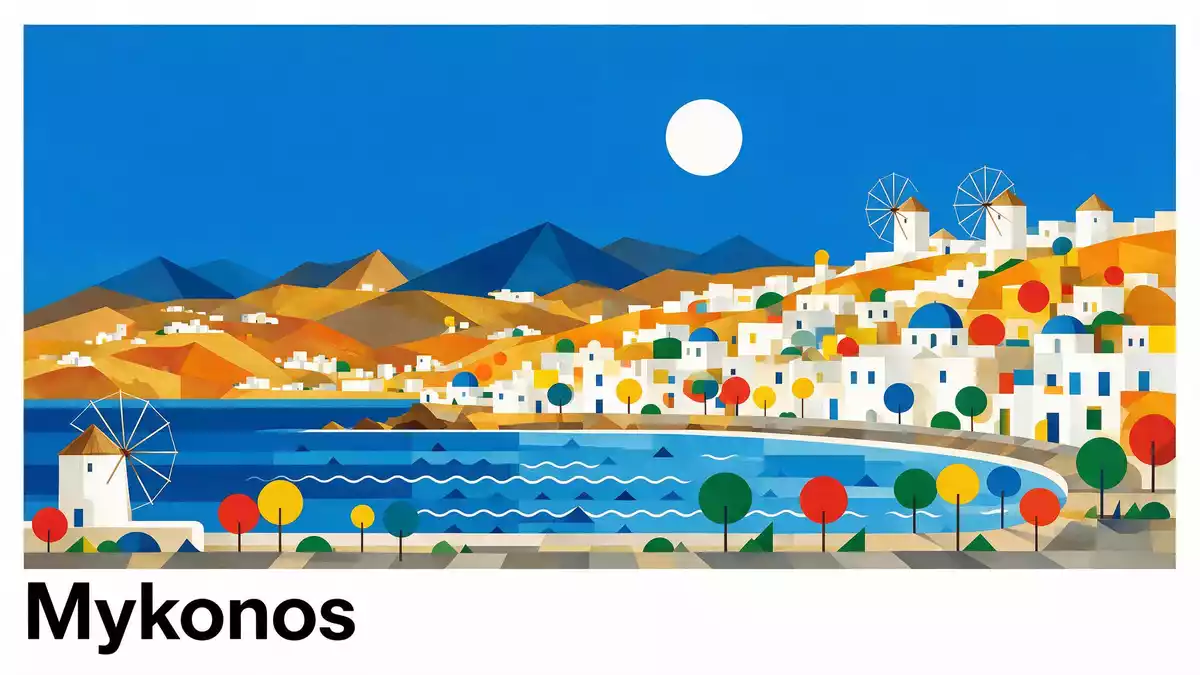
Kato Mili is the name given to the whitewashed windmills standing on the low hill above the waterfront quarter known as Little Venice in Mykonos Town on the island of Mykonos in Greece. Their forms date back to the sixteenth century, when the island lay under Venetian influence and grain milling was a central part of the local economy.
Kato Mili and the lower mills above the sea
The windmills at Kato Mili stand on a slope at the southern edge of Chora, the main town of Mykonos, between the lanes of Alefkandra and Neochori and looking out towards the sea and the harbourfront houses of Little Venice.Situated in between the picturesque Alefkandra and Neochori areas The low rise lifts the mills just enough above the waterfront for them to read as a continuous skyline, their white forms lining the ridge above the quarter below.The windmills at Kato Mili stand on a slope at the southern edge of Chora
Seven cylindrical windmill structures are preserved in this Kato Mili cluster, forming a line along the ridge above the sea and the tavern-lined lanes below.Out of 16 preserved and renovated windmills in Mykonos today, 7 are located in the area of Kato Mili Their white plastered walls and simple caps stand against the blue of sea and sky, and from the hill the view reaches across the harbour and out towards the open water of the central Aegean.
From Venetian-era milling to landmark status
The Mykonos windmills associated with Kato Mili are traditionally dated to the sixteenth century, when Venetian power shaped much of the Aegean and sailing routes passed close to the island.Built by the Venetians in the 16th century Circular stone towers were erected to harness the strong winds and grind grain that was harvested locally or shipped in from neighbouring islands.For centuries, these mills ground barley and wheat harvested locally or shipped in from neighbouring islands
During their main period of operation between the seventeenth and nineteenth centuries, the Kato Mili complex formed part of a wider network of mills on Mykonos, with Kato Mili itself numbering around ten working structures according to some accounts.During its full operation, between the 17th and 19th century, the Kato Mili complex numbered 10 (or 11, according to some accounts) windmills Their output supplied bakeries, provided durable rusks known as paximadi for sailors and passing ships, and made the island an important provisioning stop within the Cyclades.Their output fueled bakeries, supplied sailors with durable rusks called paximadi, and transformed Mykonos into a key provisioning stop
Form, layout and the surrounding townscape
Each Kato Mili structure follows a clear pattern: a cylindrical body built of local stone and plastered white, topped by a simple cap and a frame that once carried wooden sails.The famous Mykonos windmills (also referred and as Kato Mili) The mills align along the crest of the hill so that their bodies read as a row of vertical forms against the horizon, while the low slope beneath them drops towards the waterfront houses and taverns of Little Venice.
The hill at Kato Mili functions as a simple viewing platform that connects the built forms of the mills with the broader townscape of Chora. Looking inland from the ridge, the narrow streets and white cube houses of Mykonos Town spread across the slope, while looking outwards the line of mills frames the curve of the bay and the harbour below.from the hill the view reaches across the harbour and out towards the open water of the central Aegean The name Kato Mili, meaning “lower mills” in Greek, distinguishes this seafront row from other mills standing further inland on higher ground.The name Kato Mili literally means “lower mills,”
Visiting Kato Mili: what travellers from Western Europe should know
- Kato Mili stands on a low hill at the southern edge of Mykonos Town, above the quarter known as Little Venice and between the harbour area of Alefkandra and the Neochori neighbourhood. The hill is within walking reach of the waterfront streets of Chora.
- The terrain at Kato Mili consists of a short slope rising from the waterfront up to the mills, with uneven ground and simple paths that lead between the cylindrical structures and along the ridge.
- Mykonos lies within Greece, where the official language is Greek and the currency is the euro.
Searching for Kato Mili on social platforms
These links open searches for Kato Mili on each platform.
Frequently asked questions about Kato Mili
Where is Kato Mili located on Mykonos?
Kato Mili stands on a low hill at the southern edge of Mykonos Town, between Alefkandra and Neochori, overlooking the waterfront quarter known as Little Venice.
What should visitors expect when they reach Kato Mili?
Visitors find a row of white cylindrical windmills on a short slope above the sea, with simple paths between the structures and wide views over the harbour and town.
What makes Kato Mili distinctive among the Mykonos windmills?
Kato Mili brings several preserved mills together in a single line on a coastal hill, linking sixteenth-century Venetian-era milling structures with the waterfront houses of Little Venice below.


