
Kazanski Kreml, a hilltop citadel above the Volga and Kazanka
Published on 09/17/2026 at 18:51 | Editorial responsibility: Rafael Müller, Editor-in-Chief AD HOC NEWS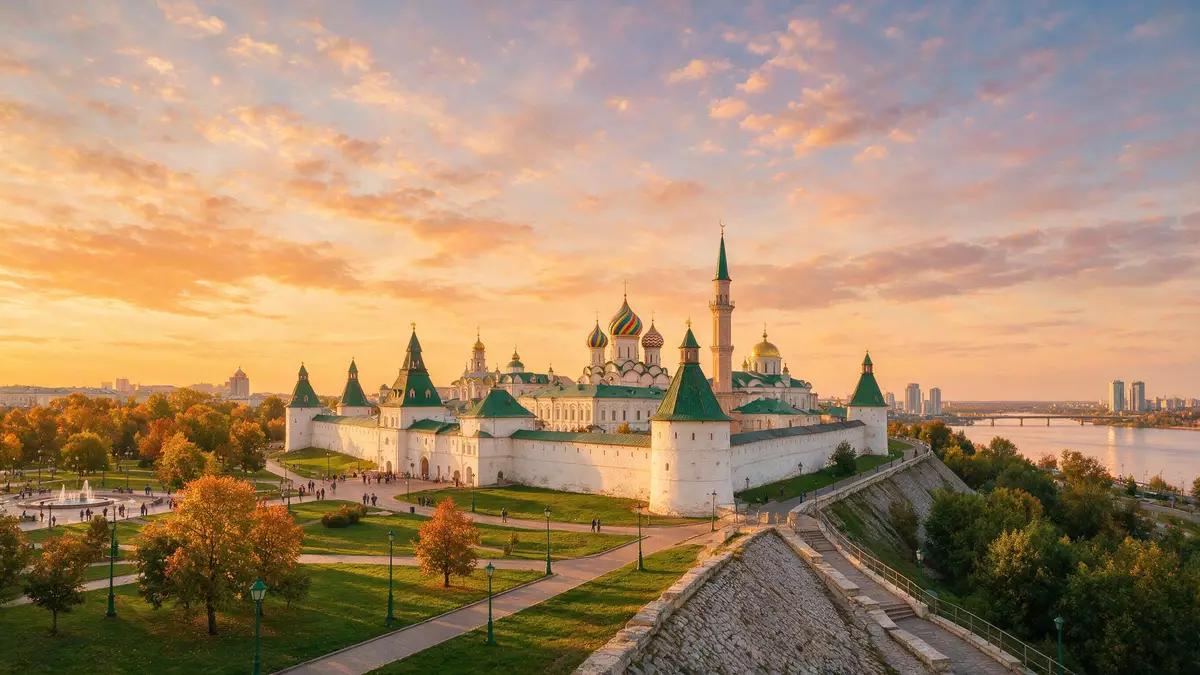
Kazanski Kreml in Kasan is a fortified hilltop ensemble overlooking the Volga and Kazanka rivers, bringing Orthodox church architecture and a major mosque into a single historic citadel.
A Tatar citadel on the Volga bend
Kazanski Kreml occupies a high terrace above the left bank of the Kazanka, close to where the river meets the Volga and the wider waterways of Russia’s Volga basin.Kazan Kremlin The fortress crowns a promontory that once held earlier settlements and now marks the historic centre of Kasan within the Republic of Tatarstan. The citadel’s enclosing walls form a pronounced outline against the skyline, with towers and gateways rising above the surrounding streets.
The site is associated with the Muslim period of the Golden Horde and the Kazan Khanate, and later with the expansion of the Russian state under Ivan IV, known as Ivan the Terrible.Historic and Architectural Complex of the Kazan Kremlin After the conquest of Kasan in 1552, the Kremlin became an Orthodox Christian seat for the Volga region, while retaining its role as a Tatar administrative centre and evolving into the official residence of the Head of the Republic of Tatarstan.official residence of the Head of the Republic of Tatarstan
Layers of stone from the sixteenth to the nineteenth centuries
The ensemble at Kazanski Kreml brings together architectural and archaeological remains stretching from the tenth to the sixteenth centuries, alongside standing buildings from the sixteenth to nineteenth centuries that define its present appearance.group of historic buildings dating from the 16th to 19th centuries White stone walls and towers frame an inner landscape of religious, administrative and residential structures that reflect both Tatar and Russian traditions. Within the perimeter, masonry elements from successive fortifications lie beneath or beside later constructions, giving the complex a stratified character.
One of the most visible contrasts is the presence of a large mosque, Kul Sharif, alongside the Annunciation Cathedral, an Orthodox church, on the same defended hill.combines elements of Christian Orthodox and Muslim architecture The mosque represents Tatar Islamic culture, while the cathedral expresses Russian Orthodox tradition, and their proximity illustrates the cultural and religious composition of Tatarstan. Nearby, the Governor’s Palace and other administrative buildings underline the Kremlin’s continuing role in regional government.
UNESCO recognition and contemporary role
The Historic and Architectural Complex of the Kazan Kremlin has been inscribed on the UNESCO World Heritage List since 2000, recognising it as the only surviving Tatar fortress in Russia and as an important place of pilgrimage.only surviving Tatar fortress in Russia and an important place of pilgrimage The inscription highlights both the ensemble of sixteenth to nineteenth century buildings and the embedded traces of earlier fortifications, as well as the site’s role in expressing the meeting of Islamic and Christian heritage on the Volga.
Alongside its status as a museum reserve, Kazanski Kreml functions as an acting centre of Tatar state culture and public authority within the Russian Federation.acting centre of the Tatar state culture and public authority of Tatarstan Offices of regional institutions sit within the fortress, and ceremonial spaces share the hilltop with religious monuments and archaeological zones. For visitors from Western Europe, the combination of administrative activity, sacred architecture and historic fortifications offers an insight into how a former khan’s seat became both a Russian kremlin and a contemporary regional capital’s emblem.
Visiting Kazanski Kreml: what travellers from Western Europe should know
- Kazanski Kreml stands above the Kazanka river near its confluence with the Volga, in the centre of Kasan, capital of the Republic of Tatarstan in Russia.
- The fortress is built on a prominent hill with stone walls, towers and gates; reaching the inner courtyards involves walking uphill along streets or paths and passing through fortified entrances.
- The complex is integrated into the city’s transport network, with urban roads and public transport routes leading towards the Kremlin area and its surrounding squares.
- Russian is the official language in Kasan and the currency is the rouble.
- Entry requirements depend on your nationality; UK travellers can check the FCDO travel advice at gov.uk/foreign-travel-advice, Irish travellers the Department of Foreign Affairs at ireland.ie.
Searching for Kazanski Kreml on social platforms
These links open searches for Kazanski Kreml on each platform.
Frequently asked questions about Kazanski Kreml
Where is Kazanski Kreml located?
Kazanski Kreml stands on a high terrace above the Kazanka river near its meeting with the Volga, in the centre of Kasan in the Republic of Tatarstan, Russia.
What can visitors expect inside Kazanski Kreml?
Visitors encounter stone fortress walls, towers, gates, a large mosque, an Orthodox cathedral, administrative buildings and open courtyards within the historic citadel.
What makes Kazanski Kreml distinctive among Russian fortresses?
It is recognised as the only surviving Tatar fortress in Russia and combines prominent Islamic and Orthodox monuments, earning UNESCO World Heritage status for its layered architecture and continuing political role.


