
Keukenhof’s spring carpet of bulbs in Lisse
Published on 08/16/2026 at 13:38 | Editorial responsibility: Rafael Müller, Editor-in-Chief AD HOC NEWS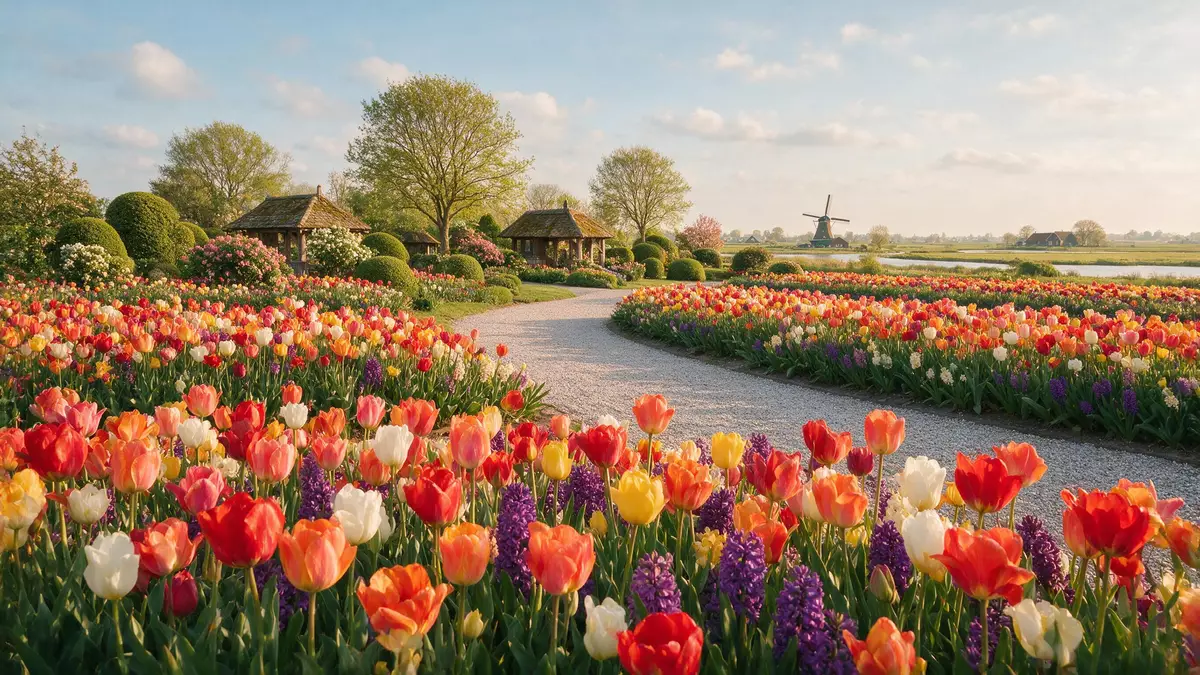
Keukenhof in Lisse is a spring garden built on historic castle grounds in the Dutch bulb-growing region, where millions of flowering bulbs turn landscaped parkland into a dense carpet of colour each year.
A bulb garden laid over a historic estate
Keukenhof lies in the town of Lisse in South Holland, in the heart of the Bollenstreek, the traditional bulb-growing belt between Amsterdam and The Hague.Located in Lisse the garden forms part of an estate around Castle Keukenhof, a manor dating to 1641 that stands beside the park and gives it its name.Kasteel Keukenhof was built in 1641
The wider grounds reach back further, to hunting land used in the fifteenth century by Jacoba van Beieren, countess of Holland and Zeeland.Keukenhof’s history starts in the fifteenth century Herbs and produce gathered for the castle kitchen gave the area its name: “Keukenhof”, or kitchen garden. That agricultural origin still echoes in the way the park is planted, even though the original kitchen plots have long since been replaced by landscape design and ornamental beds.
Nineteenth-century landscape design under spring planting
Today’s garden layout sits on an English landscape design created in 1857 by the father-and-son team Jan David Zocher and Louis Paul Zocher, well-known Dutch landscape architects of the nineteenth century.The English landscape garden was designed in 1857 Their flowing paths, water features and groves were laid around the castle as a private park and remain the underlying structure of Keukenhof’s grounds. Long sightlines and winding walks guide visitors through woodland and lawns rather than rigid formal parterres.
Within that nineteenth-century framework, modern bulb planting overlays bright bands and intricate patterns of tulips, daffodils, hyacinths and other spring-flowering species.Millions of budding bulbs in over 32 hectares Beds curve along ponds, sweep beside avenues of mature trees and cluster around pavilions. The contrast between permanent trees and shrubs and the short-lived display of bulbs gives the park a layered character: the landscape architecture is constant, while the carpet of flowers changes from year to year.
From bulb showcase to “Garden of Europe”
Keukenhof in its present form dates to the mid-twentieth century, when Dutch bulb growers and exporters sought a setting to present their varieties to international buyers.Bulb growers chose the gardens surrounding Keukenhof castle in 1949 In 1949 the gardens around the castle were selected as the site for an open-air flower exhibition, using the existing landscape park as a backdrop for trial fields and show beds. The following year the exhibition opened to wider visitors, and the seasonal park began to take shape.
The garden covers around 32 hectares, planted with millions of bulbs each season, including hundreds of tulip varieties arranged in themed sections and mixed displays.The 32-hectare bulb-flower garden Keukenhof is widely known by the descriptive name “Garden of Europe”, reflecting both its scale and its focus on cultivated spring plants rather than native woodland alone.Also known as the Garden of Europe Pavilions within the grounds host indoor displays of cut flowers and arrangements, extending the outdoor spectacle under a roof.
Visiting Keukenhof: what travellers from Western Europe should know
- Keukenhof lies near Lisse in South Holland, between Amsterdam and The Hague, in the Dutch Bollenstreek bulb region. It is reached by road links from the surrounding cities and by seasonal buses that connect with train services at nearby railway stations.
- The park is largely level, with surfaced paths running through woodland, lawns and around water. Walking the grounds involves covering several kilometres on foot, and some sections use gentle slopes and steps near bridges and viewing points.
- The surrounding landscape is agricultural, with commercial bulb fields and glasshouses nearby. In spring these fields often form broad bands of colour that can be seen from certain paths and viewpoints within the garden.
- The official language is Dutch and the currency is the euro.
Searching for Keukenhof on social platforms
These links open searches for Keukenhof on each platform.
Frequently asked questions about Keukenhof
Where is Keukenhof and what kind of place is it?
Keukenhof is a landscaped spring garden in Lisse in South Holland, Netherlands, set within the grounds of Castle Keukenhof and surrounded by commercial bulb fields.
What can visitors expect during a visit?
A visit centres on walking through woodland and parkland planted with large beds of tulips and other bulbs, exploring themed gardens and indoor flower pavilions around water and lawns.
What makes Keukenhof distinctive among European gardens?
Keukenhof combines a nineteenth-century English landscape design by the Zocher family with a mid-twentieth-century bulb exhibition, creating a seasonal carpet of spring flowers across more than 30 hectares each year.


