
Khoja Ahmed Yasawi Keshenesi, a Timurid landmark in Turkistan
Published on 08/16/2026 at 14:14 | Editorial responsibility: Rafael Müller, Editor-in-Chief AD HOC NEWS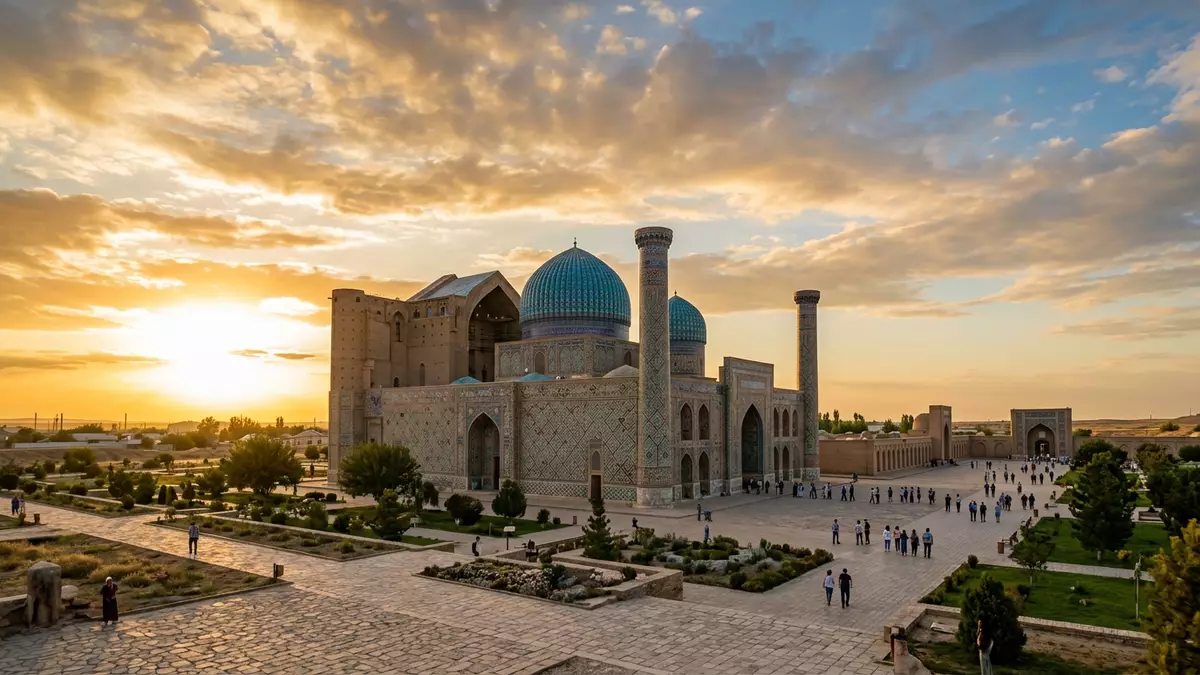
Khoja Ahmed Yasawi Keshenesi in Turkistan, southern Kazakhstan, is a vast Timurid-era mausoleum complex whose brick mass and high domes dominate the former citadel of the old trading town.Mausoleum of Khoja Ahmed Yasawi It was commissioned in the late fourteenth century by Timur, the Central Asian ruler better known in the West as Tamerlane, over the grave of the Sufi poet and mystic Khoja Ahmed Yasawi, who lived in the twelfth century.Mausoleum of Khoja Ahmed Yasawi
A Timurid mausoleum over a Sufi saint’s grave
The mausoleum stands within the archaeological area of medieval Yasi, the earlier name of Turkistan, on the north-eastern side of the modern city where caravan trade once converged on the Syr Darya corridor.medieval town of Yasi Khoja Ahmed Yasawi, whose grave anchors the complex, was a Turkic Sufi master and poet whose teachings shaped religious life across the steppe and earned him the honorific “Sultan al-Arifin”, “Leader of those who know God”.renowned philosopher and Sufi leader
Timur ordered a new mausoleum to replace an earlier twelfth-century tomb, and construction is recorded between 1389 and 1405, the period of his rule across much of Central Asia.built at the end of the 14th century Work halted in 1405 with Timur’s death, leaving some parts unfinished, but the shell that survives is one of the largest surviving buildings of the Timurid period and has long acted as a centre of pilgrimage for Turkic-speaking Muslim communities.one of the largest Timurid constructions
Brick, tile and domes: architecture and layout
Khoja Ahmed Yasawi Keshenesi is built largely of baked brick, with façades articulated by tall portal walls and surfaces faced in turquoise and blue glazed tiles that pick out geometric and floral motifs against the earth-coloured masonry.baked brick and tiled decoration The building takes a roughly rectangular plan, aligned south-east to north-west, enclosing a dense sequence of halls and chambers that together form an architectural complex combining mausoleum, mosque, khanqah and madrasa functions within one envelope.rectangular plan and orientation
Inside, the sequence of spaces includes the Kazandyk Hall, a great domed chamber named for the large metal cauldron at its centre, and the dim burial chamber of Khoja Ahmed Yasawi located beneath a prominent dome.Kazandyk Hall and burial chamber The complex contains more than thirty rooms for prayer, commemoration and hospitality, organised around axial corridors and side chambers that reflect the Timurid interest in monumental, multifunctional religious buildings.multifunctional mausoleum with many rooms
World Heritage status and the historic setting
The mausoleum and its immediate surroundings form a protected ensemble, inscribed in 2003 on the UNESCO World Heritage List as an architectural monument of outstanding universal value.UNESCO inscription in 2003 The core protected area covers the mausoleum within about 0.55 ha, ringed by a wider buffer zone encompassing the archaeological remains of the medieval town of Yasi and the former citadel walls.core area and buffer zone
Walking the grounds, visitors see the high entrance portal facing the city, the long brick façades flanking courtyards and landscaped paths, and views out across Turkistan where the mausoleum’s domes rise above lower urban fabric. The structure appears in studies of Timurid architecture as a test ground for forms and construction techniques that later appeared in Samarkand, linking this site directly to the broader story of Central Asian monumental building under Timur.architectural experimentation for Samarkand
Visiting Khoja Ahmed Yasawi Keshenesi: what travellers from Western Europe should know
- Khoja Ahmed Yasawi Keshenesi stands in the north-eastern part of Turkistan in southern Kazakhstan, on the site of the former citadel of the medieval town of Yasi.
- The complex is built on level ground within the city but its interior includes staircases, high-domed halls and uneven historic flooring that call for steady footing when moving between rooms.
- Turkistan can be reached by air and rail within Kazakhstan, with local transport and city streets bringing visitors to the mausoleum quarter surrounding Khoja Ahmed Yasawi Keshenesi.
- The official language is Kazakh and the currency is the Kazakh tenge.
- Entry requirements depend on your nationality; UK travellers can check the FCDO travel advice at gov.uk/foreign-travel-advice, Irish travellers the Department of Foreign Affairs at ireland.ie.
Searching for Khoja Ahmed Yasawi Keshenesi on social platforms
These links open searches for Khoja Ahmed Yasawi Keshenesi on each platform.
Frequently asked questions about Khoja Ahmed Yasawi Keshenesi
Where is Khoja Ahmed Yasawi Keshenesi located?
Khoja Ahmed Yasawi Keshenesi stands in Turkistan in southern Kazakhstan, in the north-eastern part of the city on the site of the medieval town of Yasi.
What should visitors expect inside the mausoleum complex?
Visitors encounter high-domed halls, the Kazandyk chamber with its great metal cauldron, smaller side rooms and the burial chamber of Khoja Ahmed Yasawi.
What makes Khoja Ahmed Yasawi Keshenesi distinctive among Central Asian monuments?
The complex combines mausoleum, mosque, khanqah and madrasa functions in one Timurid brick-and-tile building and served as a model for later architecture in Samarkand.


